
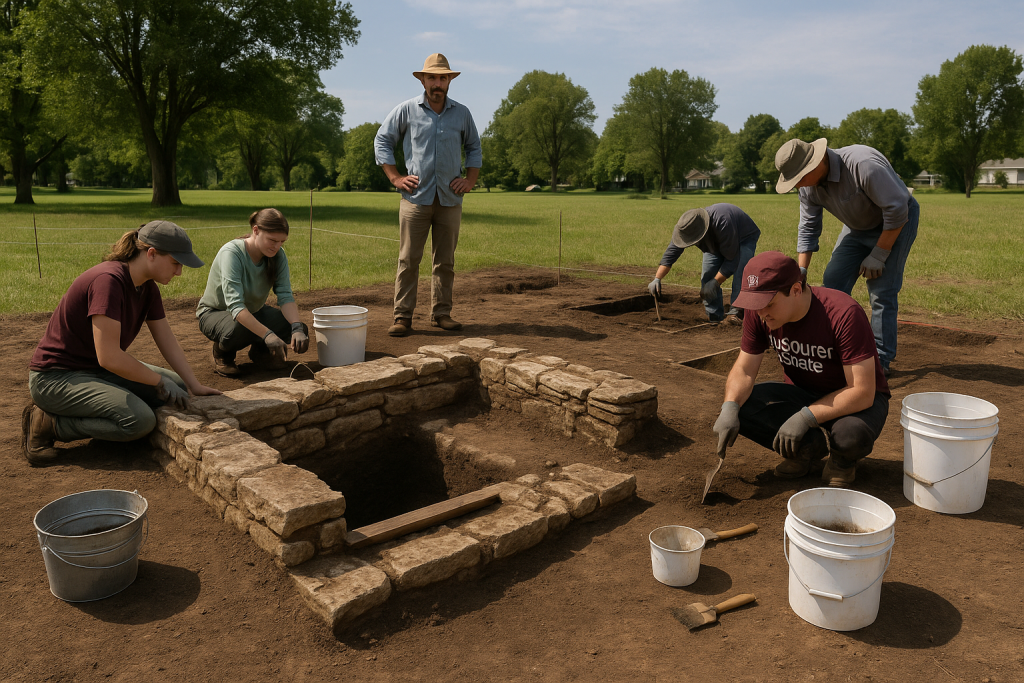
Image Credentials: Image Title: Discovery Unveils One of the Earliest Farmsteads in Springfield Source: (sora.chatgpt) Date: July 2025 Attribution: Created by AI-generated imagery (sora.chatgpt), it does not depict a real-world scene.
By Staff Writer | Open Chronicle
A recent archaeological excavation in Springfield, Missouri, has uncovered the remains of one of the region’s oldest rural properties, shedding new light on the city’s early history before the Civil War. The discovery was made during a field school conducted by students from Missouri State University, under the guidance of the Center for Archaeological Research (CAR). The team identified remnants of a house built in the 1830s by William Townsend at the site now known as McKenzie-Townsend.
William Townsend migrated from Tennessee in 1832. He settled in Springfield with his family and enslaved individuals, living on the property until the mid-1850s. Although previous excavations in the area had uncovered Civil War artifacts and 19th-century ceramics, the exact location of the main house had remained uncertain. That changed during the final week of the field training, when students discovered a three-meter section of an interior wall foundation.
In addition to the structure, archaeologists found a compact layer of debris beneath the house’s wooden floor. Ashes, ceramic fragments, and household remains had accumulated over time, likely falling through cracks in the floorboards. “It’s incredible. You don’t find archaeological sites this old with so much intact,” said Kevin Cupka, Head Director of CAR. According to him, the discovery offers a rare glimpse into everyday life in Springfield prior to the Civil War.
Around 20 students took part in the excavation, gaining hands-on experience with field surveying, GPS mapping, shovel excavation, and artifact cataloging. Christina Cheek, a senior in Anthropology, emphasized the value of the practical training. “Before this, I had no experience in these areas and found it all exciting and rewarding,” she said.
The work, however, is far from complete. Researchers now hope to locate additional structures connected to the house as well as a pioneer cemetery, which historical records suggest lies nearby but has remained missing for over a century. The team plans to use geophysical survey techniques in the next phase of the project.
Cupka Head underscored the importance of efforts like this for protecting the region’s cultural heritage. “It’s about making sure we’re doing everything possible to safeguard historic sites that are threatened by development. We’re preserving the history of our community, the history of Missouri,” he stated.
CAR also aims to bring the findings to the public through exhibitions and outreach. In an interview with Archaeology Magazine, the center expressed hopes of fostering greater community engagement. “The more public archaeology experiences we provide, the more we can inspire interest and involvement from the community,” Cupka Head concluded.
This discovery not only contributes new information about Springfield’s early settlement. It also highlights the powerful role archaeology can play when combined with education, public participation, and the commitment to preserve the past.