
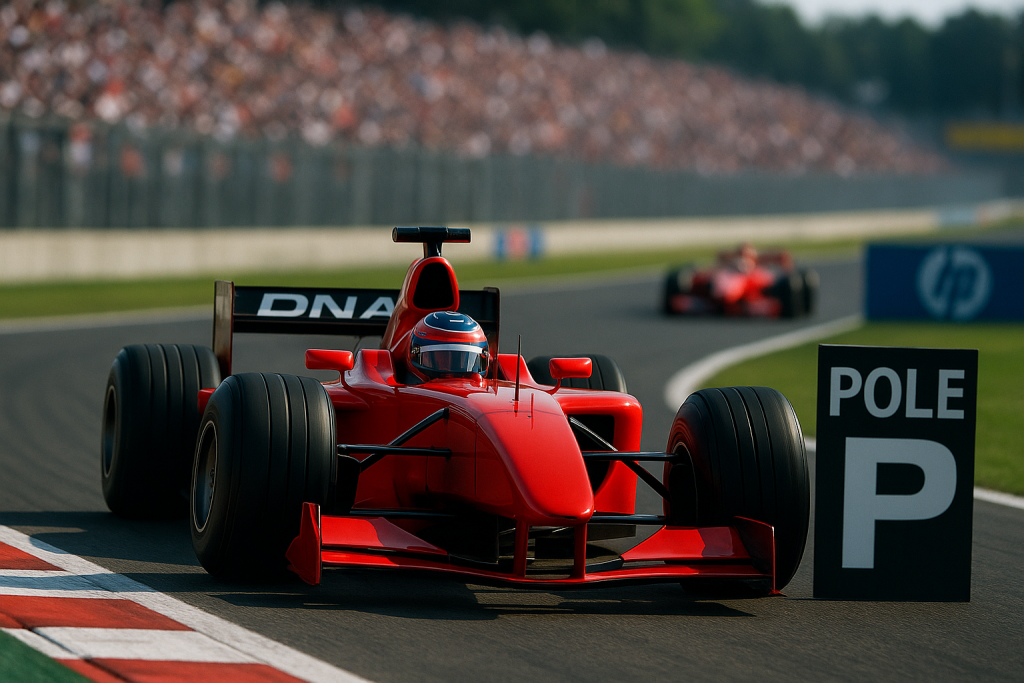
Image Credentials: Image Title: Formula One: Qualifying Source: (sora.chatgpt) Date: August 2025 Attribution: Created by AI-generated imagery (sora.chatgpt), it does not depict a real-world scene.
For much of the sport’s history, qualifying sessions differed little from practice sessions; drivers would have one or more sessions in which to set their fastest time, with the grid order determined by each driver’s best single lap, with the fastest getting first place on the grid, referred to as pole position. From 1996 to 2002, the format was a one-hour shootout. This approach lasted until the end of 2002 before the rules were changed again because the teams were not running in the early part of the session to take advantage of better track conditions later on.
Grids were generally limited to 26 cars – if the race had more entries, qualification would also decide which drivers would start the race. During the early 1990s, the number of entries was so high that the worst-performing teams had to enter a pre-qualifying session, with the fastest cars allowed through to the main qualifying session. The qualifying format began to change in the early 2000s, with the FIA experimenting with limiting the number of laps, determining the aggregate time over two sessions, and allowing each driver only one qualifying lap.
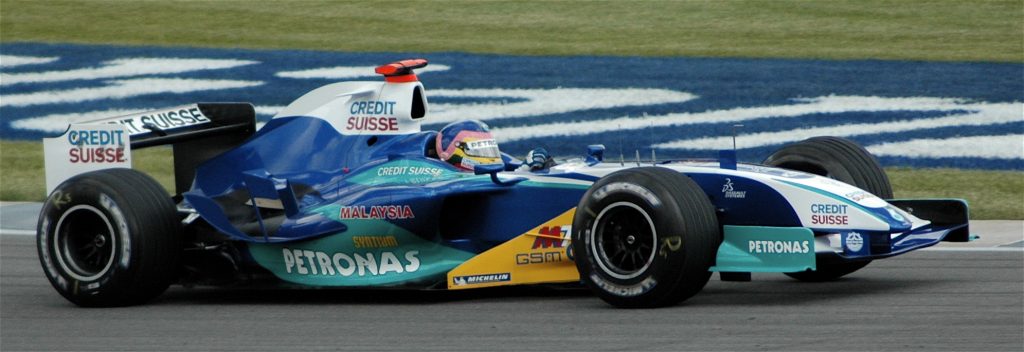
The current qualifying system was adopted in the 2006 season. Known as “knock-out” qualifying, it is split into three periods, known as Q1, Q2, and Q3. In each period, drivers run qualifying laps to attempt to advance to the next period. The slowest drivers are “knocked out” of qualification (but not necessarily the race) at the end of the period, and their grid positions are set within the rearmost five based on their best lap times. Drivers are allowed as many laps as they wish within each period. After each period, all times are reset, and only a driver’s fastest lap in that period (barring infractions) counts. Any timed lap started before the end of that period may be completed and will count toward that driver’s placement. The number of cars eliminated in each period is dependent on the total number of cars entered into the championship.
Currently, with 20 cars, Q1 runs for 18 minutes and eliminates the slowest five drivers. During this period, any driver whose best lap takes longer than 107% of the fastest time in Q1 will not be allowed to start the race without permission from the stewards. Otherwise, all drivers proceed to the race, albeit in the worst starting positions. This rule does not affect drivers in Q2 or Q3. In Q2, the 15 remaining drivers have 15 minutes to set one of the ten fastest times and proceed to the next period. Finally, Q3 lasts 12 minutes and sees the remaining ten drivers decide the first ten grid positions. At the beginning of the 2016 Formula 1 season, the FIA introduced a new qualifying format, whereby drivers were knocked out every 90 seconds after a certain amount of time had passed in each session. The aim was to mix up grid positions for the race, but due to unpopularity, the FIA reverted to the above qualifying format for the Chinese GP, after running the format for only two races.
Each car is allocated one set of the softest tyres for use in Q3. The cars that qualify for Q3 must return them after Q3; the cars that do not qualify for Q3 can use them during the race. As of 2022, all drivers are given a free choice of tyre type to use at the start of the Grand Prix, whereas in previous years, only the drivers who did not participate in Q3 had free tyre choice for the start of the race. Any penalties that affect grid position are applied at the end of qualifying. Grid penalties can be applied for driving infractions in the previous or current Grand Prix, or for changing a gearbox or engine component. If a car fails scrutineering, the driver will be excluded from qualifying but will be allowed to start the race from the back of the grid at the race stewards’ discretion.
2021 saw the trialling of a ‘sprint qualifying’ race on the Saturday of three race weekends, to test the new approach to qualifying. The traditional qualifying would determine the starting order for the sprint, and the result of the sprint would then determine the start order for the Grand Prix. The system returned for the 2022 season, now titled the ‘sprint’. From 2023, sprint races no longer impacted the start order for the main race, which would be determined by traditional qualifying. Sprints would have their qualifying session, titled the ‘sprint shootout’;[94] such a system made its debut at the 2023 Azerbaijan Grand Prix and is set to be used throughout all sprint sessions in place of the traditional second free practice session. Sprint qualifying sessions are run much shorter than traditional qualifying, and each session requires teams to fit new tyres, mediums for SQ1 and SQ2, and softs for SQ3; otherwise, they cannot participate in the session.
References
-
Fédération Internationale de l’Automobile (FIA). Formula One Sporting Regulations (various years). FIA.com.
-
Collantine, Keith. “Formula 1 qualifying rules explained.” RaceFans, 15 March 2023.
-
Noble, Jonathan. “FIA set to change qualifying format for 2003 season.” Autosport, 21 December 2002.
-
Henry, Alan. The Complete History of Grand Prix Motor Racing. London: Ebury Press, 2006.
-
Hughes, Mark. “Qualifying: Then and Now.” Motor Sport Magazine, July 2010.
-
Smith, Luke. “Formula 1 to drop elimination qualifying after two races.” NBC Sports, 7 April 2016.
-
Mitchell-Malm, Valentin. “How F1’s sprint race format has evolved since 2021.” The Race, 29 April 2023.
-
Benson, Andrew. “F1 sprint format: Everything you need to know.” BBC Sport, 28 April 2023.
-
ESPN F1 Staff. “F1 confirms sprint qualifying format for 2023 season.” ESPN, 25 April 2023.
-
Beer, Matt. “Why F1’s 107% rule exists and when it’s applied.” The Race, 12 March 2022.
Back to Formula One Encyclopedia
Explore this subject
Continue exploring related Open Chronicle Encyclopedia entries through the categories associated with this article.

Staff Writers at Open Chronicle produce trusted journalism, strategic analysis and authoritative reference content across global affairs, geopolitics, defense, science, history, technology, business, culture and sport. Their work combines accurate reporting with historical perspective and analytical depth, helping readers understand not only what is happening, but why it matters. Beyond daily news coverage, Staff Writers contribute to the Open Chronicle Encyclopedia, investigative features, original research projects and long-form reports, building a comprehensive knowledge platform designed to inform, educate and preserve reliable information for a global audience.