
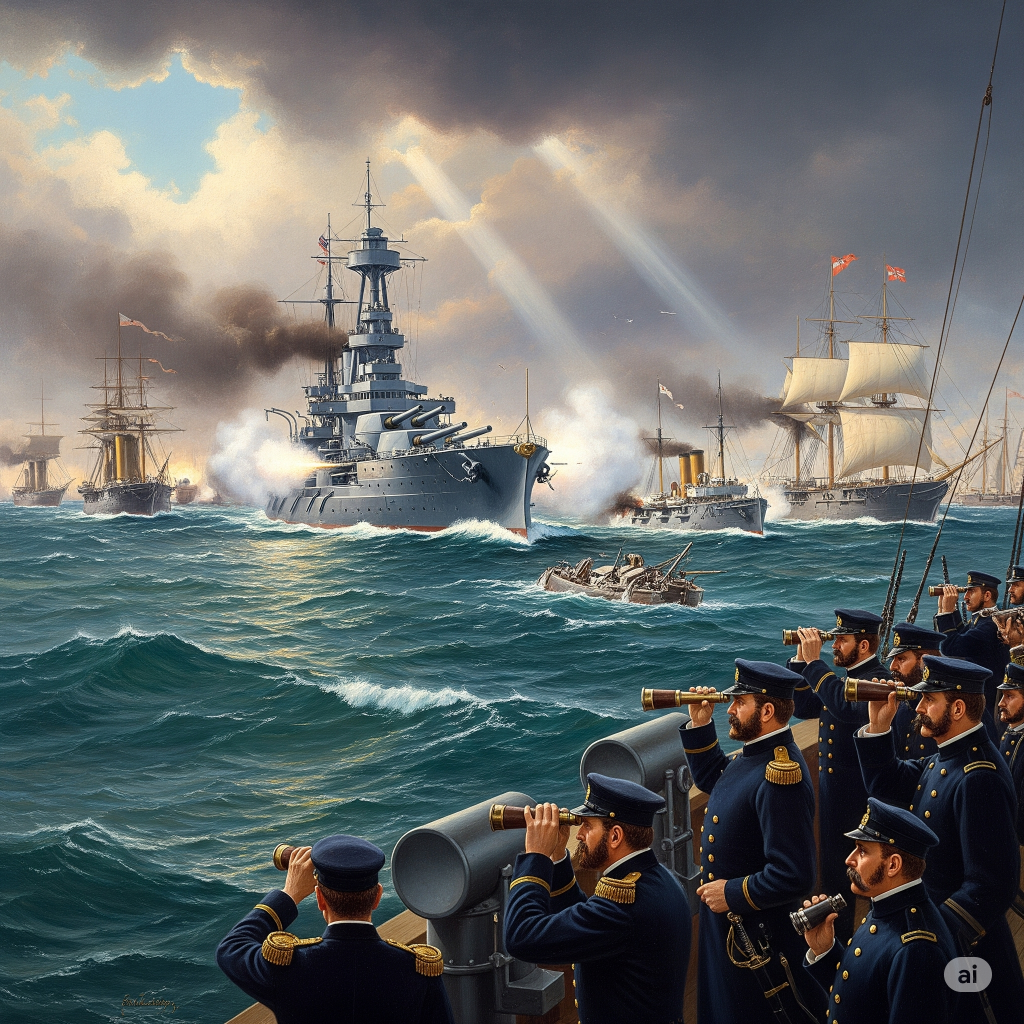
Image Credentials: Image Title: Modernization and Early 20th-Century Development of the United States Navy Source: (gemini) Date: August 2025 Attribution: Created by AI-generated imagery (gemini), it does not depict a real-world scene.
The modernization of the United States Navy began in the 1880s with the introduction of the first steel-hulled warships, a development that stimulated the American steel industry and marked the birth of what became known as “the new steel navy.” This period represented a major shift in naval technology, moving from wooden sailing ships to steam-powered steel vessels, signaling the United States’ commitment to establishing a modern, capable maritime force. The construction of steel warships enabled the U.S. Navy to enhance durability, firepower, and speed, laying the groundwork for the country’s emergence as a global naval power.
The rapid expansion of the U.S. Navy proved decisive during the Spanish–American War in 1898. The American fleet’s overwhelming victory over the outdated Spanish Navy demonstrated the strategic importance of modern warships and advanced naval tactics. This success elevated international respect for American technical expertise and naval capability. Following the war, the Navy entered a period of aggressive shipbuilding, initially producing pre-dreadnought battleships and later transitioning to dreadnoughts, which were faster, more heavily armed, and better armored. These developments allowed the United States to compete with major naval powers such as Britain and Germany.
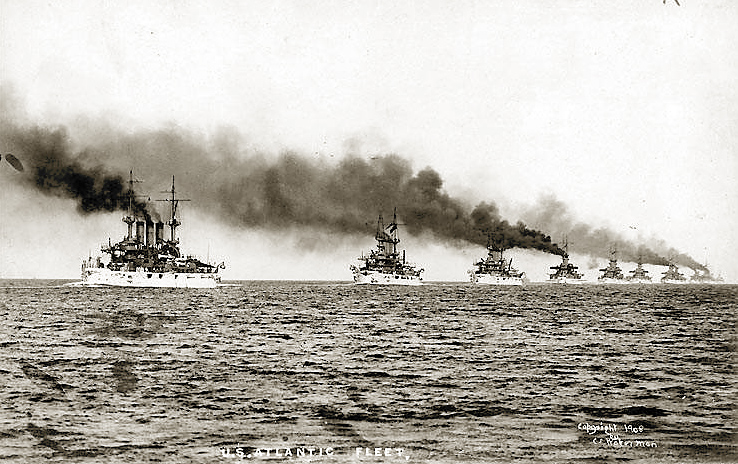
In 1907, President Theodore Roosevelt ordered the deployment of the Great White Fleet, consisting of most of the U.S. battleships along with several support vessels. The fleet embarked on a 14-month circumnavigation of the globe to demonstrate the Navy’s global reach, training capability, and the nation’s ability to project power worldwide. This mission not only showcased U.S. naval strength but also served as a diplomatic signal of American influence in international affairs, particularly in Asia and Latin America.
By 1911, the United States had begun construction of super-dreadnought battleships at a pace intended to challenge British naval supremacy. This period also marked the first use of naval aircraft in the U.S. Navy, an innovation that led to the informal establishment of the United States Naval Flying Corps. Initially focused on protecting shore installations, naval aviation would grow into a critical component of American maritime strategy. It was not until 1921, however, that naval aviation became fully operational, allowing the Navy to integrate air power with fleet operations, fundamentally changing the nature of naval warfare.
This era of modernization also included significant advancements in gunnery, communications, and propulsion systems. The Navy began incorporating wireless telegraphy, improved fire control systems, and more efficient steam turbines, enabling faster fleet movements and greater coordination during naval engagements. Strategically, the U.S. Navy adopted doctrines emphasizing sea control, power projection, and the protection of global commerce, reflecting the country’s expanding economic and geopolitical interests.
By the early 20th century, the United States Navy had transformed from a modest coastal defense force into a technologically advanced, globally capable institution. Its modernization laid the foundation for its central role in both World War I and World War II, establishing the United States as a major maritime power and a key actor in international security.
References
-
Hagan, Kenneth J. This People’s Navy: The Making of American Sea Power. New York: Free Press, 1991.
-
Spector, Ronald H. Admiral of the New Empire: The U.S. Navy in the Age of Steel and Steam. Annapolis: Naval Institute Press, 1977.
-
Evans, Mark L., and Mark R. Peattie. Kaigun: Strategy, Tactics, and Technology in the Imperial Japanese Navy, 1887–1941. Annapolis: Naval Institute Press, 1997.
-
Friedman, Norman. U.S. Battleships: An Illustrated Design History. Annapolis: Naval Institute Press, 1985.
-
Roosevelt, Theodore. The Naval War of 1812. Boston: G.P. Putnam’s Sons, 1882.
-
Hone, Trent. The United States Navy: Aircraft, Technology, and Power Projection, 1900–1925. Annapolis: Naval Institute Press, 2012.
-
Morison, Samuel Eliot. History of United States Naval Operations in World War I. Boston: Little, Brown and Company, 1936.
-
Kennedy, Paul M. The Rise and Fall of British Naval Mastery. London: Allen Lane, 1976.
Back to the United States Navy Portal
Explore this subject
Continue exploring related Open Chronicle Encyclopedia entries through the categories associated with this article.

Staff Writers at Open Chronicle produce trusted journalism, strategic analysis and authoritative reference content across global affairs, geopolitics, defense, science, history, technology, business, culture and sport. Their work combines accurate reporting with historical perspective and analytical depth, helping readers understand not only what is happening, but why it matters. Beyond daily news coverage, Staff Writers contribute to the Open Chronicle Encyclopedia, investigative features, original research projects and long-form reports, building a comprehensive knowledge platform designed to inform, educate and preserve reliable information for a global audience.