
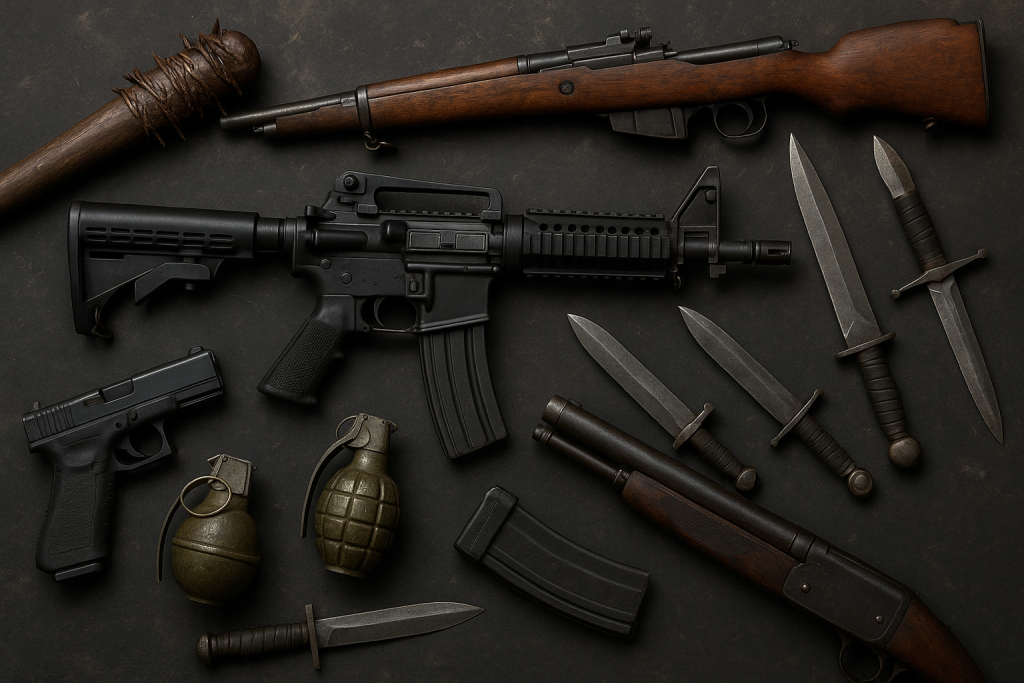
Image Credentials: Image Title: Weapon (Introduction) Source: (sora.chatgpt) Date: September 2025 Attribution: Created by AI-generated imagery (sora.chatgpt), it does not depict a real-world scene.
A weapon, also referred to as an arm or armament, is any implement or device used to deter, threaten, inflict physical damage, harm, or kill. Weapons are employed to increase the efficacy and efficiency of activities such as hunting, crime (for example, murder), law enforcement, self-defense, warfare, or suicide. In a broader sense, weapons may be understood as anything used to gain a tactical, strategic, material, or psychological advantage over an adversary or target.
Etymology
The word weapon derives from the Old English wǣpen, meaning “instrument of fighting.” Related terms in other Germanic languages include Old High German wāfan and Old Norse vápn. The broader concept of armament is associated with the Latin arma, meaning “tools” or “implements of war.” Over time, the term has been extended metaphorically to describe non-physical instruments of advantage, such as “weapons of influence” or “weapons of persuasion.”
Classification
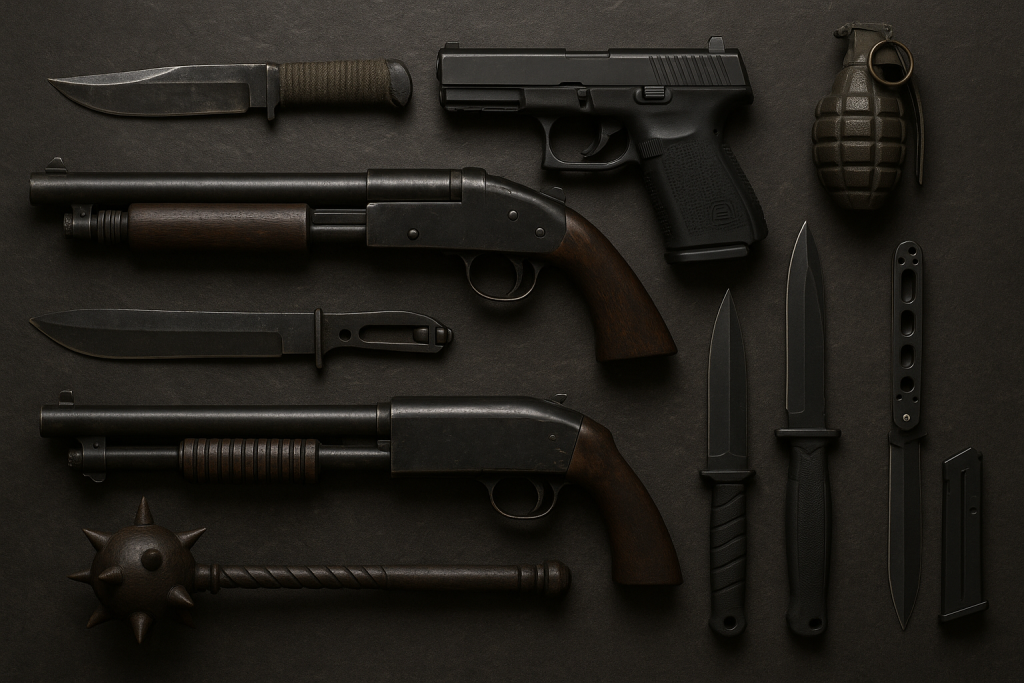
Weapons can be classified in several ways, depending on function, technology, or context of use.
By Function
-
Melee weapons: Handheld weapons intended for close combat, such as clubs, knives, spears, and swords.
-
Ranged weapons: Devices capable of projecting force over distance, including bows, crossbows, and firearms.
-
Explosive weapons: Tools that use chemical reactions to create destructive force, including grenades, bombs, and missiles.
-
Biological and chemical weapons: Agents that inflict harm through toxins, pathogens, or synthetic compounds.
-
Directed-energy weapons: Emerging technologies using concentrated energy, such as lasers or microwaves.
By Era
-
Prehistoric weapons: Stone tools, spears, and early bows.
-
Medieval weapons: Swords, longbows, crossbows, and siege engines.
-
Modern weapons: Firearms, tanks, aircraft, and missiles.
-
Contemporary and future weapons: Nuclear arms, cyberweapons, and autonomous systems.
Historical Development
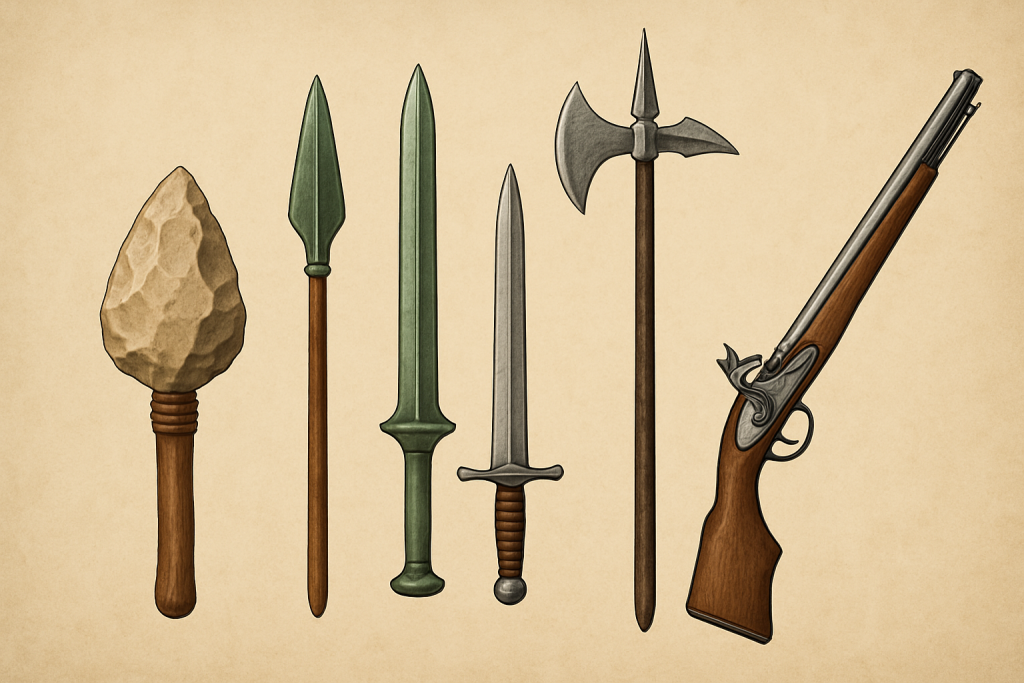
The evolution of weaponry has been closely tied to advancements in technology and societal needs. Early humans adapted stone tools for hunting and defense. The development of metallurgy enabled the creation of bronze and iron weapons, followed by more sophisticated designs during the medieval and early modern periods.
The Industrial Revolution accelerated the mass production of firearms and artillery, while the 20th century introduced tanks, aircraft, chemical weapons, and nuclear arms. In the 21st century, weapon development increasingly incorporates digital technologies, artificial intelligence, and biotechnology, reflecting broader changes in security paradigms and warfare.
Legal Aspects
The use and proliferation of weapons are subject to domestic and international regulation.
-
Domestic law: Nations impose restrictions on civilian ownership of firearms, knives, and other weapons, often varying by jurisdiction.
-
International law: Treaties such as the Geneva Conventions, the Biological Weapons Convention, and the Chemical Weapons Convention seek to limit or prohibit certain classes of weapons.
-
Arms control: Efforts such as the Treaty on the Non-Proliferation of Nuclear Weapons (NPT) and the Arms Trade Treaty (ATT) are aimed at reducing global risks associated with weapon stockpiles and transfers.
Cultural Impact
Weapons hold significant cultural and symbolic value.
-
Myth and tradition: Swords, bows, and other weapons appear prominently in myths, legends, and religious texts, often as symbols of heroism or divine power.
-
Art and literature: Depictions of weapons in art, literature, and film frequently serve as metaphors for conflict, resistance, or authority.
-
Social identity: Weapons such as the samurai sword or the knight’s lance have historically been tied to social classes, warrior castes, and national identities.
-
Modern culture: Firearms and advanced military technologies often feature in video games, films, and political debates, shaping public perceptions of conflict and security.
References
-
O’Connell, Robert L. Of Arms and Men: A History of War, Weapons, and Aggression. Oxford University Press, 1989. ISBN 978-0195057874.
-
Ferrill, Arther. The Origins of War: From the Stone Age to Alexander the Great. Thames and Hudson, 1985. ISBN 978-0500275414.
-
Black, Jeremy. War in the World: A Comparative History, 1450–1600. Routledge, 2015. ISBN 978-1138948421.
-
Howard, Michael. War in European History. Oxford University Press, 2009. ISBN 978-0199546190.
-
United Nations Office for Disarmament Affairs. “Treaty on the Non-Proliferation of Nuclear Weapons (NPT).” United Nations, 1970. https://www.un.org/disarmament/wmd/nuclear/npt/
-
Organisation for the Prohibition of Chemical Weapons (OPCW). “Convention on the Prohibition of the Development, Production, Stockpiling and Use of Chemical Weapons and on Their Destruction.” OPCW, 1997. https://www.opcw.org/chemical-weapons-convention
-
United Nations Office for Disarmament Affairs. “Convention on the Prohibition of the Development, Production and Stockpiling of Bacteriological (Biological) and Toxin Weapons and on their Destruction.” United Nations, 1975. https://www.un.org/disarmament/biological-weapons/
-
Boot, Max. War Made New: Weapons, Warriors, and the Making of the Modern World. Gotham Books, 2006. ISBN 978-1592402223.
-
Parker, Geoffrey. The Military Revolution: Military Innovation and the Rise of the West, 1500–1800. Cambridge University Press, 1988. ISBN 978-0521378653.
-
Singer, P. W. Wired for War: The Robotics Revolution and Conflict in the 21st Century. Penguin, 2009. ISBN 978-0143116844.
Back to Weapon Portal
Explore this subject
Continue exploring related Open Chronicle Encyclopedia entries through the categories associated with this article.

Staff Writers at Open Chronicle produce trusted journalism, strategic analysis and authoritative reference content across global affairs, geopolitics, defense, science, history, technology, business, culture and sport. Their work combines accurate reporting with historical perspective and analytical depth, helping readers understand not only what is happening, but why it matters. Beyond daily news coverage, Staff Writers contribute to the Open Chronicle Encyclopedia, investigative features, original research projects and long-form reports, building a comprehensive knowledge platform designed to inform, educate and preserve reliable information for a global audience.