
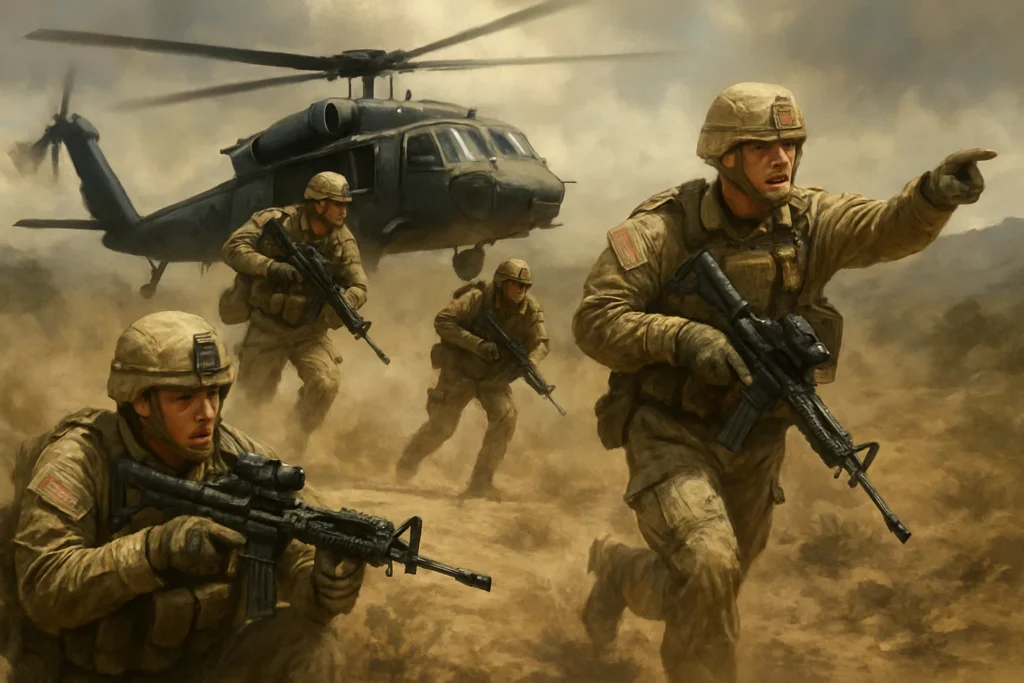
Image Credentials: Image Title: Military operation Source: (sora.openai) Date: October 2025. Attribution: Created using AI-generated imagery (sora.openai), this does not depict a real-world scene.
A military operation (op) is the coordinated military actions of a state or a non-state actor in response to a developing situation. These actions are designed as a military plan to resolve the situation in the state or actor’s favor. Operations may be of a combat or non-combat nature and may be referred to by a code name for national security. Military operations are often known for their more commonly accepted names than their actual operational objectives.
Types of military operations
Military operations can be classified by the scale and scope of force employment, and their impact on the wider conflict. The scope of military operations can be:
- Theater: this describes an operation over a large, often continental, area of operation and represents a strategic national commitment to the conflict, such as Operation Barbarossa, with general goals that encompass areas of consideration outside the military, such as the economic and political impact of military goals on areas concerned.
- Campaign: this describes either a subset of the theatre of operation, or a more limited geographic and operational strategic commitment, such as the Burma Campaign, and need not represent total national commitment to a conflict, or have broader goals outside the military impact.
- Battle: this describes a subset of a campaign that will have specific military goals and geographic objectives, as well as clearly defined use of forces, such as the Battle of Gallipoli, which operationally was a combined arms operation originally known as the “Dardanelles landings” as part of the Dardanelles Campaign, where about 480,000 Allied troops took part.
- Engagement: This describes a tactical combat event or contest for a specific area or objective, involving the actions of distinct units. For example, the Battle of Kursk, also known from its German designation as Operation Citadel, included many separate engagements, several of which were combined into the Battle of Prokhorovka. The Battle of Kursk, in addition to describing the initial German offensive operation, also included two Soviet counter-offensive operations: Operation Kutuzov and Operation Polkovodets Rumyantsev.
- Strike: this describes a single attack upon a specified target. This often forms part of a broader engagement. Strikes have an explicit goal, such as rendering facilities such as airports inoperable, assassinating enemy leaders, or limiting the delivery of supplies to enemy troops.
Definition
Parallel to and reflecting this framework for operations are organized elements within the armed forces which prepare for and conduct operations at various levels of war. While there is a general correlation between the size of units, the area within which they operate, and the scope of mission they perform, the correlation is not absolute. In fact, it is ultimately the mission that a unit performs that determines the level of war within which it operates.
— David M. Glantz, Soviet Military Operational Art
Operational level of war
The operational level of war occupies roughly the middle ground between the campaign’s strategic focus and the tactics of an engagement. It describes “a distinct intermediate level of war between military strategy, governing war in general, and tactics, involving individual battles”. For example, during World War II, the concept was applied to the use of Soviet Tank Armies.
Notes
- Glantz, Soviet Military Operational Art, p.46.
- Glantz, Soviet Military Operational Art, p.10.
- Armstrong, Red Army Tank Commanders, p.13.
References
- Armstrong, Richard N. Red Army Tank Commanders: The Armored Guards. Atglen, Penn.: Schiffer Military History, 1994. ISBN 0-88740-581-9.
- Glantz, David M. Soviet Military Operational Art: In Pursuit of Deep Battle. London: Frank Cass, 1991. ISBN 0-7146-3362-3, ISBN 0-7146-4077-8.
Categories: Operational | Military operation
Explore this subject
Continue exploring related Open Chronicle Encyclopedia entries through the categories associated with this article.

Staff Writers at Open Chronicle produce trusted journalism, strategic analysis and authoritative reference content across global affairs, geopolitics, defense, science, history, technology, business, culture and sport. Their work combines accurate reporting with historical perspective and analytical depth, helping readers understand not only what is happening, but why it matters. Beyond daily news coverage, Staff Writers contribute to the Open Chronicle Encyclopedia, investigative features, original research projects and long-form reports, building a comprehensive knowledge platform designed to inform, educate and preserve reliable information for a global audience.