
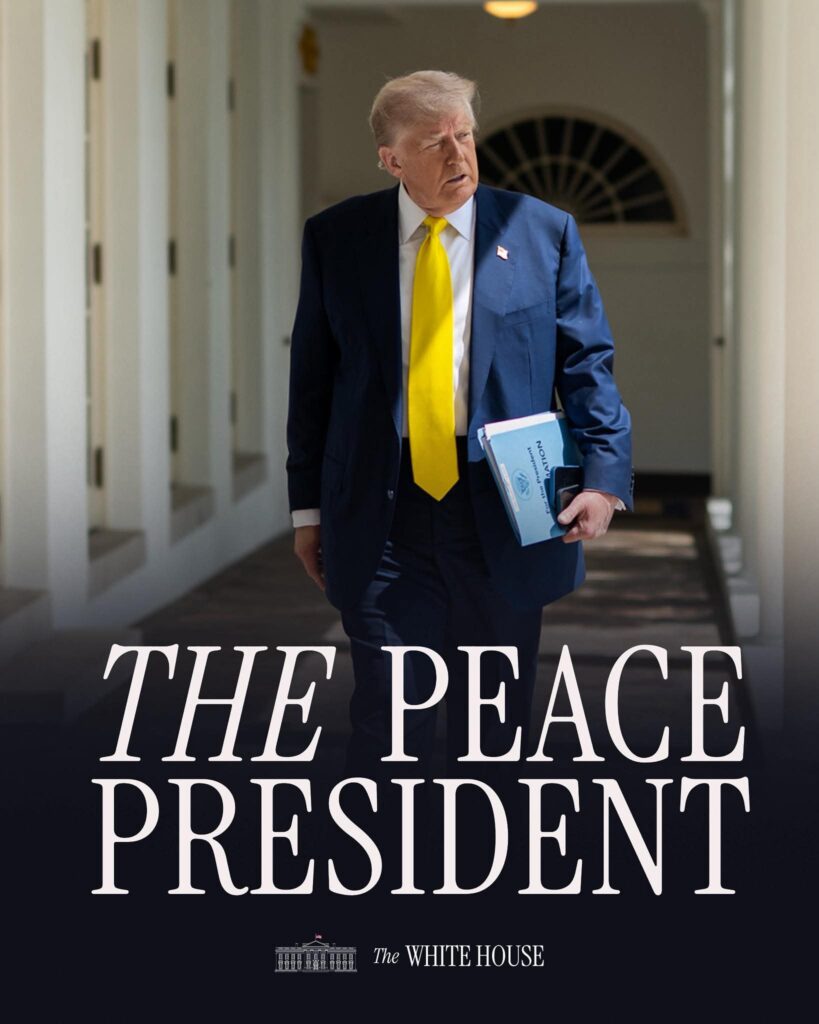
Image: The White House X @WhiteHouse
Benjamin Foster | Staff Writer with Agencies
CAIRO / WASHINGTON — October 2025 — A fragile but historic breakthrough has emerged in the Gaza conflict, as Israel and Hamas agreed to the first phase of a ceasefire deal brokered by the United States, Qatar, Egypt, and Turkey. The agreement, announced Wednesday by U.S. President Donald Trump, marks the first tangible step toward halting one of the most devastating wars in recent Middle Eastern history, though formidable obstacles remain.
Celebrations erupted in both Gaza and parts of Israel following the announcement, offering a brief respite from the despair that has gripped the region for years. Yet analysts and officials alike caution that the deal’s survival will depend on the implementation of subsequent phases, which remain under negotiation.
A First Step Toward Peace
The agreement, set to be signed on Thursday in Cairo, outlines a framework for an immediate ceasefire and a large-scale exchange of hostages and prisoners. According to negotiators, Hamas will release 48 Israeli hostages — 20 of whom are believed to be alive — in exchange for hundreds of Palestinians imprisoned by Israel. The exchange will begin within 72 hours of the ceasefire taking effect.
“The first phase of the Gaza ceasefire agreement will lead to ending the war, the release of Israeli hostages and Palestinian prisoners, and the entry of aid,” Qatari Foreign Ministry spokesman Majed Al Ansari said.
Sources close to the negotiations confirmed that Israel has agreed to include prominent Palestinian figures among those to be freed, including Marwan Barghouti, a senior Fatah leader often mentioned as a possible successor to Palestinian Authority President Mahmoud Abbas.
President Trump said he expects “all the hostages, including those deceased, to be coming back by Monday,” and expressed optimism that this deal could “finally bring lasting calm to Gaza.”
Netanyahu’s Approval and Political Calculations
Israeli Prime Minister Benjamin Netanyahu announced that he would convene his cabinet on Thursday to approve the deal. “With the approval of the first phase of the plan, all our hostages will be brought home,” Netanyahu said.
This marks the third ceasefire attempt since the conflict escalated. The first, in late 2023, collapsed after the release of more than 100 hostages. A second, in early 2024, briefly restored calm before Israeli airstrikes ended the truce. Many observers fear that this new plan could meet a similar fate if deeper issues are not resolved.
Unresolved Challenges
Behind the scenes, negotiators continue to grapple with several contentious issues. Chief among them are Israel’s withdrawal from Gaza, Hamas’s disarmament, and the post-war governance of the territory.
Hamas insists on a full Israeli withdrawal, except for a narrow border strip that Israel wishes to retain for security reasons. It also demands a long-term truce and Palestinian control over Gaza’s administration. Netanyahu, however, opposes handing governance back to the Palestinian Authority, deepening uncertainty over Gaza’s future leadership.
Trump’s 20-point peace framework, first unveiled in Sharm El Sheikh earlier this year, calls for a transitional administration in Gaza to oversee reconstruction and security. However, the plan remains vague about the creation of a Palestinian state, a notion Israel still rejects, even as several Western nations have formally recognized one.
Mounting Global Pressure
The humanitarian toll of the conflict has fueled international outrage. The United Nations recently declared a famine in Gaza, where infrastructure has been devastated and civilian casualties have mounted. Global protests have intensified, demanding an end to the fighting and the safe return of hostages.
A UN inquiry last month accused Israel of committing genocide, a claim rejected by Jerusalem as “distorted and false.” Hamas, too, faces accusations of war crimes and crimes against humanity.
A Fragile Hope
While the first phase of the ceasefire offers a glimmer of hope, the long road ahead is fraught with political and logistical challenges. The next stages, addressing Israel’s military withdrawal, Gaza’s governance, and the possibility of a future Palestinian state, will determine whether this deal marks the beginning of genuine peace or yet another short-lived truce.
For now, both sides and the international mediators are focused on the immediate task: implementing the exchange of hostages and prisoners and ensuring the guns fall silent, at least for a moment, in Gaza.
If successful, this first phase could signal a turning point in a conflict that has reshaped the Middle East, a test not only of diplomacy but of the region’s capacity to move beyond decades of bloodshed.