
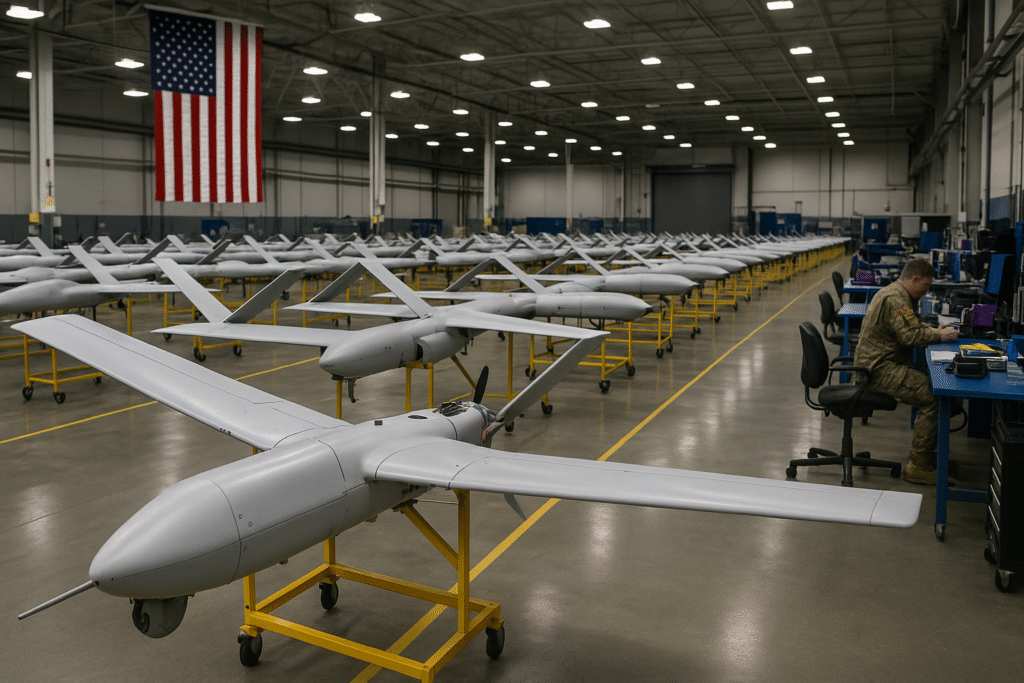
Image Credentials: Image Title: U.S. Army Drone Ambitions Source: (sora.openai) Date: October 2025. Attribution: This image was created using AI-generated imagery (sora.openai) and does not depict a real-world scene.
Elliot Hayes | Senior Editor with Agencies
The U.S. Army has unveiled an ambitious plan to produce 120,000 unmanned aerial systems (UAS) annually by 2026, the equivalent of 10,000 drones per month, as drone warfare reshapes modern battlefields. The move comes as part of a broader national effort to strengthen domestic drone manufacturing capabilities and reduce reliance on foreign supply chains, particularly China’s.
At the same time, U.S. lawmakers are pushing legislation that could transform the drone industry. The SkyFoundry Act of 2025, introduced by Representative Pat Harrigan (R-N.C.), calls for the production of 1 million small drones per year in the United States.
“China and Russia are flooding the battlefield with millions of drones while America has sat on its hands,” Harrigan warned. “More than 80% of casualties in modern war now come from drones, yet we still have no capacity to build them at scale. That failure is reckless, and it leaves our troops exposed.”
Legislative Push for a Domestic Drone Industry
In the Senate, Ted Cruz (R-Texas), John Cornyn (R-Texas), John Boozman (R-Ark.), and Tom Cotton (R-Ark.) have introduced companion legislation designed to accelerate U.S. drone production. The proposal directs the Pentagon to establish government-owned facilities responsible for designing, testing, and producing unmanned aerial systems domestically.
“This bill creates the capacity to design, test, and build a million drones a year right here in America,” Harrigan said. “It cuts China out of our supply chains, it arms our troops with what they need to dominate, and it makes clear we will never again let our enemies outproduce us in the weapons that decide wars.”
While the bill has yet to pass the House or Senate, it has gained bipartisan attention as the war in Ukraine and rising tensions with China highlight the growing importance of drone technology in modern combat.
The “War of the Drones”
The conflict in Ukraine has marked a turning point in military history, the first large-scale conflict where both sides possess robust drone warfare capabilities. Drones have been used extensively for reconnaissance, surveillance, and direct attacks, often with devastating results.
Military analysts now refer to it as the “War of the Drones,” as the conflict demonstrates how unmanned aerial systems can change the dynamics of warfare. The U.S. military, which pioneered drone use in the 1990s and 2000s, is now seeking to adapt to this new reality, where inexpensive, rapidly produced drones can dominate battlefields.
The United States was once the global leader in drone technology, particularly after 9/11, when Predator and Reaper drones played a crucial role in counterterrorism operations. However, the recent surge in low-cost drone production by China, Russia, and Iran has shifted the balance, prompting Washington to rethink its approach.
Building the Future of Drone Warfare
Defense experts argue that mass production of drones is now a national security necessity. By scaling up domestic manufacturing, the U.S. hopes to not only support its military operations but also build a resilient supply chain for future conflicts.
If fully implemented, the U.S. Army’s new drone production program and the SkyFoundry Act could mark a new industrial era for American defense manufacturing, one designed to meet the realities of 21st-century warfare.
As Harrigan emphasized, “The wars of the future will be decided in the skies by swarms of drones. We must ensure those drones are American-made.”