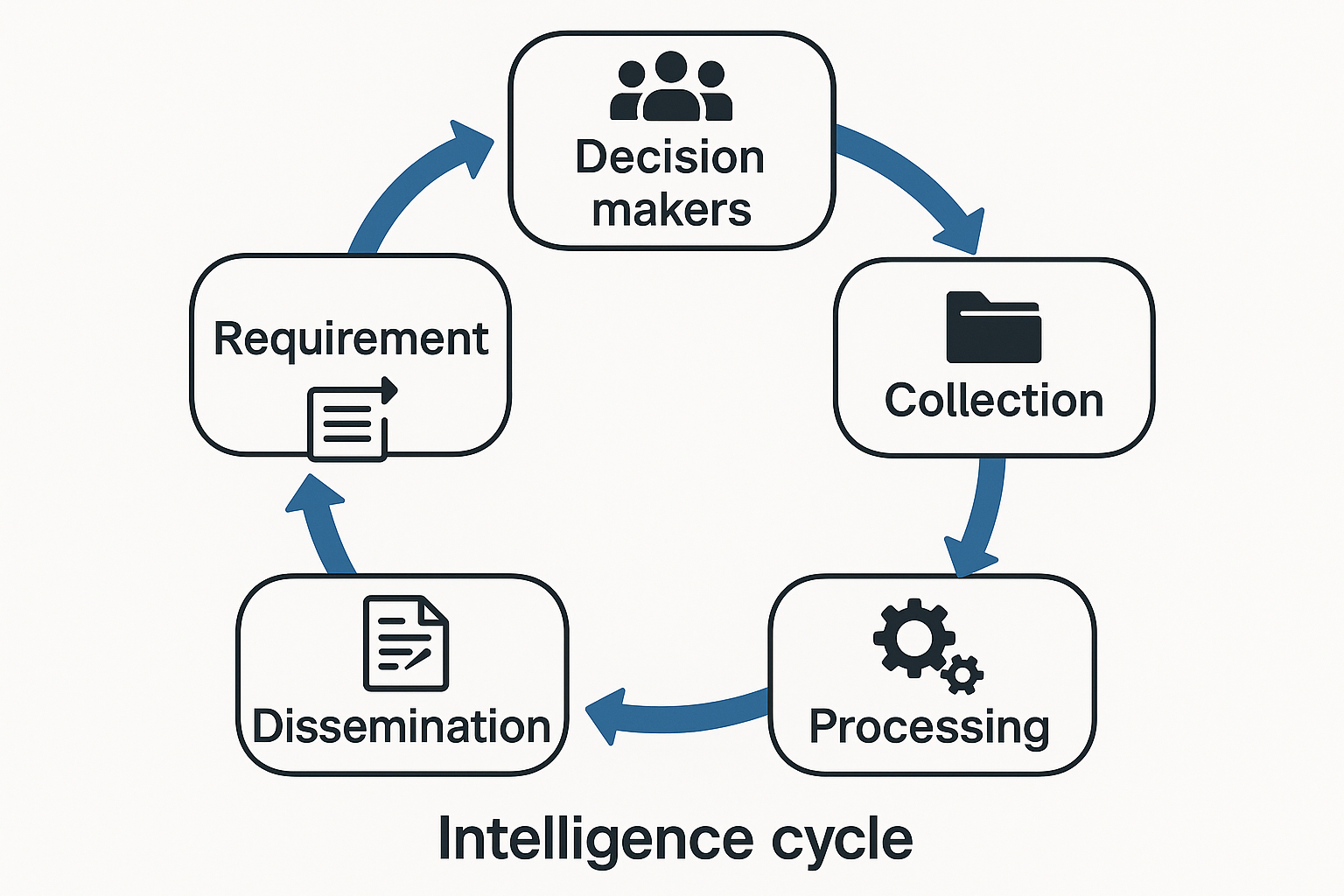
The intelligence cycle is an idealized model of how intelligence is processed in civilian and military intelligence agencies and law enforcement organizations. It is a closed path consisting of repeating nodes, which (if followed) will result in finished intelligence. The stages of the intelligence cycle include the issuance of requirements by decision makers, collection, processing, analysis, and publication (i.e., dissemination) of intelligence. The circuit is completed when decision makers provide feedback and revised requirements. The intelligence cycle is also called the intelligence process by the U.S. Department of Defense (DoD) and the uniformed services.
Conceptual model
Direction
Intelligence requirements are determined by a decision maker to meet their objectives. In the federal government of the United States, requirements (or priorities) can be issued from the White House or Congress. In NATO, a commander uses requirements (sometimes called Essential Elements of Information (EEIs)) to initiate the intelligence cycle.
Collection
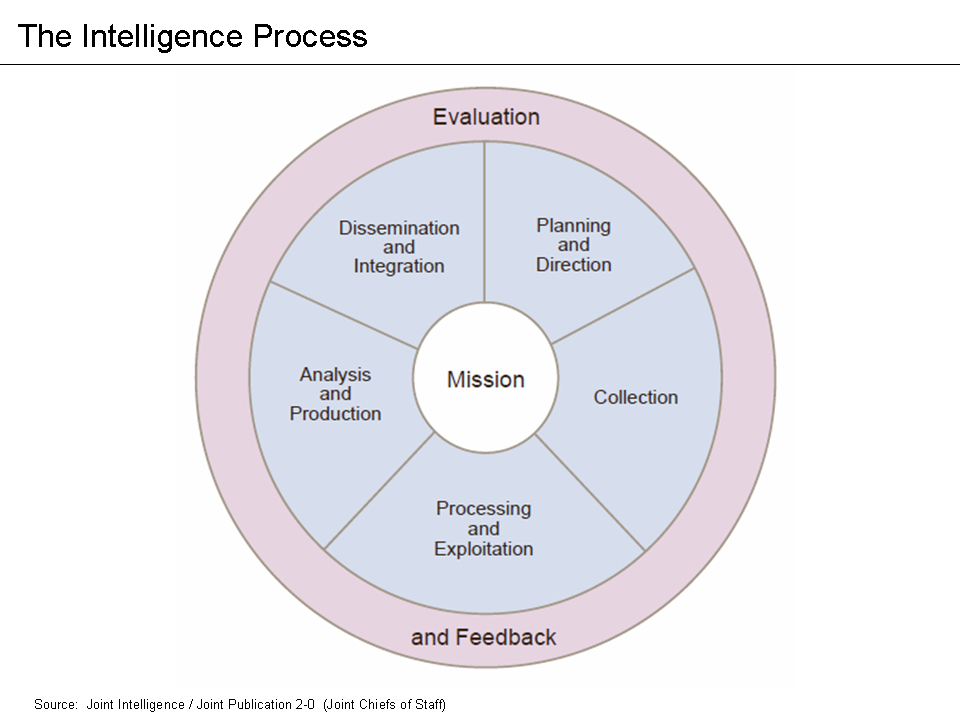
In response to requirements, an intelligence staff develops an intelligence collection plan applying available sources and methods and seeking intelligence from other agencies. The collection includes inputs from several intelligence gathering disciplines, such as HUMINT (human intelligence), IMINT (imagery intelligence), ELINT (electronic intelligence), SIGINT (Signals Intelligence), OSINT (open source, or publicly available intelligence), etc.
Processing and exploitation
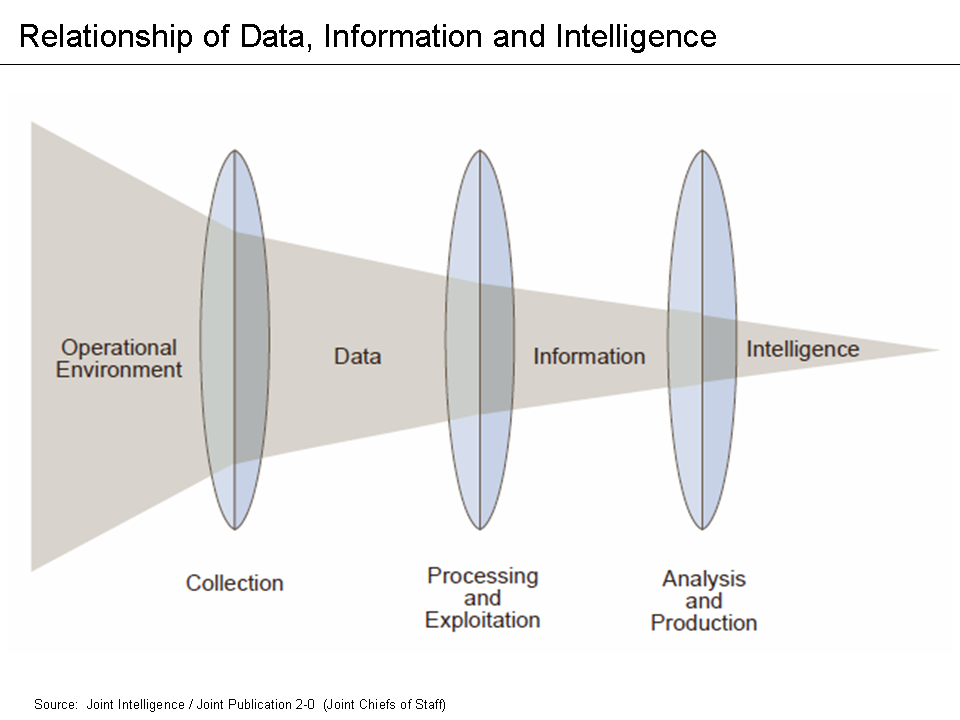
Once the collection plan is executed and the data arrives, it is processed for exploitation. This involves the translation of raw intelligence materials from a foreign language, evaluation of relevance and reliability, and collation of the raw data in preparation for exploitation.
Analysis
Analysis establishes the significance and implications of processed intelligence, integrates it by combining disparate pieces of information to identify collateral information and patterns, and then interprets the significance of any newly developed knowledge.
Dissemination
Finished intelligence products take many forms depending on the needs of the decision maker and reporting requirements. The level of urgency of various types of intelligence is typically established by an intelligence organization or community. For example, an indications and warning (I&W) bulletin would require higher precedence than an annual report.
Feedback
The intelligence cycle is a closed loop; feedback is received from the decision maker, and revised requirements are issued.
Intelligence information cycle theory
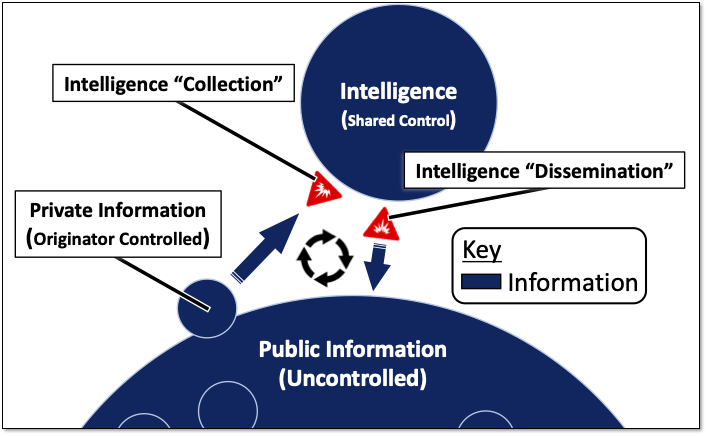
The intelligence information cycle leverages secrecy theory and U.S. regulation of classified intelligence to re-conceptualize the traditional intelligence cycle under the following four assumptions:
- Intelligence is secret information
- Intelligence is a public good
- Intelligence moves cyclically
- Intelligence is hoarded
Information is transformed from privately held to secretly held to public based on who has control over it. For example, the private information of a source becomes secret information (intelligence) when control over its dissemination is shared with an intelligence officer, and then becomes public information when the intelligence officer further disseminates it to the public by any number of means, including formal reporting, threat warning, and others. The fourth assumption, intelligence is hoarded, causes conflict points where information transitions from one type to another. The first conflict point, collection, occurs when private transitions to secret information (intelligence). The second conflict point, dissemination, occurs when secret information transitions to public information. Thus, conceiving of intelligence using these assumptions demonstrates the cause of collection techniques (to ease the private-secret transition) and dissemination conflicts, and can inform ethical standards of conduct among all agents in the intelligence process.
References
- “The Intelligence Cycle” (HTML). Central Intelligence Agency (CIA). 23 March 2013. Archived from the original (HTML) on 08 May 2020. Retrieved 30 September 2021.
- “Joint Publication 2-0, Joint Intelligence” (PDF). Defense Technical Information Center (DTIC). Department of Defense. 22 June 2007. pp. GL–11. Archived from the original (PDF) on 13 June 2016. Retrieved February 22, 2013.
- Stottlemyre, Steven (2022). “Reconceptualizing Intelligence after Benghazi”. ResearchGate. doi:10.13140/RG.2.2.19732.99204.
- Stottlemyre, Steven (2021). “The United States Intelligence Community, Secrecy and the ‘Steele Dossier’: Reconceptualizing the Intelligence Process”. Journal of European and American Intelligence Studies. 4 (2): 11–28.
Explore this subject
Continue exploring related Open Chronicle Encyclopedia entries through the categories associated with this article.

Staff Writers at Open Chronicle produce trusted journalism, strategic analysis and authoritative reference content across global affairs, geopolitics, defense, science, history, technology, business, culture and sport. Their work combines accurate reporting with historical perspective and analytical depth, helping readers understand not only what is happening, but why it matters. Beyond daily news coverage, Staff Writers contribute to the Open Chronicle Encyclopedia, investigative features, original research projects and long-form reports, building a comprehensive knowledge platform designed to inform, educate and preserve reliable information for a global audience.