
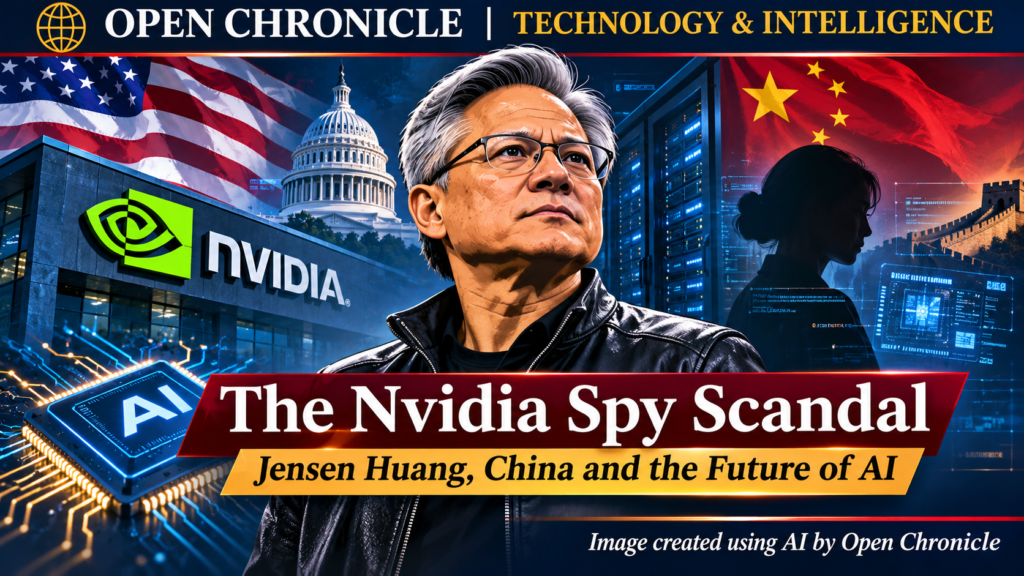
An investigation into whether Nvidia’s chief executive was targeted by a suspected Chinese intelligence operative has raised questions about corporate security, personal vulnerability and the geopolitical struggle for artificial intelligence dominance. But the distinction between allegations, confirmed facts and evidence of wrongdoing remains crucial.
By Open Chronicle News Desk
November 9, 2026 | United States
The world’s most influential artificial intelligence chipmaker is confronting an unusual challenge, one that reaches beyond semiconductor technology, export restrictions and competition with China.
Nvidia has reportedly opened an independent investigation into allegations that its chief executive, Jensen Huang, was targeted by a suspected Chinese intelligence operative during an extramarital relationship.
The controversy has drawn attention from investors, national security commentators and political figures because of Nvidia’s central position in the global artificial intelligence industry.
At the centre of the story is a question with potentially serious implications: could the personal life of one of America’s most important technology executives have created an opportunity for foreign intelligence gathering?
The available public information does not establish that Huang knowingly cooperated with a foreign intelligence service or disclosed protected company information.
China has rejected the espionage allegations, while Nvidia has indicated that its board has no reason to believe corporate secrets or national security information were compromised.
Nevertheless, the reported investigation has placed corporate governance, executive security and the growing strategic importance of artificial intelligence under an intense spotlight.
The case illustrates a broader challenge confronting major technology companies: protecting valuable intellectual property increasingly requires attention not only to computer networks and supply chains but also to the people who control them.
1. What is known about the investigation
The controversy emerged following reports that Nvidia’s board was examining allegations involving Huang’s personal relationship with a Chinese businesswoman.
According to reporting circulated on November 8 and 9, the woman was suspected by American authorities of possible links to Chinese intelligence.
Huang acknowledged having an extramarital relationship and apologised to his family.
That admission, however, is separate from the allegations of espionage.
A personal relationship does not, by itself, establish intelligence activity, coercion or the disclosure of sensitive information.
Nvidia’s reported decision to investigate the circumstances reflects the seriousness with which companies must treat potential security risks involving senior executives.
At the time of publication, the inquiry had not produced a publicly confirmed finding that Huang had compromised Nvidia’s technology or knowingly assisted a foreign government.
The distinction is essential.
The existence of an investigation demonstrates that concerns are being examined. It does not establish that the underlying allegations are true.
2. The woman identified in the reporting
The New York Times identified the woman at the centre of the allegations as Alice Huang, a former executive associated with Singapore-based Megaspeed International.
According to the newspaper’s investigation, American intelligence officials suspected that she was gathering information for Beijing.
Megaspeed has also attracted scrutiny over allegations involving access to advanced Nvidia processors subject to US export restrictions.
These are related but distinct issues.
The first concerns whether an individual was involved in intelligence collection. The second concerns whether advanced semiconductors were transferred in violation of American export controls.
Neither allegation establishes that Jensen Huang participated in unlawful activity.
The precise nature of Alice Huang’s alleged intelligence activities, the information she may have obtained and any connection to Nvidia’s commercial decisions remain central unresolved questions.
The public record does not establish that the relationship altered Nvidia’s export policies or caused the transfer of restricted technology.
3. Nvidia’s board takes control of the inquiry
On November 8, Nvidia’s board announced that an independent committee of directors, supported by outside legal counsel, would oversee the investigation.
The company emphasised the importance of American national and economic security.
Its statement also made two important points.
First, the board said it had no reason to believe that national security or Nvidia’s proprietary information had been compromised.
Second, it confirmed that Huang supported the investigation and had committed to cooperating.
The board expressed confidence in Huang and his leadership team.
Those statements indicate that Nvidia is treating the allegations seriously without assuming that wrongdoing has occurred.
An independent investigation can examine relevant communications, access to confidential information, security procedures and potential conflicts of interest.
However, Nvidia has not publicly disclosed the precise scope of its inquiry or a timetable for completing it.
The most important unanswered question is whether the investigation will identify evidence of an actual security breach, rather than merely the possibility of one.
4. Why Jensen Huang matters so much to the AI industry
Jensen Huang is not simply another technology executive.
He cofounded Nvidia in 1993 and helped transform a company originally associated with graphics processing into one of the most important suppliers of computing infrastructure for artificial intelligence.
Nvidia’s processors underpin the training and deployment of advanced AI systems used by technology companies, research laboratories and governments.
Huang has become a prominent public advocate for accelerated computing, robotics, autonomous systems and AI infrastructure.
His influence extends beyond Nvidia’s internal operations.
He regularly meets political leaders, negotiates with major technology customers and represents the company in discussions involving international trade and industrial policy.
This creates a concentration of leadership influence that investors sometimes describe as key person risk.
When a company depends heavily on the reputation, relationships and strategic judgement of one executive, uncertainty surrounding that individual can affect investor confidence.
For Nvidia, the issue is particularly sensitive because the company occupies a central position in a strategically important industry.
5. Why advanced AI chips are a national security concern
The allegations arise during an intensifying technological competition between the United States and China.
Advanced semiconductors are essential for training large AI models and operating sophisticated computing systems.
They also have potential applications in cybersecurity, intelligence analysis, scientific research and military technology.
Washington has introduced restrictions intended to limit China’s access to certain high-performance American chips and semiconductor manufacturing technologies.
Those controls reflect concerns that advanced computing capabilities could strengthen China’s military and intelligence systems.
Beijing has criticised American restrictions and sought to develop more independent domestic semiconductor capabilities.
Nvidia sits directly at the intersection of these competing interests.
The company wants access to major international markets while remaining subject to American export laws and national security requirements.
This makes its business relationships, supply chains and senior executives unusually important from a strategic perspective.
6. Megaspeed and the questions surrounding chip exports
Megaspeed International, the Singapore-based company associated with Alice Huang in published reporting, has faced scrutiny concerning its dealings in advanced AI hardware.
American authorities have examined suspicions that restricted Nvidia processors may have reached China through commercial arrangements involving third countries.
Such concerns reflect a broader enforcement challenge.
Export controls can prohibit direct sales of certain technologies, but governments must also monitor intermediaries, distributors and international transactions.
The existence of a commercial relationship with a company under scrutiny does not automatically establish that Nvidia knowingly violated export restrictions.
Similarly, the allegations involving Alice Huang do not establish that Jensen Huang facilitated illegal shipments.
The questions investigators and regulators may need to address include whether restricted technology was transferred, whether export declarations were accurate and whether company personnel had knowledge of any prohibited transactions.
These matters require documentary evidence, not assumptions based on personal relationships.
7. The political dimension: Trump, Washington and Beijing
Huang has been an influential voice in American debates over semiconductor exports.
He has argued that Nvidia should be allowed to compete in China under appropriate regulatory conditions.
His position reflects a commercial concern: excluding American companies from a major market could accelerate the development of competing Chinese technologies.
Critics of more permissive export policies argue that advanced chips can strengthen China’s technological capabilities, even when sold for commercial purposes.
The controversy surrounding Huang has intensified scrutiny of that debate.
Some American lawmakers have called for further explanations about the reported intelligence allegations and their potential implications.
President Donald Trump, meanwhile, has publicly expressed support for Huang’s character.
On November 8, Trump described the Nvidia executive as an honourable person and said he had not discussed the allegations with him.
That expression of confidence does not resolve the questions being examined by Nvidia’s board.
Nor does it establish that any regulatory or intelligence inquiry has reached a conclusion.
The political significance lies in the possibility that the controversy could influence future debates about semiconductor exports, executive accountability and national security oversight.
8. Beijing rejects the espionage allegations
China’s Foreign Ministry has denied the allegations that a Chinese intelligence operation targeted Nvidia’s chief executive.
On November 9, spokesperson Guo Jiakun rejected the accusations as unsubstantiated and characterised them as an attempt to discredit China.
Chinese state media have also questioned the reporting and suggested that the controversy could damage relations between Washington and Beijing.
These denials form an important part of the public record.
The claims concerning intelligence activity originate from reporting about American intelligence assessments. They have not been independently established through publicly released evidence.
Consequently, the allegations should not be treated as proven simply because they have been reported by major news organisations.
The distinction between an intelligence assessment, a criminal allegation and a judicial finding is fundamental to accurate reporting.
At present, the public information does not support a definitive conclusion about whether Alice Huang acted on behalf of Chinese intelligence.
9. Wall Street reacts to uncertainty
The controversy has introduced another source of volatility into Nvidia’s market valuation.
Shares fell during trading on November 9 as investors assessed the potential consequences for Huang’s leadership and the company’s corporate governance.
Reuters reported that the decline occurred against an already difficult backdrop for technology stocks, with investors questioning the sustainability of enormous spending commitments on AI infrastructure.
The market reaction therefore cannot be attributed entirely to the espionage allegations.
Nvidia’s valuation is influenced by multiple factors, including demand for AI processors, capital expenditure by major technology companies, semiconductor competition and expectations about future earnings.
Nevertheless, uncertainty surrounding Huang has created an additional concern.
Investors are evaluating whether the investigation could disrupt strategic decisions, affect government relationships or create pressure for changes in company leadership.
No departure by Huang has been announced.
The board has instead expressed confidence in his leadership.
10. Corporate espionage is not always a cyberattack
The case illustrates a security issue that extends beyond Nvidia.
Modern corporations devote substantial resources to protecting computer networks, encrypting information and preventing cyber intrusions.
But sensitive information can also be obtained through personal relationships, professional contacts, social engineering or insider access.
Intelligence organisations have historically sought information from individuals with access to valuable political, commercial and technological knowledge.
Senior executives can be attractive targets because they possess strategic information and maintain relationships with government officials and other industry leaders.
However, the existence of a personal relationship involving an executive does not demonstrate that intelligence collection occurred.
A responsible investigation must establish whether there was an actual attempt to obtain information, what methods were used and whether protected material was accessed.
The broader lesson is that corporate security depends on both technical safeguards and effective governance.
11. What investigators must establish
Several questions are likely to determine the significance of Nvidia’s inquiry.
OPEN CHRONICLE | INVESTIGATION WATCH
Was there a foreign intelligence operation?
Investigators must assess the available evidence concerning the alleged intelligence connection and distinguish verified information from unsubstantiated claims.
Was sensitive information compromised?
The inquiry must determine whether confidential company information, strategic plans or protected technological data were disclosed.
Were export control requirements violated?
Any potential irregularities involving restricted chips would need to be established through regulatory and commercial records.
Did the relationship influence business decisions?
Investigators would need evidence connecting the relationship to specific corporate actions rather than relying on coincidence or speculation.
What changes, if any, are necessary?
Nvidia may need to review executive security procedures, governance arrangements or compliance controls depending on the findings.
12. Could Huang’s future at Nvidia be affected?
Huang’s future remains one of the most closely watched aspects of the controversy.
The company’s board has publicly expressed confidence in him, and Nvidia has indicated that he intends to continue leading the business.
That position is significant.
A corporate investigation does not automatically require an executive to resign, particularly when there has been no finding of professional misconduct or security compromise.
However, the consequences could change if investigators uncover evidence of a breach, regulatory violations or failures to disclose relevant conflicts.
The potential impact would depend on the nature of any findings and the response of Nvidia’s board, regulators and shareholders.
For now, claims that Huang is about to be removed would be premature.
The more immediate challenge is maintaining investor confidence while the investigation proceeds.
13. Three possible outcomes for Nvidia
Three Possible Outcomes for Nvidia
Examining the potential consequences of the independent investigation involving Jensen Huang, corporate governance and national security concerns.
The Investigation Finds No Security Compromise
Nvidia’s independent review concludes that no protected information was disclosed and identifies no evidence that Huang knowingly assisted a foreign intelligence operation.
The company could strengthen internal security procedures while Huang continues leading its AI strategy.
Governance Reforms Follow the Investigation
Investigators identify weaknesses in executive security or compliance arrangements without establishing that sensitive technology was compromised.
Nvidia introduces additional safeguards, oversight procedures and transparency measures.
Evidence of a Serious Breach Emerges
The investigation identifies credible evidence of compromised information, export control violations or other significant misconduct.
Such findings could prompt regulatory intervention, congressional scrutiny and major decisions concerning Nvidia’s leadership.
These scenarios are Open Chronicle editorial assessments, not confirmed developments or predictions.
14. What this means for the global AI race
The controversy comes at a moment when artificial intelligence is becoming increasingly important to economic growth, scientific research and national security.
Nvidia’s technology is deeply embedded in the infrastructure supporting this transformation.
That importance makes the company’s leadership and governance matters of wider public interest.
The allegations also demonstrate how easily commercial competition, personal conduct and national security concerns can become entangled.
The United States wants to preserve its technological advantage while allowing American companies to compete internationally.
China wants to reduce its dependence on foreign technology and strengthen its own semiconductor industry.
Nvidia must operate within that strategic rivalry while meeting the expectations of customers, regulators and shareholders.
The outcome of the investigation could influence how governments and major corporations assess the security responsibilities of technology executives.
But its significance must ultimately be determined by evidence.
Conclusion | The future of Nvidia depends on facts, not speculation
The allegations surrounding Jensen Huang have created one of the most sensitive controversies facing the global artificial intelligence industry.
Nvidia has confirmed an independent investigation. Huang has acknowledged personal misconduct and committed to cooperating. China has denied the espionage allegations.
What remains unproven is whether an intelligence operation succeeded in obtaining sensitive information or influencing corporate decisions.
The distinction matters for Huang, Nvidia’s employees, investors and the wider technology industry.
If no security compromise occurred, the episode may primarily result in reputational damage and stronger governance procedures.
If investigators uncover evidence of a serious breach, the implications could extend to American export policy and the protection of strategic technologies.
For now, Nvidia’s board continues to support its chief executive.
The central question is not simply whether Jensen Huang was targeted, but whether the alleged operation succeeded in compromising anything of strategic value.
Until the investigation produces findings, that question remains unanswered.
Open Chronicle will continue monitoring Nvidia’s investigation, regulatory developments and their implications for the global AI industry.
Sources and Further Reading
1. Nvidia | Official Statement from the Board of Directors
November 8, 2026. Primary corporate statement confirming the independent investigation, the appointment of external legal counsel, the board’s confidence in Jensen Huang and its position regarding potential security compromises.
2. Reuters | Nvidia Investigates Alleged Foreign Intelligence Targeting
November 8, 2026. Reporting on the investigation, Huang’s response, the allegations involving a former Megaspeed executive and the potential consequences for Nvidia.
3. Associated Press | China Rejects Nvidia Espionage Allegations
November 9, 2026. Coverage of Beijing’s official denial, the reported intelligence allegations and the wider dispute concerning advanced semiconductor exports.
4. Reuters | Nvidia Shares and Leadership Under Scrutiny
November 9, 2026. Financial market reporting examining investor reactions, the importance of Huang’s leadership and the potential implications for the semiconductor industry.
Editorial Note
This article reflects publicly available information as of November 9, 2026. Nvidia has confirmed an independent investigation into reports that its chief executive was targeted by a foreign intelligence effort.
Allegations concerning espionage, the identity and activities of an alleged intelligence operative, and any potential compromise of confidential information remain subject to investigation. No publicly confirmed finding establishes that Jensen Huang knowingly assisted a foreign intelligence service.
The scenarios presented in this article are independent Open Chronicle editorial assessments, not confirmed developments or predictions.