
Intelligence
The systems, disciplines and methods used to collect, analyse and understand information in support of national security, military strategy, law enforcement, international relations and strategic decision making.
The intelligence field is a broad and intricate domain focused on the gathering, analysis and dissemination of information to support critical decision making in areas such as national security, military strategy, law enforcement and international relations. Often associated with covert activities and the individuals known as spies, the intelligence field is considerably broader, encompassing specialised areas including espionage, surveillance, data analysis and counterintelligence. At its core is a systematic process known as the intelligence cycle, designed to identify threats, opportunities and the intentions of foreign actors. Espionage represents only one dimension of this wider field, while disciplines such as open source intelligence, OSINT, use publicly available information to support national and international security efforts.
Intelligence Framework
Explore the concepts, processes and specialised disciplines that form the architecture of modern intelligence.
The Intelligence Field
Structure, function and contemporary relevance of intelligence as a professional and strategic discipline.
Explore the field →The Intelligence Cycle
The structured process through which information requirements become collected data, analysis and actionable intelligence.
Explore the cycle →Areas of Intelligence
The specialised collection and analytical disciplines through which modern intelligence organisations understand complex environments.
Explore disciplines →The Intelligence Cycle
Intelligence is not simply the collection of information. It is a continuous process that transforms questions and raw information into assessed intelligence capable of supporting decisions.
Explore the Intelligence CycleCore Intelligence Disciplines
Intelligence organisations rely on multiple collection and analytical disciplines. Each provides a different window into intentions, capabilities, activities and strategic environments.
Espionage
Clandestine acquisition of protected information through human, technical and covert means.
Counterintelligence
Identifying, understanding and disrupting hostile intelligence activity.
Military Intelligence
Intelligence supporting military planning, force protection and operational decision making.
Open Source Intelligence
Intelligence derived from publicly available information and openly accessible sources.
Human Intelligence
Information obtained through human sources, interpersonal contact and source networks.
Signals Intelligence
Intelligence derived from intercepted communications, electronic emissions and signals.
Imagery Intelligence
Intelligence extracted from photographic, satellite and other visual imagery.
Geospatial Intelligence
Analysis combining imagery, geography and spatial information to understand activity and terrain.
Espionage
Explore the clandestine dimension of intelligence through the history, methods, organisations, operations, agents and technologies associated with espionage and covert information gathering.
Enter the Espionage Portal →Latest Intelligence Articles
Explore articles examining intelligence concepts, organisations, disciplines, operations, people and the evolution of intelligence practice.
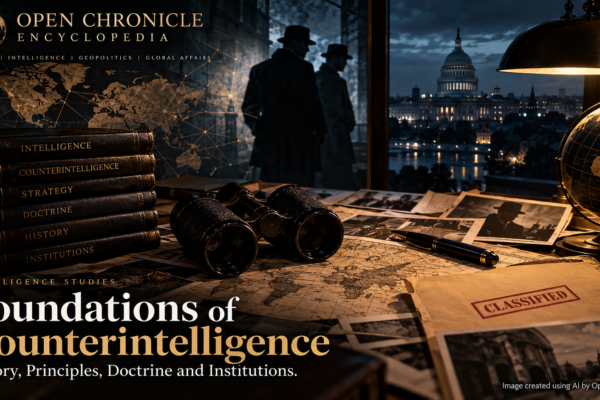
Foundations of Counterintelligence: History, Principles, Doctrine and Institutions

Inside an Espionage Operation
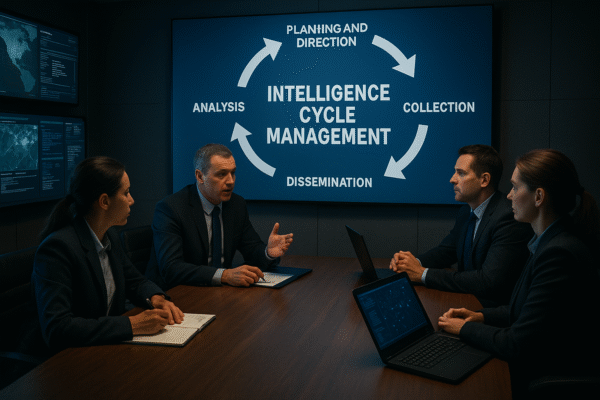
Intelligence cycle management

Cold War Espionage (Introduction)

World War I and World War II Espionage (Introduction)

United States Espionage (Introduction)

Renaissance Espionage (Introduction)

Middle Ages Espionage (Introduction)

Ancient World Espionage (Introduction)

Espionage (Introduction)
Intelligence in Practice and Culture
Intelligence extends beyond agencies and operations. Its methods influence analytical tools, corporate security, technology, history and popular culture.
Intelligence Tools
Explore methods, analytical frameworks and specialised tools used to organise information, identify patterns and support intelligence assessment.
People in Intelligence
Discover intelligence officers, analysts, agents, defectors, cryptographers and other individuals who influenced the history of intelligence.
Corporate Intelligence
Examine how intelligence methods are applied to risk, competition, investigations, security and strategic decision making outside government.
Intelligence in Culture
Explore how espionage, secrecy and intelligence organisations have been represented in literature, cinema, journalism and popular culture.
Understanding the hidden architecture of information and power.
The Intelligence Encyclopedia connects disciplines, organisations, technologies, operations and historical experience to explain how information becomes knowledge, and how knowledge influences strategic decisions.