
Image: from States Radar X @statesradar
By Benjamin Foster | Staff Writer with Agencies
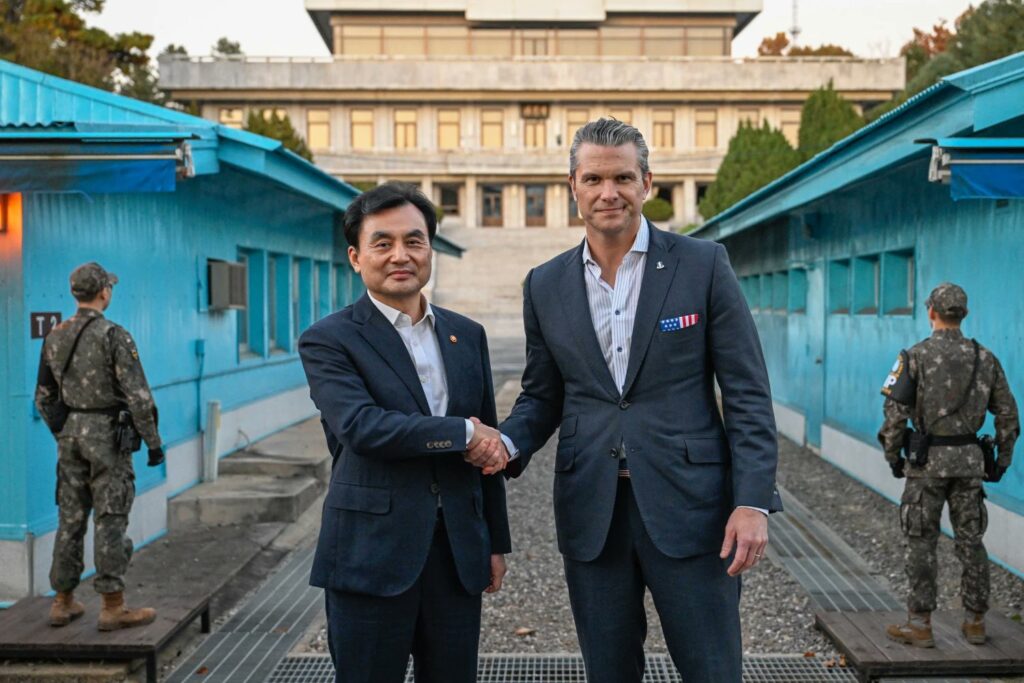
U.S. Defense Secretary Pete Hegseth visited the border between North and South Korea on Monday, becoming the first Pentagon chief in eight years to make the symbolic and highly sensitive trip.
Hegseth was joined by South Korean Defense Minister Ahn Gyu-back during his visit to Panmunjom, the iconic village within the Demilitarized Zone (DMZ) where soldiers from both Koreas stand face-to-face. The two officials also toured Observation Post Ouellette, one of the closest vantage points to North Korean territory.
Secretary of Defense Pete Hegseth,
the Republic of Korea extends its deepest respect and warmest welcome.
For 72 proud years since the Mutual Defense Treaty was signed on 1 October 1953, our two nations have stood as a blood-forged, ironclad alliance. 🇰🇷🤝🇺🇸
When communist forces… pic.twitter.com/BDWay50l7Y— Freedom & Truth (@v_v11200) November 3, 2025
According to a statement released by South Korea’s Ministry of National Defense, Hegseth and Ahn “reaffirmed the strong combined defense posture and close cooperation between South Korea and the United States.” The ministry emphasized that the visit underscored the enduring alliance between Washington and Seoul amid ongoing regional tensions.
Hegseth’s trip comes shortly after U.S. President Donald Trump’s Asia tour, during which he made multiple overtures to North Korean leader Kim Jong Un. Pyongyang, however, has not yet responded to the U.S. president’s diplomatic gestures.
Trump last met Kim in June 2019 at Panmunjom, making history as the first sitting U.S. president to step into North Korea. He briefly crossed the heavily fortified border before returning to the South for bilateral discussions with Kim.
Before that, the last U.S. defense secretary to visit the DMZ was James Mattis in October 2017, during a period of heightened nuclear tensions between Washington and Pyongyang.
Hegseth’s visit highlights renewed U.S. attention to the Korean Peninsula amid persistent security challenges, including North Korea’s continued development of its nuclear and ballistic missile programs. The trip also serves as a reminder of the ironclad U.S.–South Korea alliance, a cornerstone of stability in Northeast Asia since the Korean War armistice in 1953.