
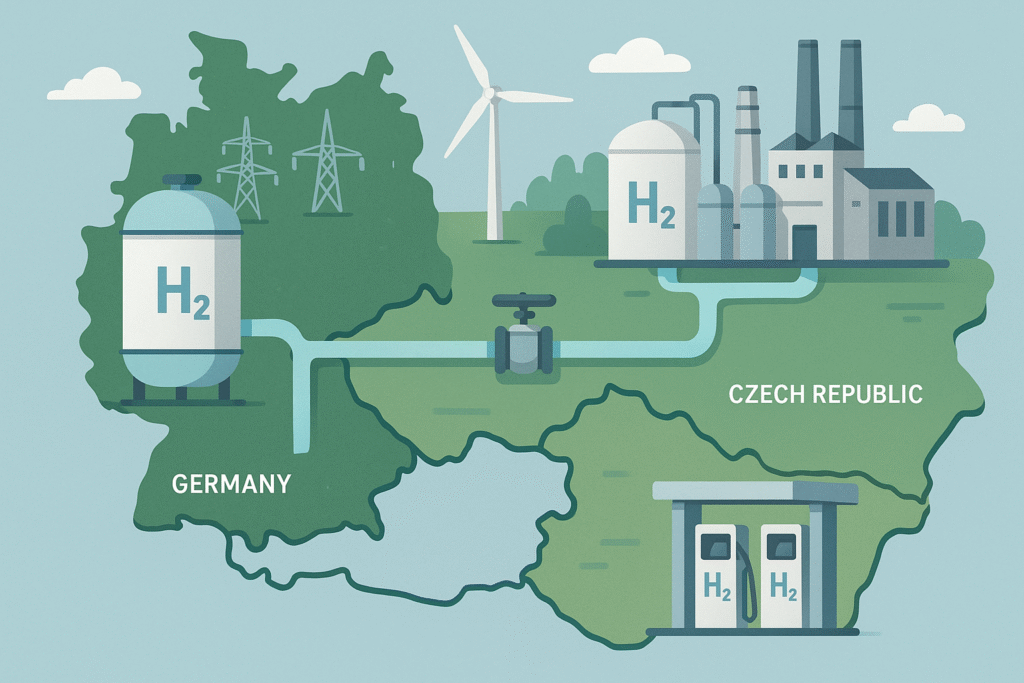
Image Credentials: Image Title: Germany and the Czech Republic Form High-Level Group to Accelerate Hydrogen Pipeline Project Source: (sora.openai) Date: November 2025. Attribution: This image was created using AI-generated imagery (sora.openai) and does not depict a real-world scene.
By Emma Cole | Staff Writer with Agencies
Germany and the Czech Republic have officially launched a high-level working group aimed at enhancing bilateral cooperation on hydrogen pipelines and infrastructure, with a primary focus on the Czech-German Hydrogen Interconnector (CGHI) project. This initiative is set to accelerate the transition to renewable energy and energy independence for both nations.
The announcement, made by Germany’s Federal Ministry of Economics, formalizes a collaborative effort to convert existing natural gas pipelines into bidirectional hydrogen transport systems. This transformation will link the two countries’ future hydrogen grids, allowing for a seamless flow of clean energy between Germany and the Czech Republic.
A Keystone Project for Energy Transition
The CGHI project has been identified by both Berlin and Prague as a cornerstone for their shared goals of reducing reliance on fossil fuels. As the European Union pushes for energy diversification and carbon neutrality, this hydrogen pipeline will play a critical role in meeting the energy needs of both countries while contributing to the EU’s broader decarbonization objectives.
The hydrogen interconnector will not only serve as a vital energy corridor for cross-border energy trade, but it is also central to Germany’s hydrogen strategy. The project aims to strengthen Germany’s internal hydrogen grid while simultaneously creating a pipeline that extends eastward into the Czech Republic, facilitating the flow of green hydrogen to support industrial decarbonization in one of Europe’s key industrial regions.
The High-Level Working Group
The newly formed working group is composed of key ministers from both countries, national regulatory bodies, and major gas network operators, including GASCADE, Open Grid Europe, NaTran, and NET4GAS. Their mandate is clear: to fast-track joint planning efforts, ensure regulatory alignment, and confirm the technical feasibility of the shared hydrogen infrastructure.
This initiative builds upon a Memorandum of Understanding (MoU) signed on April 25, 2025, between Germany and the Czech Republic, which laid the groundwork for future hydrogen collaboration. By formalizing this high-level group, the two governments are signaling their commitment to moving swiftly from policy discussions to tangible, cross-border infrastructure projects.
Industrial Decarbonization and Energy Security for the Czech Republic
For the Czech Republic, the CGHI project is of particular significance. The country is heavily reliant on energy imports, and the hydrogen interconnector will provide a secure and sustainable source of energy for its industries. The conversion of natural gas pipelines into hydrogen infrastructure will be a key enabler of the Czech Republic’s industrial decarbonization plans, allowing local industries to transition to low-carbon hydrogen while reducing reliance on traditional fossil fuels.
In addition, the project plays a crucial role in enhancing energy security by establishing a reliable and diversified supply chain for clean energy in central Europe. As the EU’s REPowerEU plan continues to drive the transition to clean hydrogen and renewable energy, this initiative will help meet EU targets for hydrogen imports, transit, and storage.
A Strategic European Hydrogen Corridor
The collaboration between Germany and the Czech Republic positions both countries as key players in Europe’s emerging hydrogen economy. By repurposing existing infrastructure, they are not only speeding up the transition to hydrogen but also ensuring that Europe remains competitive in the global energy market. The development of the Czech-German Hydrogen Interconnector will also lay the foundation for future hydrogen exports to other European countries, enhancing Europe’s energy integration and resilience.
The project is set to contribute to the European Union’s hydrogen strategy by providing a secure, sustainable, and cost-effective means of transporting green hydrogen across borders. The successful implementation of the CGHI will set a precedent for other cross-border hydrogen infrastructure projects within the EU.
Conclusion
The high-level working group’s efforts to accelerate the Czech-German Hydrogen Interconnector project mark a significant step forward in Europe’s transition to clean energy. With both nations committed to decarbonizing their energy systems and ensuring energy security, the CGHI project represents a major milestone in the development of Europe’s hydrogen economy. By repurposing existing infrastructure and enhancing cross-border collaboration, Germany and the Czech Republic are ensuring that they remain at the forefront of the global energy transition, paving the way for a cleaner, more sustainable future.