
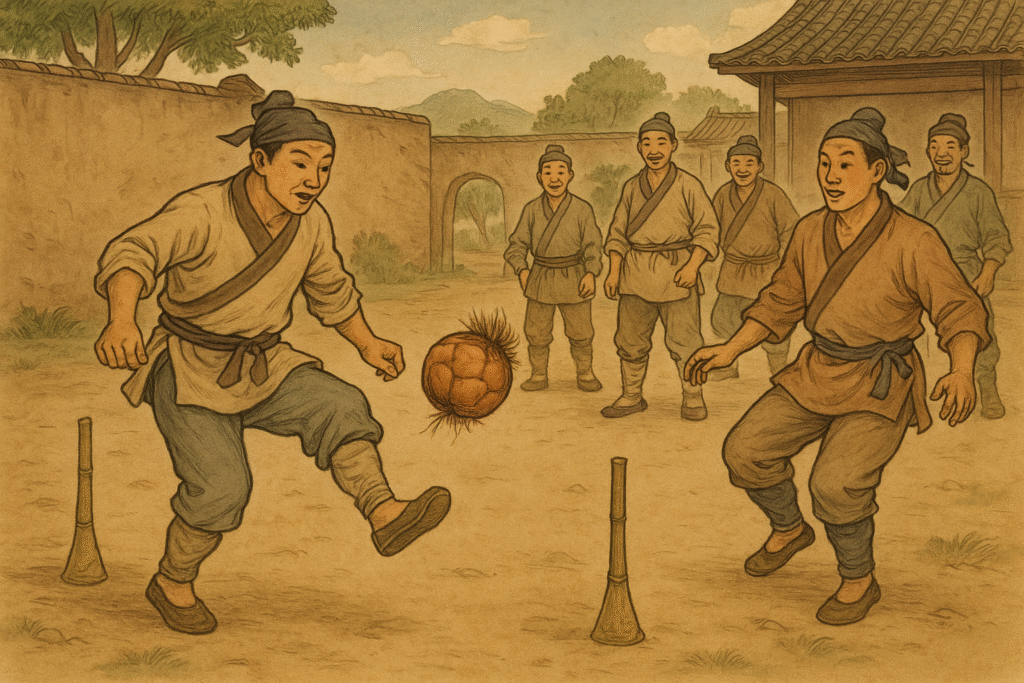
Image Credentials: Image Title: Origins of Football Source: (sora.openai) Date: November 2025. Attribution: This image was created using AI-generated imagery (sora.openai) and does not depict a real-world scene.
By José Carlos Palma | Editor-in-Chief
Football today captivates billions around the world, but its journey from a simple pastime to a global phenomenon is nothing short of extraordinary. The beautiful game didn’t start with roaring stadiums, roaring crowds, or million-dollar transfers; it began over 2,000 years ago in ancient China. Villagers, seeking entertainment, crafted a ball from leather, feathers, and hair, inventing cuju, a rudimentary form of football. The game was simple: players kicked the ball between bamboo cones, no offside rules, no red cards, just pure fun.
Fast forward to 1863, and modern football was born in England. The English Football Association was formed, drafting the first official rulebook that banned carrying the ball, prohibited violent play, and introduced an early version of the offside rule. With the British Empire’s global reach, football spread rapidly. By 1904, FIFA was established, and clubs and leagues began to form across Europe.
The first World Cup in 1930 cemented football as a worldwide spectacle. But war soon interrupted the game: World War II halted competitions, drafted players into the military, and left football in the shadows. Recovery began in the 1950s when Brazil’s Pelé debuted at age 15. By 17, he became the youngest World Cup winner, scoring two goals in the final, and quickly became the first football superstar, transforming the sport into a global cultural phenomenon.
Meanwhile, Europe developed its football pedigree with the creation of the European Cup, where teams like Real Madrid dominated with legendary stars such as Alfredo Di Stéfano and Raymond Kopa. Football heroes emerged everywhere, Bobby Charlton, Eusébio, George Best, and Johan Cruyff, each leaving indelible marks on the game. Best dazzled on the pitch and off, embodying the rockstar lifestyle, while Cruyff revolutionized tactics with Total Football, emphasizing fluid positions, high pressing, and one-touch passing.
The 1980s saw the rise of televised football, Italy’s Serie A dominated by clubs like AC Milan and Juventus, and the arrival of Diego Maradona at Napoli. Maradona led the club to historic success, and his infamous “Hand of God” goal in 1986 immortalized him as one of the sport’s greatest legends. Yet controversies and substance abuse marked the end of his career, illustrating the highs and lows of football stardom.
The 1990s brought major transformations: the offside rule was clarified, the Premier League launched, and European football underwent commercialization. Legendary players such as Zinedine Zidane and Ronaldo Nazário defined a generation with exceptional skill, record-breaking goals, and memorable World Cup performances. Clubs like Manchester United, Real Madrid, and Barcelona grew into global brands, emphasizing commercial power as much as footballing excellence.
The 2000s introduced the era of the Galácticos, where Real Madrid signed Ronaldo, Zidane, Figo, and Beckham, creating a superstar-studded squad. Meanwhile, José Mourinho emerged as a tactical genius, winning the Champions League with Porto in 2004 and later shaping Chelsea and Inter Milan into formidable sides. On the other hand, young talents Cristiano Ronaldo and Lionel Messi rose to prominence, sparking a rivalry that would dominate football for over a decade, with multiple Ballon d’Or awards and Champions League titles exchanged between them.
The 2010s and 2020s brought further evolution: tactical revolutions, financial power shifts, and rising stars like Erling Haaland, Jude Bellingham, and Kylian Mbappé reshaping the game. Clubs in the Premier League and La Liga continued to compete at the highest level, while new leagues in the MLS and Saudi Arabia attracted top talent, signaling the globalization and commercialization of football.
From humble beginnings in ancient China to global spectacles in modern stadiums, football has evolved into a sport where talent, culture, money, and media converge. Legends like Pelé, Maradona, Messi, and Ronaldo remind us of the beauty and drama of the game, while new stars ensure that the story of football continues to thrill fans for generations to come.
Football isn’t just a game; it’s a living, breathing saga that has adapted and grown for over two millennia, and it shows no signs of slowing down.