
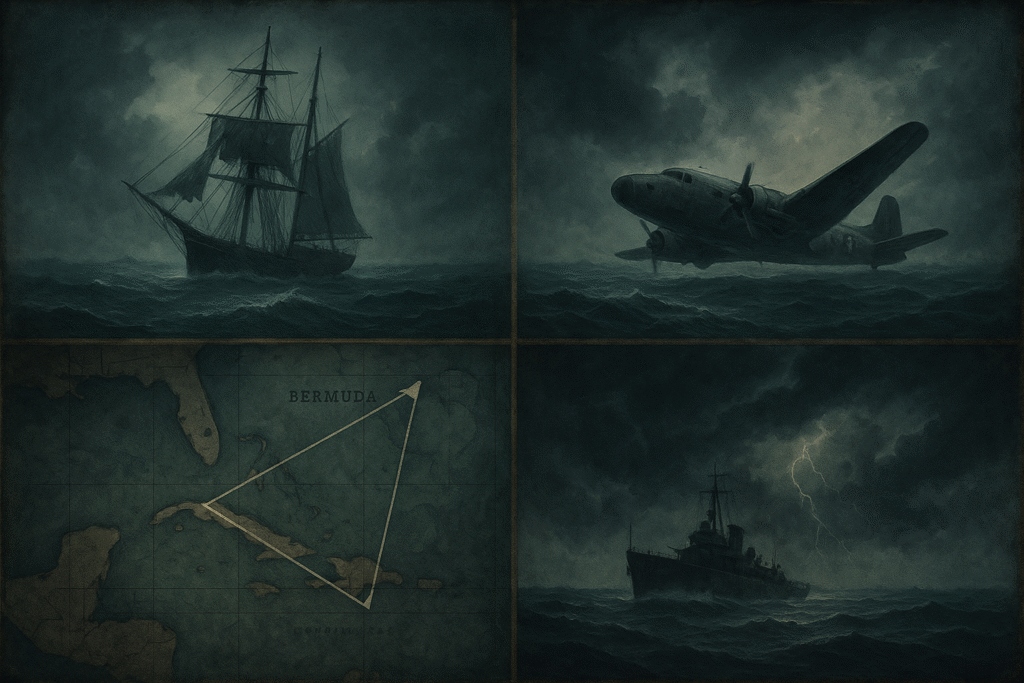
Image Credentials: Image Title: The Bermuda Triangle: Mystery, Mayhem, and the Science Behind the Legends Source: (sora.openai) Date: November 2025. Attribution: This image was created using AI-generated imagery (sora.openai) and does not depict a real-world scene.
By Liam Scott | Staff Writer
For over a century, the Bermuda Triangle has captured imaginations with tales of vanished ships and missing planes. Stretching between Florida, Bermuda, and the Caribbean, this stretch of ocean, ranging from 500,000 to 1.5 million square miles, has been blamed for more than 50 ships and 20 aircraft disappearing without a trace. The stories are chilling, from deserted schooners to lost naval convoys, and each disappearance seems like the beginning of a thriller with no ending.
Consider the eerie case of Ellen Austin in 1881. Captain Griffin encountered a drifting ship in the stormy Sargasso Sea. Fully stocked but completely abandoned, it seemed like a ghost vessel. When Griffin placed some of his crew aboard to sail both ships to New York, a violent storm struck, and the schooner and the men vanished.
Then there was the USS Cyclops, which departed Barbados in 1918 carrying 11,000 tons of manganese ore. In a routine report, the crew noted fair weather and then disappeared. No distress call, no wreckage, no survivors. The Cyclops remains the largest non-combat loss of life in U.S. naval history, claiming 305 souls.
Even smaller vessels have met mysterious fates. On December 22, 1967, the luxury cruiser Witchcraft set out from Miami for a quiet evening. A calm call for help came in after striking an object, yet less than 20 minutes later, rescuers found nothing—no boat, no men, no flare.
Aircraft have also vanished. On December 5, 1945, five planes left Fort Lauderdale for a training run. The leader reported compass failure over the Florida Keys and steered northeast. Communication faltered, fuel dwindled, and eventually all 27 crew members disappeared. Even rescue planes were lost attempting to find them.
The mysteries extend beyond vessels. Great Isaac Rock, home to two lighthouse keepers, was found empty in 1969 after a hurricane passed. Supplies were untouched, the lighthouse undamaged, yet the men were gone. Theories abound, from smuggling to supernatural forces, but the truth remains elusive.
Despite decades of eerie stories, science provides more mundane answers. Australian scientist Carl Kruzniki, along with the U.S. National Oceanic and Atmospheric Administration (NOAA), points to logical explanations: crowded shipping lanes, violent storms, tricky currents like the Gulf Stream, and navigational challenges from magnetic anomalies. The region sees high traffic, and accidents are statistically no more common than in other busy waters. Insurance giant Lloyd’s of London and the U.S. Coast Guard agree, the Bermuda Triangle isn’t cursed; it’s simply a difficult and unpredictable stretch of ocean.
Similar patterns appear elsewhere. The Bass Strait Triangle between mainland Australia and Tasmania has a long history of unexplained disappearances. The 1978 case of Frederick Valentich, a young pilot who reported a metallic object before vanishing, echoes the eerie Bermuda stories. Ships like the MV Ble Star and the sloop Alisa also disappeared under strange circumstances. Even in 2025, aircraft in the Bass Strait vanished without explanation, reinforcing the region’s fearsome reputation.
In truth, most disappearances, whether in the Bermuda Triangle, the Bass Strait, or elsewhere, can be attributed to natural hazards, human error, and sometimes sheer bad luck. Strong currents, shallow waters, rogue winds, and sudden storms create a deadly combination for sailors and pilots alike. Our minds, however, prefer a good story: a ghost ship, a sunken city, or a time warp, rather than a math problem explaining atmospheric pressure and ocean currents.
And perhaps that’s why the Bermuda Triangle will never lose its mystique. Science may offer explanations, but the legends, the eerie tales, and the vanished vessels continue to haunt our imagination, an enduring reminder that the ocean still holds secrets, even in the age of satellites and GPS.