
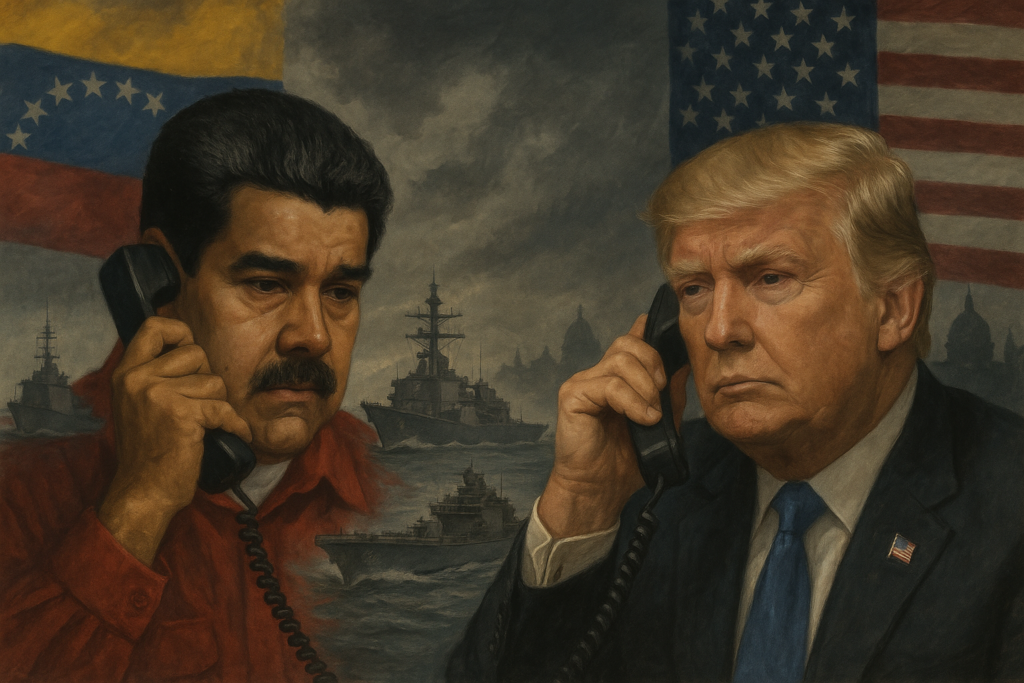
Image Credentials: Image Title: Maduro Confirms ‘Cordial’ Call With Trump as U.S. Military Pressure Sharpens in the Caribbean Source: (sora.openai) Date: December 2025. Attribution: This image was created using AI-generated imagery (sora.openai) and does not depict a real-world scene.
By Jordan Price | with agencies
The phone call lasted only minutes, yet it sent tremors across a region already bristling with warships, accusations, and political mistrust. Ten days after the conversation took place, Venezuelan President Nicolás Maduro publicly confirmed it; he spoke directly with U.S. President Donald Trump, a rare exchange after years of hostility between Caracas and Washington.
Maduro described the call in unexpectedly warm terms, saying it was “respectful, even cordial.” It was the first such acknowledgment of dialogue at the highest level since the United States began dramatically escalating its military presence in the Caribbean in August.
The Trump administration insists the growing armada is part of an anti–drug trafficking operation. Venezuela claims it is something else entirely: the prelude to regime change.
For months, U.S. destroyers, surveillance aircraft, and support vessels have patrolled the Caribbean basin. In November, the world’s largest aircraft carrier joined them. The sudden expansion of American firepower so close to Venezuelan waters triggered immediate alarm in Caracas, which accused Washington of preparing an intervention.
The United States has repeatedly denied the accusation. Yet the military pressure has been unmistakable. The region has witnessed more than 20 U.S. strikes on suspected narcotics vessels in the Caribbean and Pacific, according to Trump and Defense Secretary Pete Hegseth. These attacks have left 83 people dead.
One of the operations, launched on September 2, killed 11 aboard a vessel near Venezuelan waters. Another, confirmed by the White House, targeted survivors from that first strike, an action Democratic lawmakers argue could constitute a war crime. A congressional investigation is already being demanded on Capitol Hill.
The spike in military activity prompted the U.S. Federal Aviation Administration to issue warnings. Eight major international airlines suspended flights to and from Venezuela as a precaution. Even deportation flights were briefly halted before resuming on Wednesday with 266 Venezuelans repatriated aboard Eastern Airlines.
Amid the turbulence, Trump confirmed the call with Maduro, but offered few details. “I only said a couple of things to him,” he remarked, brushing off further questions.
Washington’s stance toward Maduro has hardened dramatically in recent months. U.S. officials accuse him of leading the so-called Cartel of the Suns, an alleged narcotrafficking network the United States recently labeled a terrorist organization. The reward for information leading to Maduro’s capture was raised to $50 million in August, one of the highest bounties the U.S. has ever placed on a foreign leader.
Maduro calls the accusations fabricated, part of a “psychological siege” intended to destabilize his government and justify military encirclement. He insists Venezuela has endured “22 weeks of psychological warfare,” a phrase echoed by Interior Minister Diosdado Cabello, who claims the campaign has escalated into “psychological terrorism.”
Maduro’s comments about the call hint at a rare moment of de-escalation. “If that call means steps are being taken toward respectful dialogue, welcome the diplomacy,” he said. However, he also warned that real diplomacy often occurs out of view. “I don’t like microphone diplomacy,” he added, suggesting that any meaningful negotiation must occur “in silence.”
The United States, meanwhile, shows no signs of easing pressure. Trump recently promised more aggressive operations against what he called “Venezuelan drug traffickers,” saying they would begin “very soon.”
The brief, cordial call between Trump and Maduro comes at a moment more dangerous than any time since Venezuela’s political crisis began. Washington refuses to recognize Maduro’s 2018 and 2024 elections, calling them fraudulent. Caracas believes the U.S. military buildup is designed to topple the government and seize control of Venezuela’s vast oil reserves.
Diplomacy has returned, but only as a whisper, floating above the rumble of aircraft carriers.
Whether this single phone call signals a step away from confrontation, or merely the calm before another storm, remains uncertain.
For now, the Caribbean holds its breath.