
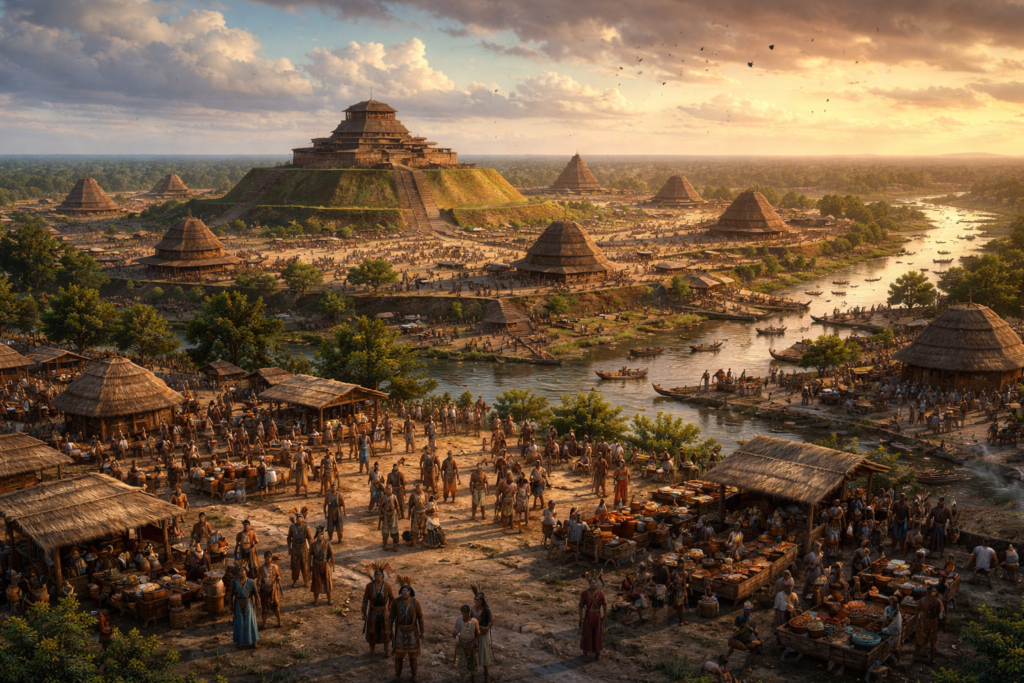
Image Credentials: Image Title: Cahokia: The Native American Metropolis That Rivalled Medieval London Source: (sora.openai) Date: December 2025. Attribution: This image was created using AI-generated imagery (sora.openai) and does not depict a real-world scene.
By Benjamin Foster | Staff Writer
A millennium ago, the landscape of North America was not the sparsely populated wilderness often depicted in colonial myths. Instead, it was a continent of thriving urban centers, complex trade networks, and political systems as sophisticated as those in Europe. At the heart of this world stood Cahokia, a city that, at its peak, was equal in size and complexity to medieval London.
Around 1000 AD, London was home to roughly 12,000 people. Simultaneously, across the Atlantic, Cahokia (located in present-day Illinois) housed an equivalent population. This urbanization was fueled by a “Medieval Warm Period” (900–1300 AD), which provided longer growing seasons and allowed for an agricultural revolution based on maize, beans, and squash.
This surplus of food supported more than just farmers; it allowed for the rise of:
- Specialized Craftspeople: Artists and engineers who created intricate copper work and pottery.
- Political Elites: Leaders who managed complex economies and religious hierarchies.
- Trade Networks: Hubs that imported obsidian from the Rockies, shells from the Gulf of Mexico, and copper from the Great Lakes.
Cahokia was a masterpiece of urban planning. Its most striking features were monumental earthen mounds that served as foundations for temples and elite residences. Monks Mound, which still stands today, remains the largest prehistoric earthen structure in the Americas.
The city featured wide plazas designed for public ceremonies, markets, and athletic games. Beyond the central hub lay woodhenge-like timber circles used for celestial observations, proving that Cahokia’s inhabitants possessed advanced knowledge of astronomy and geometry.
Cahokia was not an anomaly. In the American Southwest, the Ancestral Puebloans were constructing multi-story stone cities in places like Chaco Canyon. Across the Mississippi Valley and the Southeast, various mound-building cultures flourished, creating a tapestry of nations and kingdoms that mirrored the political landscape of Anglo-Saxon Britain.
When European colonists arrived in the 16th and 17th centuries, they found mostly village-based societies and assumed the land had always been “untamed.” In reality, they were witnessing the aftermath of a massive social transformation.
Around the 13th century, the “Little Ice Age” began. Shortened growing seasons and prolonged droughts put immense pressure on urban centers.
- Legitimacy Crisis: As harvests failed, many communities revolted against leaders who claimed to control the weather.
- Decentralization: Unlike the rigid structures of many European states, many Native North American societies chose to adapt by dispersing into smaller, more flexible, and sustainable settlements.
Today, the remains of Cahokia and its sister cities are often mistaken for natural hills. Because these civilizations built primarily with wood, cane, and thatch rather than stone, their “cathedrals” have eroded over time.
However, modern archaeology and Indigenous oral histories are reclaiming this narrative. They reveal that North America was a land of monuments and metropolitan centers long before the first European ship appeared on the horizon.
References
- DuVal, K. (2024). Native Nations: A Millennium in North America. Random House.
- Pauketat, T. R. (2009). Cahokia: Ancient America’s Great City on the Mississippi. Viking.
- UNESCO World Heritage Centre. Cahokia Mounds State Historic Site.
-
HistoryExtra Podcast. (2024). “North America’s Lost Cities,” featuring Kathleen DuVal.