
Image: from NEXTA X@nexta_tv
By Open Chronicle Staff with Agencies
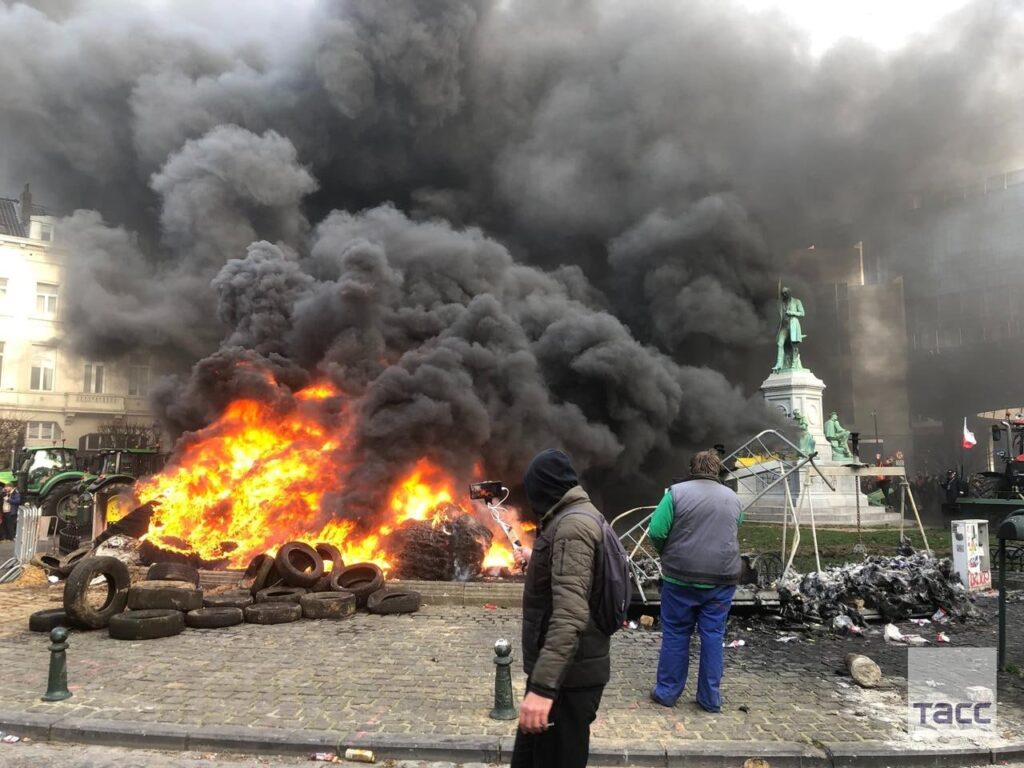
Brussels became a battlefield on Thursday as thousands of farmers deployed tractors, potatoes, and eggs to protest the looming EU-Mercosur free-trade agreement. The demonstrations coincided with a high-stakes summit where European leaders debated whether to finalize, amend, or postpone a deal 25 years in the making.
Police utilized tear gas and water cannons to hold back demonstrators near the Europa building and Place Luxembourg. The farmers’ message was clear: they cannot compete with South American imports that do not adhere to the same stringent environmental and health regulations imposed on European agriculture.
“What we ask is to be able to live off our work,” one protester told reporters. “We are against Mercosur because if we import meat from abroad where they don’t respect the same rules, it’s not normal.”
Chaos in the heart of the EU, Brussels as farmers hit the area against the EU deal with South American bloc Mercosur, which is the final nail in the coffin of the already struggling industry.
No farmers, no food!
We stand with the farmers.
Fk the EU
pic.twitter.com/nzWFgdAZlh— Tommy Robinson 🇬🇧 (@TRobinsonNewEra) December 18, 2025
The Saturday deadline for signing the accord now faces a massive hurdle. Italian Prime Minister Giorgia Meloni has officially joined French President Emmanuel Macron in opposing a “premature” signing.
- The French Stance: Macron arrived at the summit, declaring the accord “cannot be signed” without further negotiations in January, demanding stricter pesticide restrictions and port inspections.
- The Italian Shift: Meloni’s alignment with France likely provides the “blocking minority” needed to stop European Commission President Ursula von der Leyen from proceeding this weekend.
- The Supporters: German Chancellor Friedrich Merz warned that failing to sign would harm the EU’s global credibility, arguing the deal is a necessary counterweight to Beijing’s influence in Latin America.
Proponents of the deal, including von der Leyen, argue that the agreement is a strategic necessity. With the U.S. moving toward unilateralism and China expanding its export controls, the Mercosur pact would create a market of 780 million people, covering a quarter of global GDP.
Agathe Demarais of the European Council on Foreign Relations warned that a failure to sign “risks pushing Latin American economies closer to Beijing’s orbit.”
Despite the internal friction in Europe, Mercosur leaders remain committed. In a rare moment of alignment, Argentina’s libertarian Javier Milei and Brazil’s centre-left Lula da Silva both support the deal.
Lula, who has staked his diplomatic credibility on the pact, expressed frustration with European delays, warning that if it isn’t signed now, Brazil may not pursue further agreements during his presidency. Milei framed the deal as a “spear” to penetrate global markets rather than a “shield” of protectionism.
While von der Leyen and European Council President António Costa are still scheduled to fly to Brazil, the likelihood of a formal signing ceremony on Saturday is fading. The summit in Brussels will determine if a delay is inevitable or if a last-minute set of “reciprocal guarantees” can satisfy the growing list of skeptical EU member states.