
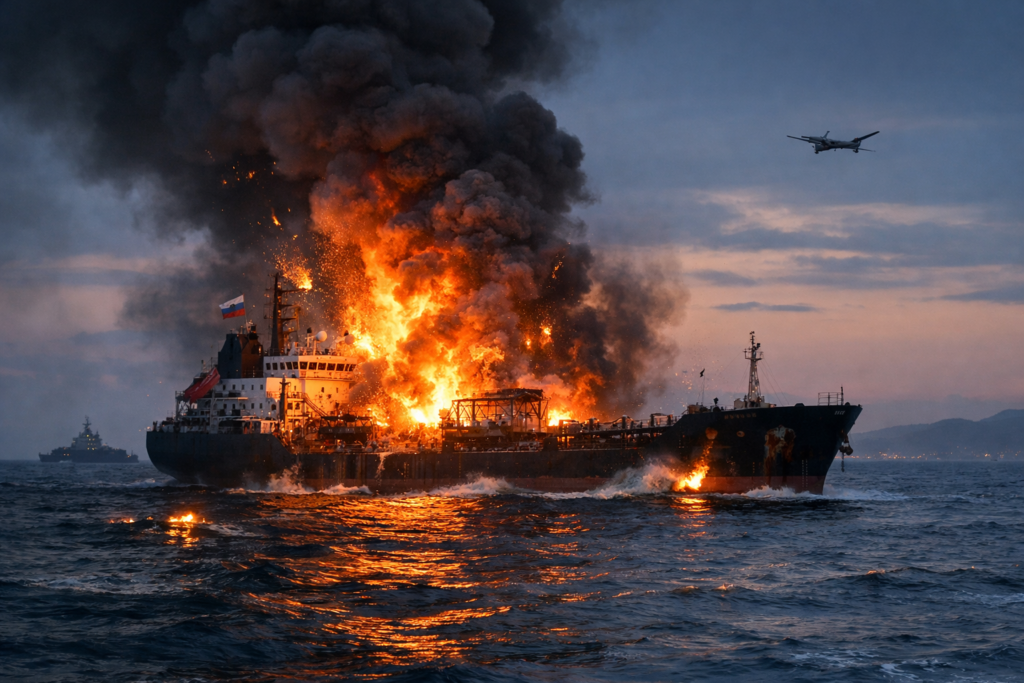
Image Credentials: Image Title: Ukraine Expands Maritime Front: First Strike on Russian Tanker in Mediterranean Source: (sora.openai) Date: December 2025. Attribution: This image was created using AI-generated imagery (sora.openai) and does not depict a real-world scene.
By Open Chronicle Staff with Agencies
In a significant escalation of its long-range capabilities, Ukraine has reportedly struck a Russian tanker in the Mediterranean Sea. This marks the first time Kyiv’s reach has extended into these waters to target Russia’s maritime logistics, signaling a new phase in the war’s economic and naval dimensions.
A source from the SBU (Ukraine’s internal security agency) confirmed that the vessel, identified as the Qendil, suffered “critical damage” after being hit by Ukrainian drones. The operation took place in neutral waters, more than 2,000 kilometers (1,243 miles) from Ukrainian territory.
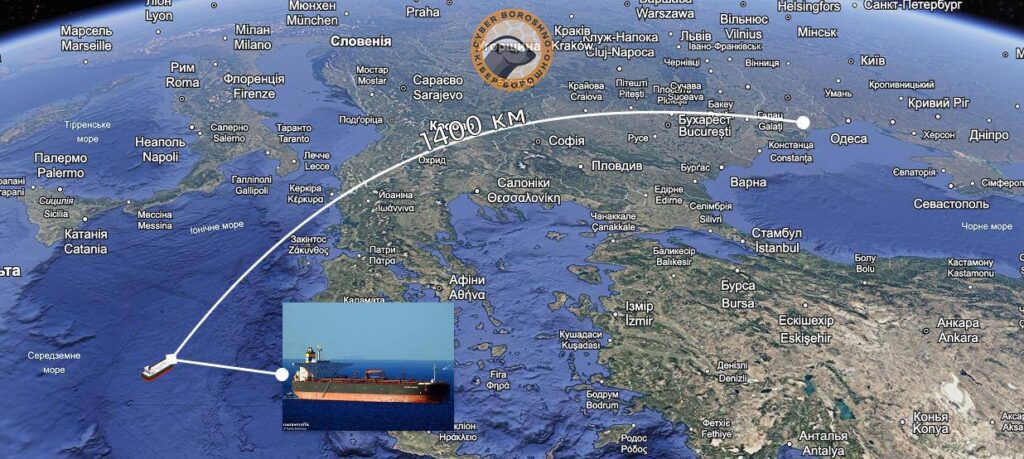
The SBU justifies the strike by categorizing the tanker as a “legitimate military target.” According to Ukrainian intelligence, the Qendil is a component of Russia’s “shadow fleet”, a network of aging vessels used to:
-
Circumvent international oil sanctions.
-
Fund the ongoing invasion of Ukraine through crude oil exports.
-
Operate under opaque ownership to bypass Western restrictions.
The vessel was reportedly empty at the time of the attack, preventing a potential environmental disaster in the Mediterranean.
President Vladimir Putin addressed the incident during a live television event, dismissing any claims that the strike would disrupt Russian oil supplies. However, his rhetoric remained sharp, vowing a retaliatory response from the Kremlin.
-
Retaliation: Putin stated that Russia would respond with “much stronger strikes” against Ukrainian infrastructure.
-
Kaliningrad Warning: The Russian President also used the moment to issue a stern warning against any Western or Ukrainian attempt to blockade Kaliningrad, Russia’s exclave on the Baltic Sea. He warned that such a move would lead to an “unseen escalation” and potentially trigger a “large-scale international conflict.”
The strike coincides with major financial developments for Kyiv. The European Union recently announced a €90bn (£79bn) interest-free loan to bolster Ukraine’s defense and economy.
While Oleksandr Merezhko, chairman of Ukraine’s Foreign Affairs Committee, welcomed the loan, he highlighted a significant funding gap. With the IMF estimating a need for $137bn to keep the country running, Merezhko renewed calls for the West to seize and utilize frozen Russian assets in Europe.
“The aggressor should be punished… it is a matter of justice,” Merezhko stated, emphasizing that Russian funds should directly finance Ukraine’s defense against the very state that owns them.
Sky News military analyst Michael Clarke noted that the Ukrainian claim of “critical damage” is likely accurate. He observed that Ukraine is increasingly comfortable legitimizing deep-strike operations far beyond its borders to disrupt the financial arteries of the Russian war machine.
By striking in the Mediterranean, Kyiv has sent a clear message: Russian assets are no longer safe in international waters, regardless of their distance from the front lines.