
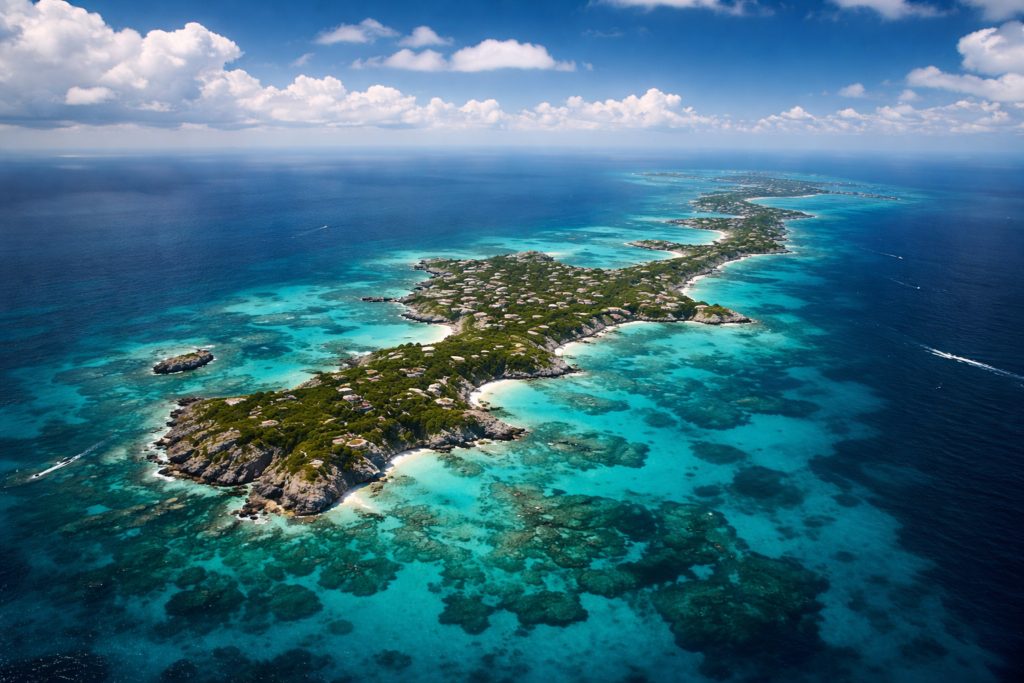
Image Credentials: Image Title: The Bermuda Secret: A Geological Mystery Solved? Source: (sora.openai) Date: December 2025. Attribution: This image was created using AI-generated imagery (sora.openai) and does not depict a real-world scene.
By Open Chronicle Staff with Agencies
For decades, the Bermuda archipelago has sat as a geological outlier in the Atlantic Ocean. While its name is often synonymous with myth and legend, the real mystery has been scientific: why are these islands still above water?
A new study by seismologists William Frazer (Carnegie Science) and Jeffrey Park (Yale University) has identified a massive, previously unknown structure beneath the islands that finally explains why Bermuda hasn’t sunk back into the sea.
The “Swell” Problem
Most volcanic island chains, such as the Hawaiian Islands, follow a predictable pattern. They are formed by a deep-rooted mantle plume—a localized column of hot magma rising from deep within the Earth. This plume creates a bathymetric swell, a bulging “pimple” on the seafloor that supports the islands.
However, Bermuda is different:
-
Age: It formed approximately 33 million years ago.
-
Inactivity: There has been no volcanic activity for millions of years.
-
The Missing Plume: Unlike Hawaii, Bermuda has no active deep-rooted plume to keep it afloat.
Normally, without a plume to provide heat and buoyancy, the seafloor should have cooled, contracted, and receded, dragging the 181 islands of the archipelago into the depths of the Atlantic.
Seismic “X-Rays” Reveal the Truth
To solve this, Frazer and Park analyzed seismic waveforms from earthquakes. Much like a medical X-ray, these vibrations change speed depending on the density of the material they pass through:
-
Dense material: Vibrations move faster.
-
Less dense material: Vibrations slow down.
The researchers discovered a massive 20-kilometer-thick layer of low-density rock sitting directly beneath the oceanic crust. This hidden layer provides enough buoyancy to act as a permanent “anchor” for the swell, keeping the islands elevated without the need for an active mantle plume.
The Role of Underplating
This geological phenomenon is known as underplating. Researchers believe this thick layer was “emplaced” or trapped during Bermuda’s last major volcanic period, roughly 30 to 35 million years ago.
“We identify features associated with a ~20-kilometer-thick layer of rock below the oceanic crust that has not yet been reported,” the researchers explain in their paper. “This thick layer… could support the bathymetric swell.”
While other interpretations of the seismic data may exist, this “underplating” theory is currently the most robust explanation for Bermuda’s survival. It suggests that the archipelago isn’t just a collection of old volcanoes, but a unique structure reinforced by a hidden foundation that resists the natural sinking process of the Atlantic floor.
Key Takeaways
| Feature | Traditional Island Model | The Bermuda Model |
| Support Source | Active Mantle Plume | 20km Low-Density Rock Layer |
| Sustainability | Relies on constant heat | Relies on permanent buoyancy |
| Status | Sinks once the plume moves | Remains buoyant through “underplating.” |