
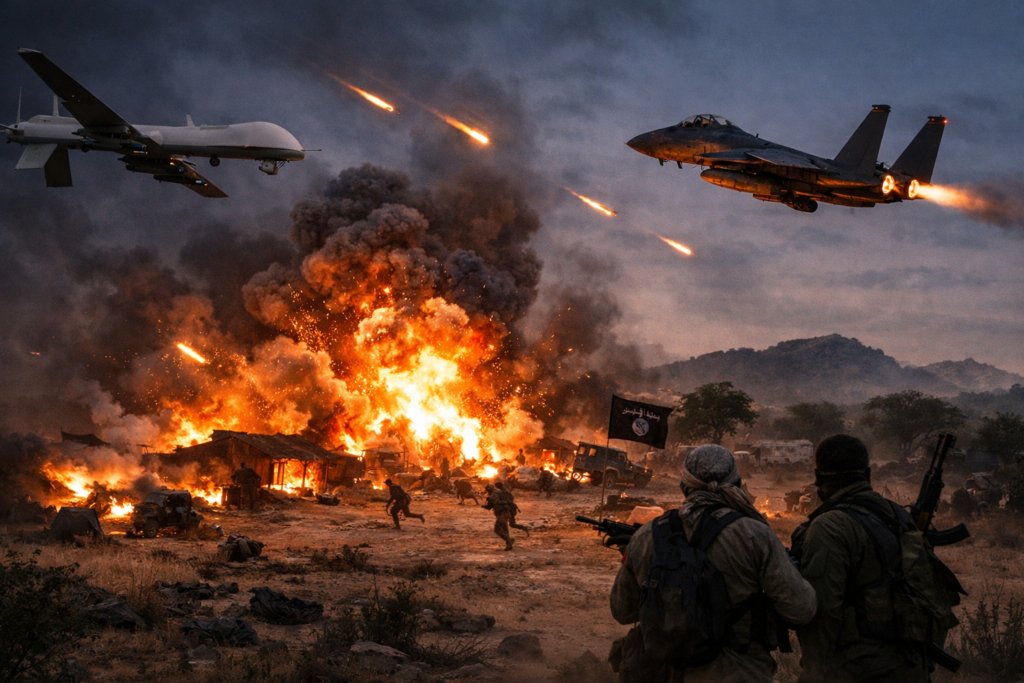
Image Credentials: Image Title: U.S. Launches “Deadly” Air Strikes Against ISIS in Northwest Nigeria Source: (sora.openai) Date: December 2025. Attribution: This image was created using AI-generated imagery (sora.openai) and does not depict a real-world scene.
By Open Chronicle Staff with Agencies | December 26, 2025
SOKOTO, Nigeria / WASHINGTON D.C. — In a dramatic expansion of U.S. military operations in West Africa, the United States has launched a series of “powerful and deadly” air strikes against Islamic State (ISIS) militants in northwest Nigeria. The operation, conducted at the request of the Nigerian government, marks a significant shift in U.S. foreign policy under President Donald Trump, who has cited the targeted killing of Christians as a primary catalyst for the intervention.
The Operation: Precision Strikes in Sokoto
The strikes, which took place on Thursday, targeted multiple Islamic State camps in Sokoto State. U.S. Africa Command (AFRICOM) confirmed that the operation was carried out in close coordination with Nigerian authorities.
-
Method of Attack: The Pentagon released footage showing at least one projectile launched from a U.S. warship. Defense officials confirmed the use of high-precision munitions to minimize collateral damage while neutralizing “ISIS Terrorist Scum.”
-
Intelligence Background: The strikes followed weeks of intensive intelligence-gathering flights conducted by U.S. assets over Nigeria since late November.
-
Casualties: While specific numbers have not been released, AFRICOM stated that “multiple militants” were killed in the bombardment.
Trump: “Christianity Faces an Existential Threat”
President Donald Trump took to Truth Social to announce the mission, using characteristic rhetoric to frame the conflict as a defense of religious freedom.
“Tonight, at my direction… the United States launched a powerful and deadly strike… who have been targeting and viciously killing, primarily, innocent Christians, at levels not seen for many years, and even Centuries!” — President Donald Trump
The President had been warning of military intervention since late October, arguing that the Nigerian government had failed to sufficiently protect Christian communities from extremist violence.
A Delicate Diplomatic Balance
While the Nigerian Foreign Ministry welcomed the security cooperation and intelligence sharing, it offered a more nuanced view of the violence on the ground.
Differing Perspectives on the Conflict:
-
U.S. View: Focuses heavily on the persecution of Christians, with Defense Secretary Pete Hegseth warning that there is “more to come.”
-
Nigerian View: President Bola Tinubu and his administration emphasize that armed groups target both Muslims and Christians. They have cautioned that framing the issue solely as religious persecution ignores the complex socio-economic and security factors at play.
Regional Volatility
The air strikes occurred on the same day as a suspected suicide bombing at a mosque in northeast Nigeria, which killed at least five people and injured dozens more. This underscores the multi-front challenge facing the Nigerian state as it battles various Islamist insurgencies, including Boko Haram and ISIS-affiliated groups.
The U.S. intervention in Nigeria follows similar large-scale strikes against ISIS targets in Syria last week, suggesting a broader, more aggressive U.S. stance against Islamic State remnants globally.
| Factor | Detail |
| Location | Sokoto State, Northwest Nigeria |
| U.S. Command | AFRICOM |
| Key Justification | Protection of Christian communities; ISIS neutralization |
| International Context | Parallel strikes occurring in Syria |
The Road Ahead
President Tinubu, in his recent Christmas message, called for national peace and religious tolerance. However, with U.S. Defense Secretary Hegseth promising further action, the role of the U.S. military in Nigeria appears to be shifting from advisory to active combat participation, raising questions about the long-term presence of American forces in the Sahel.