
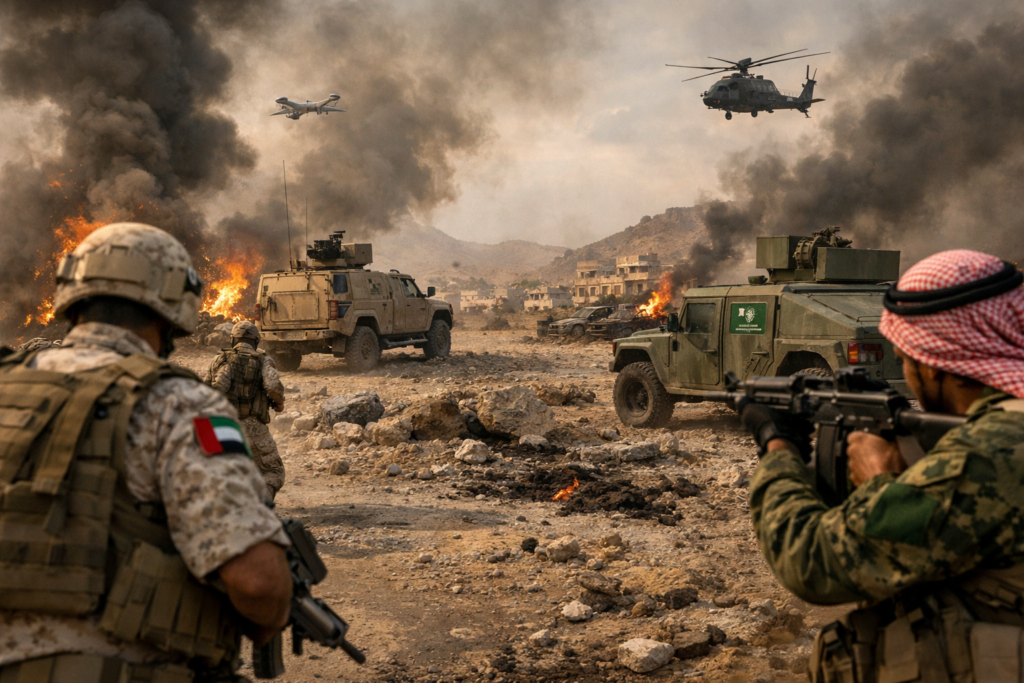
Image Credentials: Image Title: Gulf Rift Deepens: UAE Withdraws Forces After Saudi Airstrike Ignites Yemen Crisis Source: (sora.openai) Date: December 2025. Attribution: This image was created using AI-generated imagery (sora.openai) and does not depict a real-world scene.
By Open Chronicle Global Security Desk with Agencies | December 31, 2025
The longstanding alliance between the Middle East’s two most powerful monarchies reached a historic breaking point on Tuesday, December 30. The United Arab Emirates (UAE) announced the immediate withdrawal of its remaining military personnel from Yemen, following a direct military confrontation with Saudi Arabia that has upended regional security and rattled global oil markets.
The Incident: Midnight Strike at Mukalla Port
The crisis escalated rapidly following a Saudi-led coalition airstrike on the southern Yemeni port of Mukalla. Riyadh justified the attack by claiming it targeted an unauthorized weapons shipment arriving from the UAE port of Fujairah aboard a cargo vessel identified as the Greenland.
-
Saudi Allegation: Riyadh asserts the shipment contained arms and combat vehicles intended for the Southern Transitional Council (STC), a separatist group aiming to undermine the Saudi-backed Yemeni government.
-
UAE Response: Abu Dhabi expressed “surprise” at the strike, insisting the shipment contained no weaponry and was destined for its own counterterrorism units.
-
Outcome: While Saudi state media reported no casualties, Yemeni state TV aired footage of black smoke and charred vehicles at the dockside.
The 24-Hour Ultimatum and Withdrawal
Following the strike, Rashad al-Alimi, head of Yemen’s Saudi-backed Presidential Leadership Council (PLC), issued a stinging 24-hour ultimatum for all Emirati forces to exit the country. He accused the UAE of directing the STC to “rebel against the authority of the state.”
In a strategic “comprehensive assessment,” the UAE Ministry of Defence announced it would voluntarily end its counterterrorism mission. This marks the final departure of a military presence that had been largely drawn down in 2019 but remained as a specialized unit.
“The security of Saudi Arabia and other Gulf countries constitutes an inseparable part of our own security.”
— Official Statement from Qatar, reflecting the regional anxiety.
A Divergence of Interests
Once the “twin pillars” of Gulf security, Saudi Arabia and the UAE have seen their interests drift apart significantly in 2025:
| Point of Friction | Saudi Arabia’s Stance | UAE’s Stance |
| Yemen Governance | Supports the unified, internationally recognized government. | Has historically supported the STC (separatists). |
| National Security | Views STC advances toward its border as a “red line.” | Prioritizes counterterrorism and maritime influence in the Red Sea. |
| Oil Strategy | Seeks consensus within OPEC+ for production stability. | Occasionally, challenges quotas to maximize economic expansion. |
Global and Economic Repercussions
The fallout was felt immediately beyond the Arabian Peninsula:
-
Diplomatic Pressure: US Secretary of State Marco Rubio held urgent calls with both foreign ministers to prevent a total collapse of Middle East security coordination.
-
Market Shock: Major stock indexes across the Gulf fell on the news, as investors feared the rift would disrupt the upcoming OPEC+ meeting scheduled for Sunday.
-
Security Blockade: President Alimi has declared a 72-hour no-fly zone and a total sea and ground blockade on all crossings in the south.
The Road Ahead
The withdrawal may temporarily cool the direct military friction, but the political future of Yemen remains in peril. The STC, led by Aidarous al-Zubaidi, has already rejected the PLC’s orders, claiming they lack consensus. With the UAE forces gone, a power vacuum in the south could either lead to an STC-Saudi confrontation or provide an opening for Houthi rebels to regain momentum.