
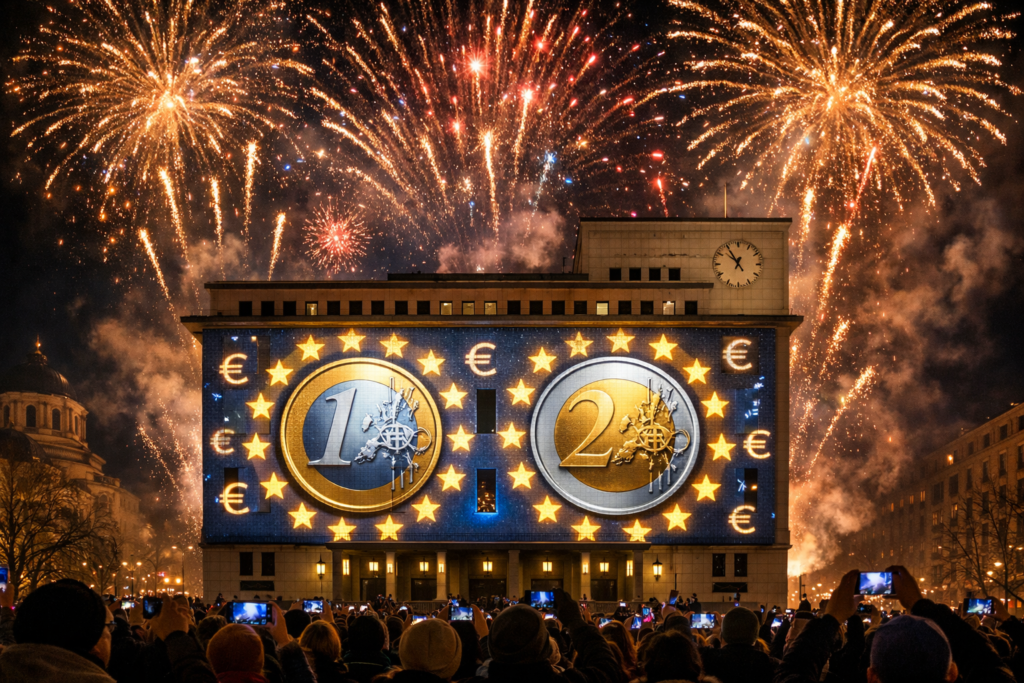
Image Credentials: Image Title: A New Era for the Balkans: Bulgaria Joins the Euro Zone as the Lev Enters History Source: (sora.openai) Date: December 2025. Attribution: This image was created using AI-generated imagery (sora.openai) and does not depict a real-world scene.
By Open Chronicle News Desk | January 1, 2026
SOFIA, Bulgaria — At the stroke of midnight on Thursday, fireworks illuminated the Balkan skies and the facade of the Bulgarian National Bank glowed with a digital display of euro coins. The spectacle marked a historic milestone; Bulgaria has officially become the 21st member of the euro zone, formally retiring its centuries-old currency, the lev.
The transition integrates Bulgaria’s economy of 6.7 million people into a single currency group now used by more than 350 million Europeans. Bulgaria follows Croatia, which was the last nation to join the bloc in January 2023.
A Seat at the Table
Beyond the physical change of banknotes in wallets, the move grants Bulgaria significant institutional power. As a full member, the Governor of the Bulgarian National Bank now holds a seat and a vote on the European Central Bank’s (ECB) Governing Council. This allows Sofia to have a direct say in the interest rate-setting policies that govern the European economy.
Public Sentiment: Hope vs. Hesitation
Successive governments have pursued euro adoption since Bulgaria joined the European Union in 2007. While the business community has largely championed the move for reducing transaction costs and increasing investment, the general public remains nuanced in its outlook.
-
The Optimists: Many citizens view the change as a matter of convenience and stability. “Anyone who goes on a trip will not have problems exchanging currency; now everything will be normal,” said Antonia Tsvetkova, a local jeweler. Stefan Bisterkov, a driving instructor, echoed the sentiment, noting that the fixed exchange rate, where 10,000 leva becomes roughly 5,113 euros, makes the transition straightforward. “It’s all the same. And I think it will be better.”
-
The Skeptics: Some Bulgarians harbor fears that the transition will be used by retailers as an excuse to raise prices, fueling inflation. This anxiety is compounded by a volatile domestic political climate; the government recently stepped down following intense protests against proposed tax hikes.
The Economic Transition
To ensure a smooth transition, Bulgarian authorities have implemented a “dual-pricing” period where goods are labeled in both leva and euros. The Bulgarian lev had been pegged to the euro since the currency’s inception, which helped stabilize the economy in preparation for this week’s full integration.
| Bulgaria Euro Zone Quick Facts | |
| Official Join Date | Thursday, January 1, 2026 |
| Population Added to Eurozone | 6.7 Million |
| Previous Currency | Bulgarian Lev (BGN) |
| Fixed Exchange Rate | 1.95583 BGN = 1 EUR |
| ECB Council Seat | Yes |
What Happens Next?
For the next two weeks, both the lev and the euro will circulate together, allowing citizens to spend their remaining national currency. After this period, the lev will no longer be legal tender, though the central bank will continue to exchange old notes indefinitely.
As the fireworks fade, the focus shifts to the long-term impact on Bulgaria’s credit rating and its ability to attract deeper European integration, a goal that has been nearly two decades in the making.