
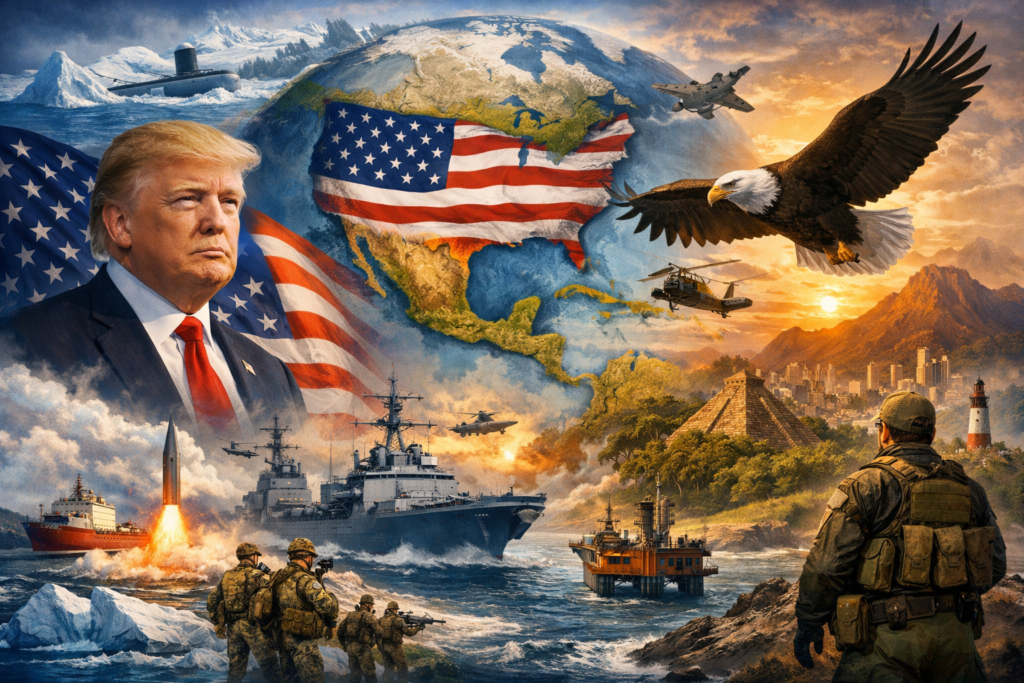
Image Credentials: Image Title: The Trump Corollary: Reasserting the Monroe Doctrine for a New Century Source: (sora.openai) Date: January 2025. Attribution: This image was created using AI-generated imagery (sora.openai) and does not depict a real-world scene.
By Open Chronicle Geopolitics Desk | January 1, 2026
In a significant shift in American foreign policy, the United States has officially declared the Western Hemisphere as the centerpiece of its National Security Strategy. Moving away from decades of globalized entanglements, the administration has announced the restoration and enforcement of the Monroe Doctrine, a 19th-century policy revamped for the modern era to ensure American preeminence from the Arctic to the tip of Tierra del Fuego.
This new strategic framework, dubbed the “Trump Corollary,” seeks to eliminate foreign influence in the Americas while recalibrating military and economic power closer to home.
Denying Non-Hemispheric Competitors
The core of the Trump Corollary is a “zero-tolerance” policy regarding extra-hemispheric interference. The U.S. has pledged to deny competitors, specifically pointing toward growing influence from powers like China and Russia, the ability to:
-
Position Military Forces: Any attempt to establish a military presence or “threatening capabilities” in the region will be viewed as a direct security threat.
-
Control Strategic Assets: The strategy prohibits foreign rivals from owning or controlling “strategically vital assets,” such as ports, telecommunications infrastructure, or critical mineral mines.
Military Readjustment: Bringing Power Home
Perhaps the most radical element of the strategy is the proposed global military pivot. The U.S. will begin moving troops and assets away from theaters of declining importance, such as parts of Europe or the Middle East, to address “urgent threats” in the Americas.
-
Border Security and Cartels: The strategy shifts away from a “law enforcement-only” approach to the drug war. It explicitly authorizes the use of lethal force and military deployments to secure the U.S. border and dismantle cartels.
-
Strategic Access: The U.S. will establish or expand military access in key locations throughout the hemisphere to ensure it can “assert itself confidently” whenever necessary.
The “Partner of First Choice” Model
The administration aims to replace traditional aid models with a mixture of Commercial Diplomacy and reciprocal trade.
-
Tariffs and Reciprocity: Tariffs and reciprocal trade agreements are being wielded as “powerful tools” to encourage regional governments to align with U.S. strategy.
-
Rewarding Alignment: Governments, political parties, and movements that align with American principles will receive economic and security rewards. Conversely, the U.S. will use “various means” to discourage nations from collaborating with extra-hemispheric rivals.
Economic Strengthening of the Hemisphere
The ultimate goal of this “Restoration of Preeminence” is to build a more economically sophisticated Western Hemisphere. By prioritizing American commerce and investment, the strategy hopes to turn partner nations into vibrant markets for U.S. industry while simultaneously securing the supply chains that the U.S. homeland depends on.
The Geopolitical Outlook
Critics argue that a return to the Monroe Doctrine may alienate long-standing partners who value their sovereignty, while proponents argue that it is a “common-sense” return to prioritizing the immediate neighborhood. By making the Western Hemisphere the “top priority region,” the U.S. is signaling that the era of looking past its neighbors is over.
The Trump Corollary marks the beginning of a “Hemispheric Fortress” era—one where American security is inextricably linked to its total preeminence in its own backyard.
Bibliography
- Monroe, James. “Seventh Annual Message to Congress (The Monroe Doctrine).” December 2, 1823. National Archives and Records Administration. https://www.archives.gov/milestone-documents/monroe-doctrine.
- Roosevelt, Theodore. “The Roosevelt Corollary to the Monroe Doctrine.” Annual Message to Congress, December 6, 1904. National Archives and Records Administration. https://www.archives.gov/milestone-documents/roosevelt-corollary.
- U.S. Department of Defense. Global Posture Review: Readjusting Military Presence to Address Hemispheric Threats. Washington, DC: Pentagon Press, 2025.
- U.S. Department of State. Commercial Diplomacy and Reciprocal Trade in the Americas: A Framework for Hemispheric Preeminence. Bureau of Western Hemisphere Affairs. Washington, DC: Government Publishing Office, 2025.
- U.S. President. National Security Strategy of the United States: A Western Hemisphere Priority. Washington, DC: The White House, 2025.
- Dent, David W. The Monroe Doctrine: The Evolution of an American Foreign Policy Strategy. Westport, CT: Greenwood Press, 1999.
- Gilderhus, Mark T. “The Monroe Doctrine: Meanings and Messages.” Presidential Studies Quarterly 36, no. 1 (2006): 5–16.
- Grandiner, Greg. Empire’s Workshop: Latin America, the United States, and the Rise of the New Imperialism. Revised Edition. New York: Metropolitan Books, 2021.
- Kaye, Harvey J. The Fight for the Four Freedoms: What Made FDR and the Greatest Generation Truly Progressive. New York: Simon & Schuster, 2014.
- Pérez, Louis A., Jr. The War of 1898: The United States and Cuba in History and Historiography. Chapel Hill: University of North Carolina Press, 1998.