
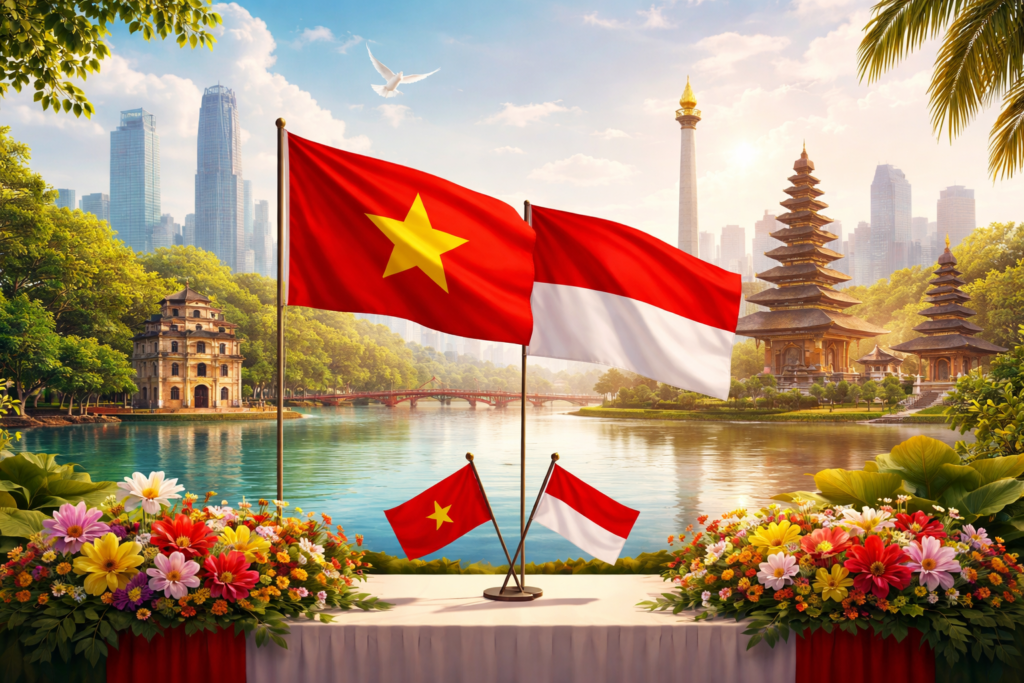
Image Credentials: Image Title: “Việt Nam and Indonesia Mark Seven Decades of Partnership with a Strategic Vision for Southeast Asia Source: (Gemini) Date: January 2026. Attribution: This image was created using AI-generated imagery (Gemini) and does not depict a real-world scene.
By Open Chronicle News Desk | January 5, 2026
HÀ NỘI — After more than seventy years of diplomatic engagement, Việt Nam and Indonesia are entering a new phase in their bilateral relationship, one defined by deep political trust, strategic alignment, and a shared vision for peace and prosperity in Southeast Asia.
Professor Vijay Sakhuja, a leading scholar of geopolitics and international relations and former Director of India’s National Maritime Foundation, has described ties between the two countries as among the most exemplary and strategically significant in the region. In his recent policy brief titled Việt Nam and Indonesia Cherishing Seven Decades of Bilateral Relations, Sakhuja argues that the partnership has evolved far beyond conventional diplomacy to become a key pillar of the regional order.
The relationship was established in the 1950s, a formative period when both nations were emerging from long and arduous struggles for independence. According to Sakhuja, these shared historical experiences forged a strong sense of mutual understanding, national self-reliance, and a common determination to protect sovereignty. This foundation led to the formal establishment of diplomatic relations on December 30, 1955.
What began as a traditional friendship has steadily deepened over time. In 2013, the two countries elevated their ties to a Strategic Partnership, followed by a major milestone in March 2025 when the relationship was upgraded to a Comprehensive Strategic Partnership during Party General Secretary Tô Lâm’s visit to Indonesia. Sakhuja described this step as a historic turning point that reflects the highest level of political trust between Hà Nội and Jakarta.
Geographically and geopolitically, both countries occupy positions of exceptional importance. Việt Nam sits along critical maritime routes and supply chains connecting Northeast Asia with mainland Southeast Asia. Indonesia, as the world’s largest archipelagic state, controls key sea lanes including the Malacca, Sunda, and Lombok Straits. This strategic complementarity, Sakhuja notes, makes the two nations natural partners in advancing regional connectivity and stability.
Economic cooperation has become the most dynamic pillar of the relationship. Indonesia is currently Việt Nam’s second largest trading partner within ASEAN, while Việt Nam ranks as Indonesia’s fourth largest. Both governments have set an ambitious target of raising bilateral trade to 18 billion US dollars by 2028. Investment cooperation is also expanding, highlighted by VinFast’s planned 1.2 billion dollar investment in an electric vehicle manufacturing facility in Indonesia. Beyond its commercial value, the project symbolises Việt Nam’s growing strengths in green technology and innovation, aligning closely with Indonesia’s energy transition and sustainable development goals.
Defence and security cooperation also feature prominently in the partnership. As a maritime security expert, Sakhuja emphasises that both countries share a commitment to a free, open, and rules-based Indo-Pacific, grounded in the 1982 United Nations Convention on the Law of the Sea. The successful conclusion of negotiations on the delimitation of the exclusive economic zone is cited as a landmark achievement, demonstrating both sides’ willingness to resolve sensitive issues peacefully and contribute to stability in the East Sea.
At the multilateral level, Việt Nam and Indonesia play central roles within ASEAN. Sakhuja argues that close coordination between Hà Nội and Jakarta is essential to maintaining ASEAN unity and centrality at a time of intensifying competition among major powers. Their cooperation, he notes, helps shape a more coherent Southeast Asian voice in regional and global forums.
As the partnership enters its eighth decade, Sakhuja concludes that the relationship between Việt Nam and Indonesia now extends well beyond national interests. It reflects the emergence of both countries as responsible middle powers, increasingly influential in shaping the security and economic architecture of Southeast Asia and the wider Indo-Pacific region.