
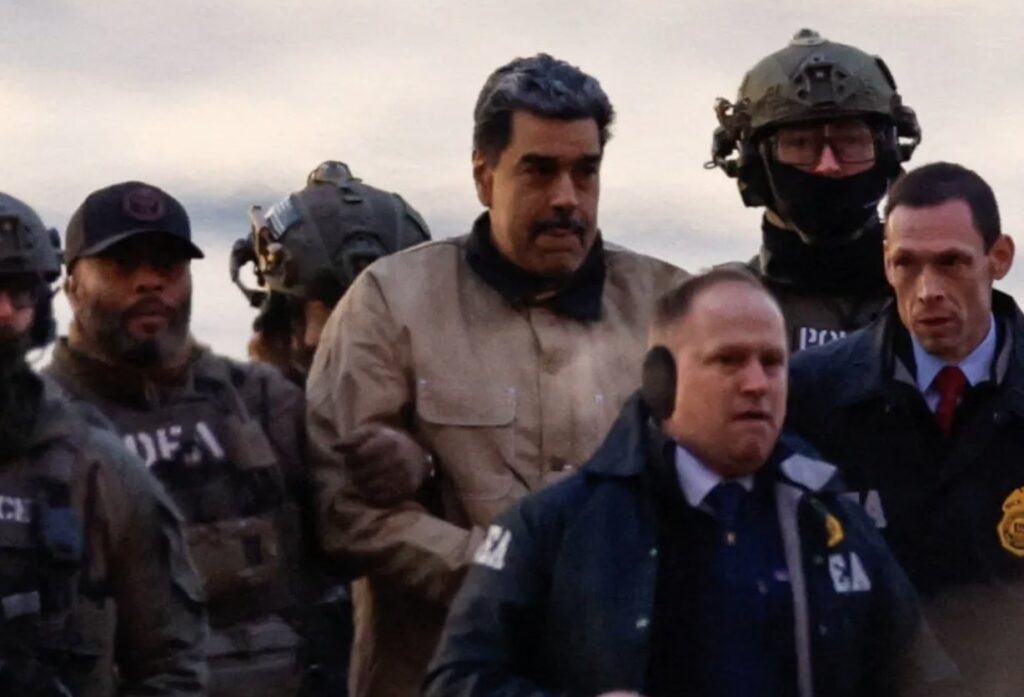
Image: from Marta Dhanis X@MartaDhanis
Former Venezuelan president Nicolás Maduro pleaded not guilty on Monday to charges of narco terrorism in a federal court in New York, two days after he was seized by United States forces in a dramatic operation in Caracas that has sent shockwaves through Latin America and beyond.
Appearing before a judge in Manhattan, the sixty-three-year-old leader said he had been forcibly taken from Venezuela and described the operation as a kidnapping. According to US media present in the courtroom, Maduro told the judge that he remained the legitimate president of his country and categorically rejected the accusations against him, declaring himself innocent.
The court appearance followed a series of extraordinary announcements by President Donald Trump over the weekend. Trump said the United States was now effectively running Venezuela and was seeking full access to the country’s vast oil reserves, which he said were essential to rebuilding the nation after years of economic collapse.
The events have triggered widespread international concern. United Nations Secretary General António Guterres told an emergency meeting of the Security Council that respect for sovereignty, political independence, and territorial integrity must be upheld. Several countries in the region issued sharp rebukes, warning that the precedent set by the operation could destabilise the hemisphere.
Nicolás Maduro just pleaded not guilty to narco-terrorism and drug trafficking charges in a NY federal court after being captured by US forces.
Hopefully, justice is served and this tyrant spends the rest of his life rotting in prison…pic.twitter.com/HL9pB0sNJc
— PoliticalPulse (@Poli_Pulse1776) January 5, 2026
Mexico’s President Claudia Sheinbaum said on Monday that the Americas do not belong to any single power, while Colombian President Gustavo Petro released a fiery statement condemning Washington’s actions. Petro said that as a former guerrilla fighter, he was prepared to resist what he described as imperial aggression.
Maduro came to power in two thousand thirteen after the death of Hugo Chávez and presided over a period marked by deep economic crisis, mass emigration, and political repression. The United States and the European Union have long accused him of manipulating elections, imprisoning opponents, and overseeing systemic corruption. His removal brings an abrupt end to a quarter-century of socialist rule in Venezuela, leaving a population of around thirty million people facing profound uncertainty.
Inside Venezuela, reactions were divided. On Sunday, around two thousand supporters rallied in Caracas, some riding motorcycles and carrying rifles, waving national flags and chanting in support of Maduro. In the National Assembly, deputies shouted slogans backing the ousted leader. At the same time, many Venezuelans abroad expressed relief at his downfall.
For now, the Trump administration has signalled that it wants a degree of continuity within the Venezuelan state apparatus. Delcy Rodríguez, who served as vice president under Maduro and has been named interim leader, initially struck a defiant tone but later said she was ready to cooperate with Washington. Trump has made clear that he does not intend to support opposition figures previously regarded by Western governments as the winners of disputed elections.
Asked what he expected from Rodríguez, Trump said the United States needed total access to Venezuela’s resources, particularly oil. Venezuela holds the world’s largest proven oil reserves, but years of sanctions, underinvestment, and mismanagement have left production infrastructure in poor condition. Following Trump’s remarks, shares in major US oil companies rose sharply in early trading.
Trump’s actions in Venezuela come amid a broader pattern of assertive foreign policy rhetoric. Over the weekend, he suggested that Cuba was close to collapse and repeated his view that Greenland should come under US control. He also issued threats toward Colombia, even as Washington acknowledged that no US ground troops are currently stationed in Venezuela. Officials have instead pointed to economic pressure, including an oil blockade, backed by a significant naval presence in the Caribbean.
Details of the operation in Caracas were still emerging on Monday. Cuban authorities said that thirty-two Cuban personnel were killed during the assault. US officials confirmed that no American service members were killed, although some were wounded.
Outside the New York courthouse, demonstrators gathered to protest the arrest. Sydney Loving, a left-wing activist, said she stood with the people of Venezuela and opposed US military interventions, arguing that such actions benefit financial interests rather than ordinary citizens. Others took the opposite view. Ángel Montero, who emigrated from Venezuela to the United States, called Maduro’s removal the best gift he had ever received and said he was grateful to Trump.
Maduro’s wife, Cilia Flores, who was captured alongside him in the early hours of Saturday during an assault involving warplanes and naval forces, also pleaded not guilty. Both remain in US custody as the legal process moves forward, even as the political and diplomatic consequences of their capture continue to unfold across the region.