
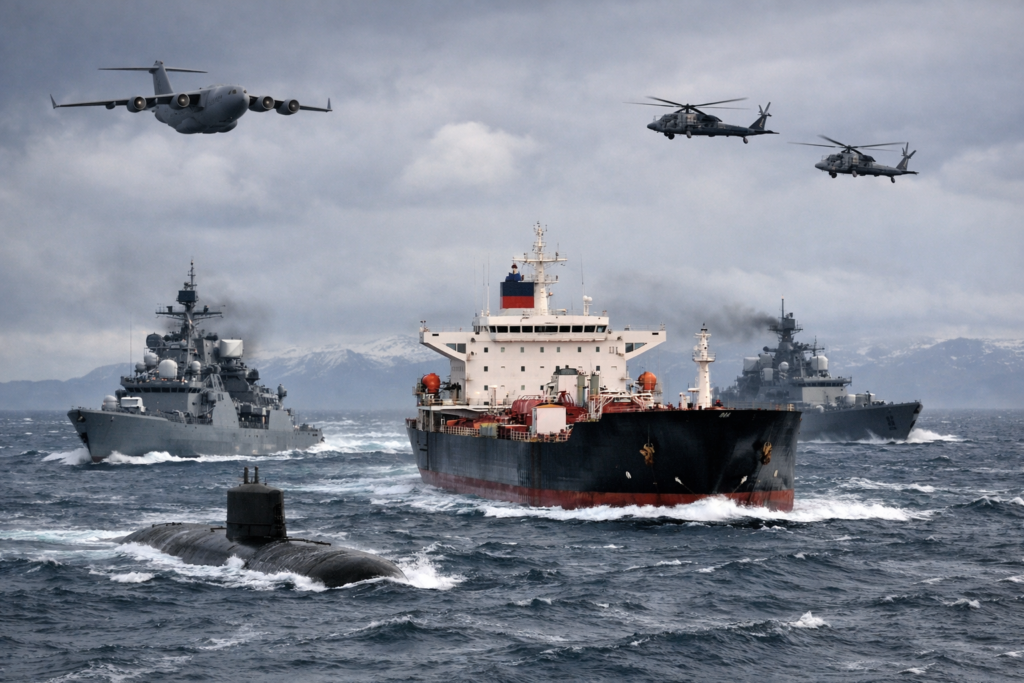
Image Credentials: Image Title: Russia Sends Warships to Escort Sanctioned Oil Tanker Pursued by U.S. Forces Source: (sora.openai) Date: January 2026. Attribution: This image was created using AI-generated imagery (sora.openai) and does not depict a real-world scene.
By Open Chronicle News Desk | January 7, 2026
Russia has deployed naval forces to shield an oil tanker pursued across the Atlantic by the United States, intensifying an already volatile confrontation over sanctions enforcement and global energy flows.
According to US officials, Moscow dispatched two naval vessels and a submarine to escort the Russian-flagged tanker Marinera, which is currently sailing through the North Atlantic between Iceland and Britain, heading northeast. The move comes as US forces prepare for a possible interdiction, having positioned at least ten special operations and transport aircraft at Royal Air Force bases in the United Kingdom, some believed to be carrying helicopters.
The tanker, formerly known as Bella 1, has been under US scrutiny for months over allegations that it violated American sanctions by transporting Iranian oil and attempting to collect sanctioned crude from Venezuela. In December, the US Coast Guard sought to execute a seizure warrant while the vessel was in the Caribbean. The tanker refused boarding, altered course, and returned to the Atlantic. US officials now say boarding plans remain active.
Footage verified by the BBC reportedly shows a US Coast Guard Legend-class cutter tracking the Marinera from a distance, underscoring the high level of monitoring. The ship’s final destination is believed to be either the Baltic Sea or the Russian port of Murmansk on the Barents Sea.
In a statement, the Russian Foreign Ministry said it was following developments with “concern” and accused the United States and its NATO allies of applying disproportionate pressure. Moscow insisted that the tanker is sailing in international waters under the Russian flag and in full compliance with international maritime law, describing the attention it is receiving as unjustified.
During its attempt to evade seizure, the vessel took a series of unusual steps. It painted a Russian flag on its hull, changed its name from Bella 1 to Marinera, and registered with a Russian shipping registry. These measures failed to deter the US pursuit. The New York Times reported that several other tankers operating on the Venezuela route have adopted similar tactics, switching flags to the Russian registry, a development that has further strained relations between Washington and Moscow following the US attack on Venezuela, which Russia has condemned.
Western officials suspect the Marinera and several comparable vessels of being part of Russia’s so-called shadow fleet, a network of ships used to transport Russian, Iranian, and Venezuelan oil in defiance of sanctions imposed by the United States, the European Union, and their partners. Registry records indicate that these ships, all sanctioned by Washington, have changed home ports to southern Russian cities such as Sochi and Taganrog while altering ownership and flag details.
The episode highlights the growing risk of confrontation at sea as sanctions enforcement increasingly collides with great power rivalry. With US forces signaling readiness to act and Russian naval units now physically interposed, the fate of the Marinera could test the limits of maritime law, sanctions regimes, and crisis management in contested international waters.