
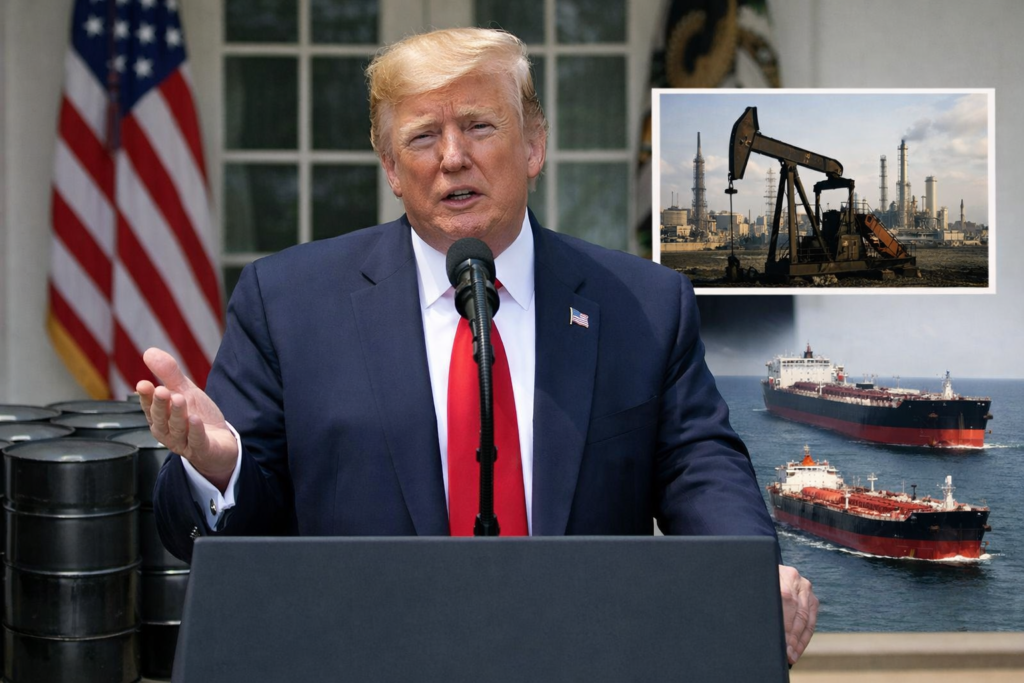
Image Credentials: Image Title: Trump Announces Venezuela to Transfer Up to 50 Million Barrels of Oil to U.S. After Maduro’s Capture Source: (sora.openai) Date: January 2026. Attribution: This image was created using AI-generated imagery (sora.openai) and does not depict a real-world scene.
By Open Chronicle News Desk | January 7, 2026
US President Donald Trump announced on Tuesday that interim authorities in Venezuela have agreed to transfer between 30 million and 50 million barrels of sanctioned Venezuelan oil to the United States, describing the move as one intended to benefit both Venezuelans and Americans.
In a statement published on his social media platform Truth Social, Trump said the oil, which he described as high quality, would be sold at market price. He added that the proceeds from the sales would be controlled by him as president to ensure the funds are used in ways that benefit the people of both countries. Trump said he has instructed Energy Secretary Chris Wright to execute the plan immediately, with the oil to be transported on storage ships directly to US unloading docks.
The announcement comes days after a major US military operation in Venezuela. US forces carried out airstrikes on targets in the northern parts of the country, including air defense and communications infrastructure, while special operations units conducted a raid in Caracas that resulted in the capture of President Nicolas Maduro and his wife, Cilia Flores. Both have since pleaded not guilty to drug and weapons-related charges during their initial court appearance in the United States.
Venezuela holds the world’s largest proven oil reserves, but years of mismanagement, corruption, underinvestment, and international sanctions have severely weakened its oil industry. Production has fallen sharply, and much of the country’s energy infrastructure is in poor condition. Trump framed the oil transfer as part of a broader effort to rebuild Venezuela’s economy while securing US influence over its vast energy resources.
The Trump administration has presented the operation as a revival of a hardline interpretation of the Monroe Doctrine, linking military intervention, economic pressure, and energy policy into a single strategy. Officials have argued that restricting Venezuela’s oil revenues while redirecting resources under US supervision is necessary to combat alleged narco trafficking networks and systemic corruption tied to the former government.
Financial markets reacted quickly to the announcement, with oil prices easing slightly amid expectations of additional supply entering the market. Analysts noted that while up to 50 million barrels is significant, it represents a relatively modest volume compared to global daily oil consumption, which exceeds 100 million barrels per day.
The plan has drawn mixed reactions internationally. Critics argue that the arrangement effectively leverages military force to gain control over natural resources, raising serious questions about international law and sovereignty. Supporters counter that the move could stabilize Venezuela’s collapsing economy and prevent further humanitarian deterioration, provided the funds are managed transparently.
Key details remain unclear, including how revenue from the oil sales will be allocated, how ownership of the oil will be legally defined, and what role US energy companies may play in the future reconstruction of Venezuela’s oil sector. As implementation begins, the oil transfer is set to become a central test of the Trump administration’s assertive foreign and energy policy approach toward Latin America.