
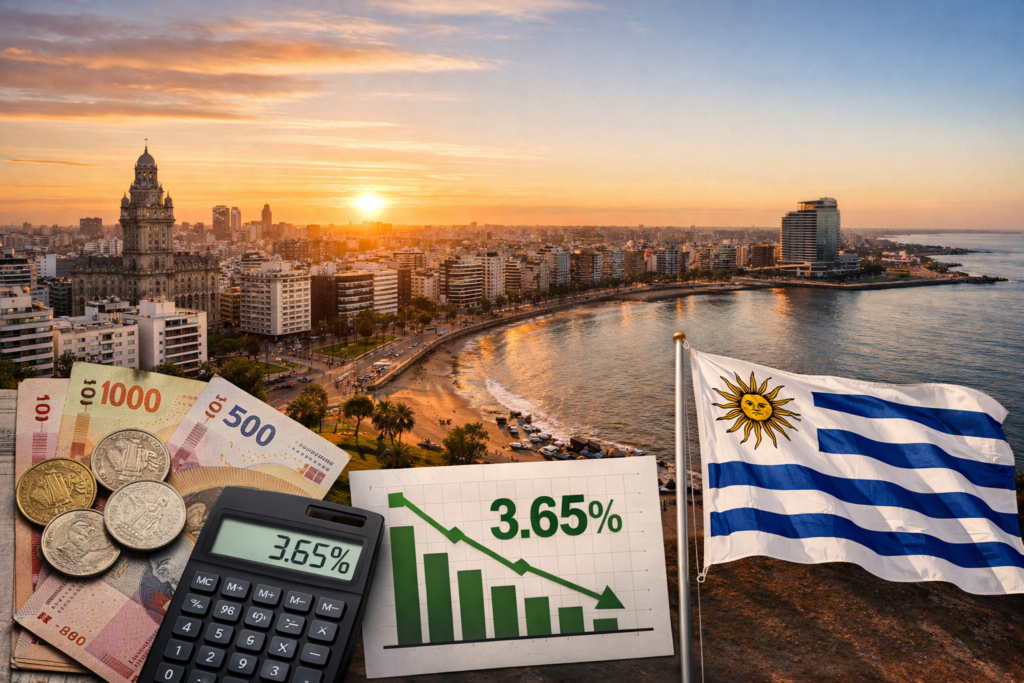
Image Credentials: Image Title: Uruguay Closes 2025 with Lowest Inflation Since 2001, Central Bank Signals Possible Rate Cuts Source: (sora.openai) Date: January 2026. Attribution: This image was created using AI-generated imagery (sora.openai) and does not depict a real-world scene.
By Open Chronicle News Desk | January 7, 2026
Uruguay has closed 2025 with one of the strongest inflation performances in its modern economic history, marking a turning point for a country that spent decades battling price instability. With consumer prices rising just 3.65 percent over the year, inflation ended well below the Central Bank of Uruguay’s 4.5 percent target and at its lowest year-end level since 2001.
The result was reinforced by a rare monthly decline in prices in December, when inflation fell by 0.09 percent. That outcome extended a remarkable streak of 31 consecutive months in which inflation remained inside the official tolerance band of 3 percent to 6 percent. For policymakers, this consistency signals a level of price stability that would have seemed improbable only a decade ago.
The moderation in prices was not limited to volatile items. Core inflation measures also remained subdued. One core gauge, which excludes fruits, vegetables, and fuels, rose just 0.04 percent in December and stood at 3.89 percent year over year. A broader core index increased 0.24 percent on the month and reached 3.66 percent annually. These figures suggest that underlying price pressures across the economy are firmly contained.
🇺🇾La INFLACIÓN CAYÓ🔻 en 2025 a 3,65% anual, informó INE Uruguay.
Es la MENOR INFLACIÓN anual DESDE 2001. Quedó casi un punto porcentual DEBAJO de la META del Banco Central.
✍️@NicolasLussich pic.twitter.com/oHuWfuTQoA— Buenas Noticias Uruguay (@BuenasUruguay) January 6, 2026
December’s headline decline was driven mainly by two major household categories. Food and non alcoholic beverages dropped 0.36 percent, with vegetable prices plunging 5.8 percent. Housing and utilities fell 1.44 percent, largely because electricity bills declined 4.9 percent after the state-owned utility applied its annual UTE Premia rebate. These factors outweighed increases in areas such as restaurants and accommodation, recreation, sport, and culture.
With inflation undershooting its target and economic growth slowing, the central bank moved to support activity. On December 23, it cut its policy interest rate by 50 basis points from 8 percent to 7.5 percent in a unanimous decision. The move signaled a shift in focus from restraining prices to preventing inflation from falling too far below target.
Central bank governor Guillermo Tolosa has warned that Uruguay now faces a new kind of risk. Rather than overheating, the danger is “missing from below,” as weaker demand, subdued expectations, and a relatively strong peso reinforce disinflationary forces. In this environment, too much restraint could hold back growth and push inflation below levels consistent with healthy economic activity.
Private sector forecasts suggest inflation will drift back toward the target over time. The median estimate among analysts puts inflation at 4.52 percent by the end of 2026 and 4.63 percent over a 24-month horizon. Officials have also indicated that further easing is possible next year, potentially taking interest rates below their neutral level if inflation and activity remain soft.
The official statistics agency released the figures on social media, with local media quickly amplifying the news. For Uruguay, the headline is no longer how to tame runaway prices, but how to preserve its hard-won price credibility while ensuring the economy does not stall. Balancing those two goals will define monetary policy in 2026 and beyond.