
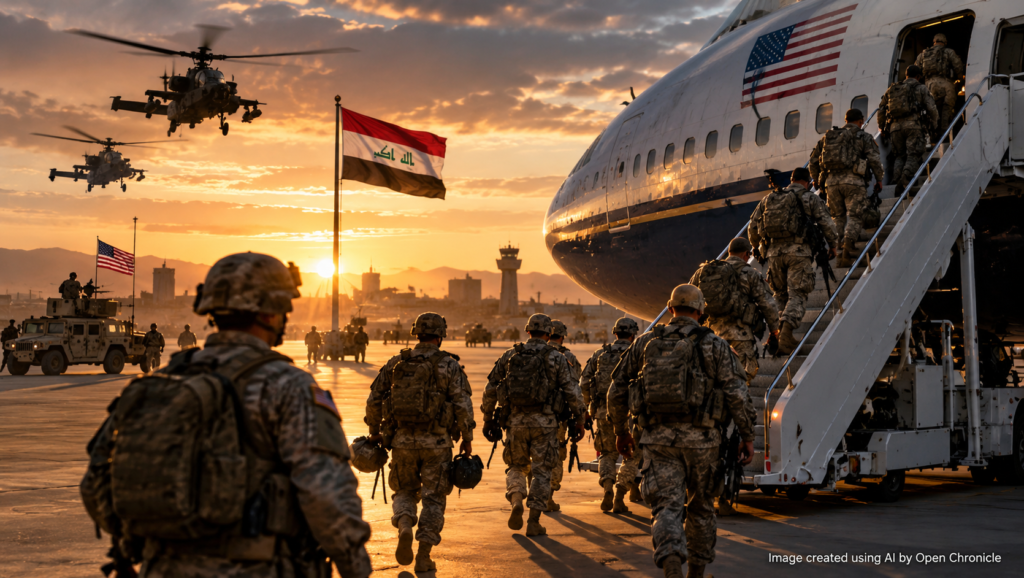
The United States has completed the withdrawal of its forces and equipment from Erbil Air Base, closing the Iraq chapter of Operation Inherent Resolve more than 12 years after the counter ISIS mission began. Iraqi forces will now assume primary responsibility for national security, while the US led task force moves its headquarters to Jordan and continues operations elsewhere in the region.
By Open Chronicle with agencies | September 30, 2026
WASHINGTON — The United States military has completed its withdrawal of forces and equipment from Erbil Air Base in northern Iraq, formally ending the Iraq based phase of the counter ISIS mission launched in 2014.
US Central Command announced Wednesday that the departure marked the completion of the transition agreed between Washington and Baghdad, transferring primary responsibility for Iraq’s security to Iraqi forces.
The broader campaign against ISIS is not ending.
Combined Joint Task Force Operation Inherent Resolve remains active, but its headquarters has relocated from Iraq to Jordan. American and coalition forces will also continue counter ISIS operations elsewhere in the region, including Syria.
Twelve years of Operation Inherent Resolve in Iraq
The American military returned to Iraq in 2014 after ISIS seized large areas of Iraqi territory and threatened the country’s political and security institutions.
Iraqi authorities sought international assistance, leading to the establishment of a US led coalition and Operation Inherent Resolve.
The campaign involved air operations, intelligence, surveillance, training and assistance to Iraqi forces as they fought to recover territory controlled by ISIS.
Erbil eventually became one of the principal centres of the coalition mission.
Its air base served as the main operational hub for Combined Joint Task Force Operation Inherent Resolve and hosted most of the approximately 1,500 American and coalition personnel supporting counter ISIS operations, according to CENTCOM.
The removal of the remaining personnel and equipment from Erbil on September 30 completed the withdrawal process.
CENTCOM says Iraqi forces can manage the threat
Admiral Brad Cooper, commander of US Central Command, praised the American military personnel, diplomats and civilians who participated in the mission.
“Job well done to the tens of thousands of American service members, diplomats, and civilian personnel who answered the call in Iraq,” Cooper said.
He argued that the security environment had changed substantially since the intervention began.
“Because of your grit, sacrifice and professionalism, ISIS no longer poses a systemic threat to Iraq’s national security and Iraqi security forces, including the Peshmerga and other Iraqi Kurdistan Region security forces, now possess the capacity, leadership, and operational independence to unilaterally manage threats to their homeland.”
The assessment represents the central justification for transferring primary security responsibility back to Baghdad.
Withdrawal began last year
American and coalition forces began withdrawing from federal Iraq in October 2025 as Washington and Baghdad moved away from the multinational counter ISIS framework toward a bilateral defence relationship.
Erbil remained an important coalition position during that transition.
Wednesday’s departure of the remaining forces and equipment completed the process.
The change does not mean the end of military cooperation between the United States and Iraq. Instead, the relationship is moving away from the structure established specifically to fight ISIS.
Iraqi security institutions will now take the lead in confronting remaining extremist networks operating inside the country.
Counter ISIS headquarters moves to Jordan
The regional counter ISIS campaign will continue from outside Iraq.
Combined Joint Task Force Operation Inherent Resolve has relocated its headquarters to Jordan, allowing the coalition to maintain a command structure for continuing operations.
US forces also remain involved in counter ISIS operations in Syria alongside coalition partners and the Syrian government.
The shift therefore represents a geographical and strategic reorganisation rather than the complete dismantling of the coalition’s counterterrorism capabilities.
“As we step back and hand full primary responsibility for Iraq’s security to the Government of Iraq and the brave people of Iraq, U.S. and coalition forces stationed across the region will remain ready to respond to any ISIS threats that arise,” Cooper said.
“Maintaining our vigilance and readiness is essential to protecting the U.S. homeland and strengthening regional security,” he added.
A military presence reestablished in 2014
The departure closes another chapter in a much longer history of American military involvement in Iraq.
US forces invaded Iraq in 2003 and overthrew Saddam Hussein’s government.
American combat forces subsequently remained in the country during years of insurgency and sectarian violence before withdrawing in 2011.
That withdrawal proved temporary.
Three years later, the rapid territorial expansion of ISIS brought American forces back to Iraq after Baghdad requested international assistance.
Operation Inherent Resolve subsequently became the framework through which the United States and its coalition partners supported Iraqi forces against the extremist organisation.
The September 30 departure therefore ends a continuous American military presence associated with that mission dating back to 2014.
ISIS remains a regional security concern
Although CENTCOM says ISIS no longer represents a systemic threat to Iraqi national security, the organisation has not disappeared.
The decision to maintain Operation Inherent Resolve from Jordan demonstrates that Washington still considers ISIS capable of presenting a regional security challenge.
American and coalition forces will retain the ability to respond if the organisation rebuilds operational capacity or attempts to exploit security gaps.
The continuation of operations in Syria is particularly significant because extremist networks have historically operated across the border between Iraq and Syria.
For Washington, the objective is now to maintain counterterrorism pressure without sustaining the same permanent military footprint inside Iraq.
Iran backed militias remain another challenge
The departure also comes as Baghdad confronts a separate security issue involving powerful armed groups linked to Iran.
The Iraqi government has sought to bring weapons controlled by non state groups under state authority.
Some influential militias, however, have resisted efforts to disarm.
Their presence has complicated Iraq’s security environment and its relationships with both Washington and Tehran.
The departure of American forces therefore occurs at a moment when Baghdad is assuming greater responsibility not only for containing ISIS but also for managing armed groups operating outside the conventional security establishment.
Kurdish officials concerned about air defence
The withdrawal has generated contrasting reactions within Iraq.
Iran aligned groups have welcomed the American departure, viewing the end of the coalition presence as a political and strategic victory.
Officials in the Kurdistan Region have expressed greater concern.
The American presence at Erbil provided capabilities that included protection against aerial threats, and Kurdish authorities have raised questions about the consequences of losing US air defence support amid continuing risks from drones and missiles.
Those concerns illustrate how differently the coalition presence was perceived across Iraq’s political and security landscape.
Iraq takes primary responsibility
The central strategic change is now clear.
For more than a decade, Operation Inherent Resolve provided an international military framework supporting Iraq’s fight against ISIS.
That framework inside Iraq has now ended.
Iraqi forces, including federal security institutions and forces in the Kurdistan Region, are expected to manage the remaining terrorist threat with substantially greater operational independence.
The United States, meanwhile, is shifting toward a regional posture in which forces stationed elsewhere can respond if ISIS again develops into a larger threat.
The relocation of the task force headquarters to Jordan preserves that capability while ending the permanent Iraq based structure established during the crisis of 2014.
For Washington and Baghdad, September 30 therefore marks both an ending and a transition.
The American military mission that returned to Iraq as ISIS swept across the country has concluded. The wider campaign against the organisation continues, but responsibility for defending Iraq itself now rests primarily with Iraqi forces.