
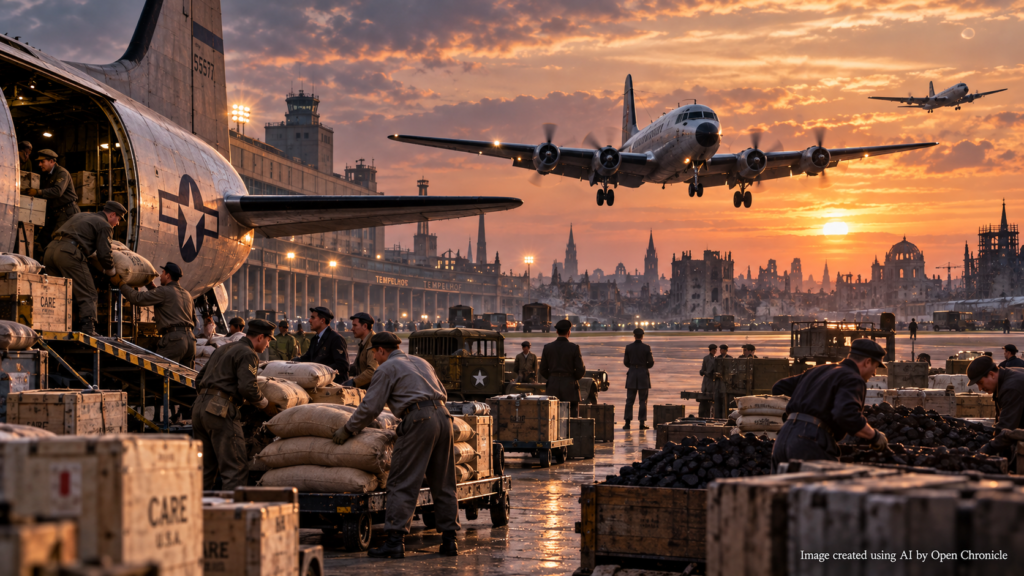
How an extraordinary fleet of transport aircraft kept West Berlin alive, defeated a blockade without firing a shot and turned a divided city into one of the first great battlegrounds of the Cold War
By Open Chronicle History Desk
On September 30, 1949, aircraft completed the final official missions of one of the most remarkable logistical operations in modern history.
For fifteen months, the skies above Germany had become an aerial highway.
American C-54 Skymasters.
British Dakotas and Avro Yorks.
Civilian transports.
Cargo aircraft carrying flour, coal, medicine, fuel and machinery.
Day and night, in rain, fog, snow and darkness, they had flown through narrow air corridors toward a city surrounded by Soviet-controlled territory.
Their destination was West Berlin.
The Soviet blockade of the western sectors of the city had already been lifted on May 12, 1949.
But the aircraft kept flying.
The Western Allies wanted Berlin supplied with substantial reserves in case the blockade returned.
Only on September 30 did the American-led airlift formally end. British operations wound down on a slightly different timetable, with RAF historical records noting that Operation Plainfare continued into early October.
What had begun as an improvised response to an international crisis had become something much larger.
It demonstrated that an entire modern city could be sustained from the air.
It transformed military transport aviation.
It hardened the division of Europe.
And it helped define the confrontation that would dominate international affairs for the next four decades:
the Cold War.
1. Berlin After Hitler
When Nazi Germany surrendered in May 1945, much of Berlin lay in ruins.
The victorious Allied powers divided Germany into occupation zones controlled by the United States, Britain, France and the Soviet Union.
Berlin presented an unusual geographical problem.
The former German capital was located deep inside the Soviet occupation zone.
Yet Berlin itself was also divided.
The United States controlled one sector.
Britain another.
France another.
The Soviet Union controlled the eastern sector.
The arrangement had been created when the Allies were still partners in the war against Nazi Germany.
But the alliance did not survive victory.
Almost immediately, profound disagreements emerged over Germany’s political and economic future.
2. From Allies to Rivals
The wartime alliance had always contained deep ideological tensions.
The United States and Britain represented liberal capitalist democracies.
The Soviet Union was a communist one-party state under Joseph Stalin.
While Adolf Hitler remained the common enemy, those differences could temporarily be subordinated.
After 1945, they became impossible to ignore.
Soviet influence expanded across Eastern Europe.
Communist governments emerged throughout much of the region.
Western governments increasingly feared that Moscow intended to extend its influence farther west.
The Soviet leadership, meanwhile, viewed Western economic and political initiatives in Germany as potential threats to Soviet security and interests.
Germany became one of the central arenas of this confrontation.
Berlin became its most dangerous pressure point.
3. A City Inside the Soviet Zone
The geographical position of West Berlin made it extraordinarily vulnerable.
The western sectors contained roughly two million inhabitants, yet they were surrounded by territory controlled by the Soviet Union.
Almost everything a modern city required had to arrive from outside.
Food.
Coal.
Fuel.
Medicine.
Industrial materials.
Raw materials.
Mail.
Machinery.
Transport links therefore represented political power.
The Western Allies possessed agreed air corridors into Berlin, but surface access by road and rail depended upon continuing cooperation with Soviet authorities. U.S. Air Force historical accounts emphasize this crucial distinction.
If those roads and railways were closed, West Berlin could be isolated.
In 1948, that is exactly what happened.
4. The Currency Crisis
Germany’s economy remained severely disrupted after the war.
Inflation, shortages and black markets complicated reconstruction.
The Western powers increasingly concluded that economic recovery required currency reform.
In June 1948, they introduced the Deutsche Mark into their occupation zones.
The Soviet Union strongly opposed the move.
The disagreement was about more than banknotes.
Currency reform represented another step toward the economic integration of western Germany.
To Moscow, it appeared to threaten Soviet influence over Germany’s future.
Berlin once again became the place where competing visions collided.
5. June 24, 1948: The Blockade Begins
On June 24, 1948, Soviet authorities imposed a comprehensive blockade of the western sectors of Berlin.
Road traffic was restricted.
Rail traffic stopped.
Water routes were obstructed.
Electricity supplies were affected.
The intention was to exert enormous pressure upon the Western Allies.
They now faced a strategic dilemma.
They could abandon West Berlin.
They could attempt to force their way through the Soviet blockade on the ground.
Or they could find another way to supply the city.
The second option risked armed confrontation between former wartime allies.
In a Europe still recovering from the devastation of the Second World War, that possibility was terrifying.
The remaining alternative seemed almost impossible.
Supply Berlin entirely by air.
6. Could a City Be Supplied From the Sky?
Aircraft had supplied isolated military forces before.
But West Berlin was not an isolated battalion.
It was a vast urban population.
Millions of people required enormous quantities of food and fuel every day.
Coal presented an especially difficult challenge.
Berlin needed it for heating, industry and electricity generation.
Coal was heavy.
Bulky.
Dirty.
And now it would have to be transported aboard aircraft.
The operation would have to continue regardless of weather.
Summer storms.
Autumn rain.
Winter fog.
Snow.
Ice.
Aircraft would have to land at intervals measured in minutes.
Nothing comparable had previously been attempted on such a sustained scale.
7. June 26, 1948: The Airlift Begins
The American airlift began on June 26, 1948.
U.S. Air Force historical records state that C-47 transports made 32 flights into Berlin carrying about 80 tons of cargo during the initial operation.
The American operation became known as:
Operation Vittles.
The British effort became:
Operation Plainfare.
What initially looked like an emergency improvisation rapidly developed into an enormous multinational logistical system.
More aircraft arrived.
More crews arrived.
Airfields expanded.
Maintenance systems grew.
Cargo handling became increasingly efficient.
The skies over Germany began to resemble an airborne conveyor belt.
8. The Aircraft of the Airlift
Several aircraft types became associated with the operation.
The American Douglas C-47 Skytrain participated in the early stages.
But the larger Douglas C-54 Skymaster became particularly important because it could carry substantially greater loads.
British forces employed aircraft including:
the Dakota,
the Avro York,
and other military and civilian transports.
The RAF also used Sunderland flying boats during parts of the operation.
Different aircraft carried different cargoes.
Food.
Coal.
Salt.
Medicine.
Industrial materials.
Even entire pieces of equipment required for Berlin’s infrastructure.
The aircraft were no longer merely transports.
They had become the city’s lifeline.
9. Tempelhof, Gatow and Tegel
Three Berlin airfields became central to the operation.
Tempelhof served the American sector.
Gatow served the British sector.
And Tegel was constructed in the French sector during the crisis.
Aircraft arrived almost continuously.
Cargo had to be unloaded immediately.
The aircraft then departed so another could land.
Every unnecessary minute on the ground reduced the efficiency of the entire system.
Berliners themselves played an essential role in unloading aircraft and maintaining the infrastructure supporting the airlift.
The operation therefore depended not only upon pilots.
It depended upon mechanics, controllers, engineers, loaders, meteorologists, administrators and thousands of civilians.
10. William H. Tunner
One of the most important figures in transforming the airlift into a highly organized operation was Major General William H. Tunner.
Tunner had extensive experience with large-scale air transport operations during the Second World War.
He introduced strict scheduling and procedural discipline.
Aircraft entered corridors at predetermined times and altitudes.
Different types were grouped according to performance.
Landing sequences were tightly controlled.
If an aircraft missed its approach, it generally returned to its home base rather than circling and disrupting the traffic stream.
The result was an increasingly efficient system.
U.S. Air Force history records that aircraft sometimes landed only about three minutes apart.
The airlift was becoming an industrial production line in the sky.
11. The Three Air Corridors
The entire operation depended upon three narrow air corridors connecting western Germany with Berlin.
Aircraft flew through Soviet-controlled territory along these routes.
Air traffic therefore had to be precisely organized.
Aircraft entered at assigned altitudes.
Controllers monitored their progress.
Radar systems helped guide aircraft during poor weather.
Thousands of flights had to share limited airspace without producing catastrophic congestion.
The techniques refined during the Berlin Airlift became important milestones in the development of large-scale military air transport and air traffic management.
12. Winter
Summer had been difficult.
Winter threatened disaster.
Berlin winters could bring:
fog,
snow,
ice,
low cloud,
and freezing temperatures.
Aircraft still had to fly.
Coal consumption increased precisely when flying conditions became most dangerous.
Runways became slippery.
Aircraft required de-icing.
Navigation became harder.
Crews flew repeated missions in exhausting conditions.
Maintenance personnel worked around the clock.
The airlift survived.
That fact was strategically crucial.
If the Western Allies could sustain Berlin through winter, Soviet hopes that logistical impossibility would force them to withdraw became increasingly unrealistic.
13. Coal From the Sky
Few images better illustrate the extraordinary nature of the airlift than sacks of coal being loaded into aircraft.
Coal normally travelled by train, barge or ship.
Now it was flying.
Tons of it.
Aircraft interiors became coated with black coal dust.
Loading and unloading were physically demanding.
The cargo was inefficient compared with compact high-value goods.
But without coal, Berlin could not survive the winter.
The airlift therefore became not merely a food supply operation.
It became an airborne energy network.
14. The Candy Bomber
The airlift also produced one of the most famous human stories of the early Cold War.
American pilot Gail Halvorsen began dropping small packages of sweets to Berlin children using miniature parachutes.
Other pilots joined the effort.
Halvorsen became known as the:
Candy Bomber
or
Uncle Wiggly Wings.
The gesture had little effect on the immense tonnage requirements of the city.
Its symbolic effect was much greater.
Children who only a few years earlier had lived under Nazi rule now watched American aircraft arrive not with bombs, but with food and sweets.
The contrast became a powerful image of the changing relationship between Germans and the Western Allies.
15. The Easter Parade
By spring 1949, the airlift had become extraordinarily efficient.
On April 16–17, 1949, the Allies staged what became known as the Easter Parade.
The objective was to demonstrate the enormous carrying capacity the system had achieved.
U.S. Air Force history records that approximately 13,000 tons of cargo were delivered during the operation’s record-setting day.
The message was difficult to misunderstand.
The blockade was not forcing the Western Allies out of Berlin.
The logistical battle was being won.
16. The Soviet Union Reconsiders
By spring 1949, the blockade had failed to achieve its principal objective.
West Berlin had not been abandoned.
The Western Allies had not withdrawn.
Instead, the airlift had become increasingly effective.
Meanwhile, the blockade was damaging Soviet international standing.
Negotiations began.
On May 5, 1949, an agreement was reached to end the blockade.
At one minute after midnight on May 12, surface access to West Berlin reopened.
Trains moved again.
Road traffic resumed.
The blockade was over.
But the airlift was not.
17. Why the Aircraft Kept Flying
Ending the operation immediately would have been risky.
What if the blockade returned?
The Western Allies therefore continued flying supplies into Berlin.
Food reserves accumulated.
Coal reserves grew.
Fuel stocks increased.
The objective was to create a substantial buffer that would allow West Berlin to withstand another interruption of surface transport.
U.S. Air Force historical records explicitly state that the airlift continued until September 30 to build reserves of food, fuel and other supplies in case the blockade was reimposed.
For more than four months after the blockade ended, aircraft continued arriving.
18. September 30, 1949: The Final Official Flights
Finally, on September 30, 1949, the American-led Berlin Airlift officially concluded.
The operation had lasted more than fifteen months.
Between June 26, 1948 and September 30, 1949, Allied aircraft transported more than 2.3 million tons of cargo into Berlin. U.S. Air Force records attribute approximately three quarters of that tonnage to American aircraft and record more than 189,000 American flights alone.
British participation was also enormous.
RAF aircraft and British civilian operators transported food, coal and other supplies throughout the crisis, forming an essential component of the combined operation.
The last aircraft did not merely close a transport operation.
They marked the end of one of the first great confrontations of the Cold War.
19. The Human Cost
The Berlin Airlift was peaceful in the sense that the Western Allies and Soviet Union did not directly fight one another.
But it was not without casualties.
Aircraft crashed.
Pilots died.
Crew members were killed.
Ground personnel also lost their lives.
Weather, fatigue, mechanical failure and the relentless tempo of operations created constant danger.
The U.S. Air Force historical account records the deaths of 30 American servicemen and one American civilian in twelve crashes during the operation. AF History
British and German participants also died.
Their deaths are commemorated in Berlin.
The airlift succeeded, but the success had a human price.
20. Berliners
The story cannot be reduced to aircraft and Allied strategy.
West Berliners themselves endured months of severe hardship.
Electricity was rationed.
Food remained limited.
Heating was difficult.
Daily life was dominated by shortages and uncertainty.
The possibility that the Western powers might eventually abandon the city could never be completely dismissed.
Yet the population remained.
Berliners unloaded aircraft, repaired infrastructure and supported the operation.
RAF historical analysis emphasizes that the determination of Berlin’s inhabitants was itself indispensable to the airlift’s success.
Without them, the aircraft alone could not have saved the city.
21. From Former Enemies to Allies
Perhaps one of the most remarkable transformations occurred psychologically.
Only three years earlier, American and British aircraft had bombed German cities.
Now American and British aircraft were keeping part of Germany’s former capital alive.
The political geography of Europe had changed with extraordinary speed.
The principal confrontation was no longer Germany against the Allied powers.
It was increasingly:
East versus West.
West Germany would become integrated into the Western political and economic system.
East Germany would emerge within the Soviet sphere.
Berlin would remain divided between those worlds.
22. Two German States
The crisis accelerated the political division of Germany.
In May 1949, the western occupation zones became the Federal Republic of Germany, commonly known as West Germany.
In October, the Soviet occupation zone became the German Democratic Republic, or East Germany.
The division that had begun as an occupation arrangement was becoming institutionalized.
Germany was now divided.
Berlin was divided.
Europe was divided.
The Cold War map was taking shape.
23. NATO
The Berlin crisis also contributed to Western security cooperation.
In April 1949, while the blockade was still underway, the North Atlantic Treaty was signed.
The resulting North Atlantic Treaty Organization created a formal collective defense alliance linking the United States, Canada and Western European states.
The Berlin crisis was not the sole cause of NATO.
But it provided dramatic evidence of the strategic confrontation already emerging in Europe.
The postwar settlement was becoming a long-term geopolitical order.
24. The First Great Cold War Crisis
The Berlin Blockade is frequently described as one of the first major crises of the Cold War.
That description captures something fundamental.
Two opposing power systems confronted each other directly.
Neither wanted to retreat.
Neither wanted a new world war.
The solution was therefore extraordinary.
Instead of breaking the blockade with tanks, the Western Allies flew over it.
Instead of escalating immediately to military confrontation, they turned logistics into strategy.
Transport aircraft became instruments of geopolitical power.
25. Logistics as Strategy
The Berlin Airlift demonstrated something military planners would never forget:
logistics can determine political outcomes.
Aircraft were traditionally associated with reconnaissance, bombing and combat.
Berlin demonstrated another form of air power.
Transport.
Sustainment.
Mobility.
Infrastructure.
Organization.
The ability to move enormous quantities of material rapidly could itself influence international politics.
Modern strategic airlift owes part of its institutional development to lessons learned over Berlin.
26. A City Beneath an Endless Stream of Aircraft
For Berliners, the sound became constant.
Engines overhead.
Aircraft approaching.
Aircraft landing.
Aircraft departing.
Another aircraft behind them.
And another.
And another.
The sky itself had become part of the city’s infrastructure.
Every aircraft represented something tangible.
Flour.
Coal.
Milk.
Medicine.
Fuel.
Hope.
For fifteen months, survival arrived from above.
27. Berlin Was Not Finished
The crisis ended.
The division did not.
Berlin would remain one of the most dangerous points on the Cold War map.
In 1961, East German authorities constructed the Berlin Wall.
Families were divided.
Streets were severed.
Subway routes were disrupted.
Checkpoint Charlie became internationally famous.
American and Soviet tanks would face each other across the city.
Berlin remained divided until 1989.
Then another extraordinary moment arrived.
The Wall opened.
The Cold War order that had seemed permanent began collapsing.
Germany reunified in 1990.
28. From Airlift to Reunification
The history connecting 1948 and 1989 is one of the central narratives of postwar Europe.
The Berlin Airlift.
The creation of two German states.
NATO and the Warsaw Pact.
The Berlin Wall.
Checkpoint Charlie.
Decades of division.
The peaceful revolutions of 1989.
The fall of the Wall.
German reunification.
Seen from that perspective, the airlift was not an isolated episode.
It was one of the opening chapters of a forty-year struggle over Europe’s political future.
29. Why September 30 Matters
September 30, 1949 deserves to be remembered because it marked the conclusion of an experiment many observers initially considered impossible.
Could millions of people be sustained almost entirely from the air?
The answer had been demonstrated above Berlin.
But the significance extended far beyond logistics.
The airlift showed how military technology could be used for sustainment rather than destruction.
It demonstrated Western determination to remain in Berlin.
It revealed the growing geopolitical division of Europe.
It transformed relations between West Germans and the Western Allies.
And it helped establish Berlin as the symbolic front line of the Cold War.
September 30, 1949: When the Sky Kept Berlin Alive
Imagine Berlin on the final day.
A city still scarred by war.
Ruined buildings remained visible.
Families were rebuilding their lives.
Germany itself was being divided into rival political systems.
Above the city, transport aircraft continued to arrive.
For fifteen months, those aircraft had carried the essentials of urban survival through narrow corridors across Soviet-controlled territory.
They had flown through darkness.
Fog.
Snow.
Ice.
Mechanical failures.
Exhaustion.
They carried flour and medicine.
But above all, they carried coal.
An entire modern city had been sustained by an airborne logistics network operating with a precision previously unimaginable.
On September 30, 1949, the official American-led operation finally ended.
The blockade had failed months earlier.
Berlin remained divided, but West Berlin remained connected to the West.
The aircraft stopped arriving with the relentless frequency of the previous fifteen months.
The Cold War, however, was only beginning.
For another forty years, Berlin would stand at the center of the confrontation.
And the sound of those transport aircraft would remain part of the city’s historical memory.
The Berlin Airlift had demonstrated that sometimes one of the most consequential victories in a geopolitical confrontation could be achieved not by dropping bombs, but by delivering bread, medicine and coal.
Historical Sources and Further Reading
For this article, I would build our usual four-card block around the U.S. Air Force Historical Support Division, Royal Air Force, National Museum of the United States Air Force, and a specialist RAF historical study. The USAF source is particularly useful because it provides the chronology, cargo totals, American flight statistics, Tunner’s operational system and the reason flights continued until September 30. AF History
U.S. Air Force Historical Support Division: The Berlin Airlift