
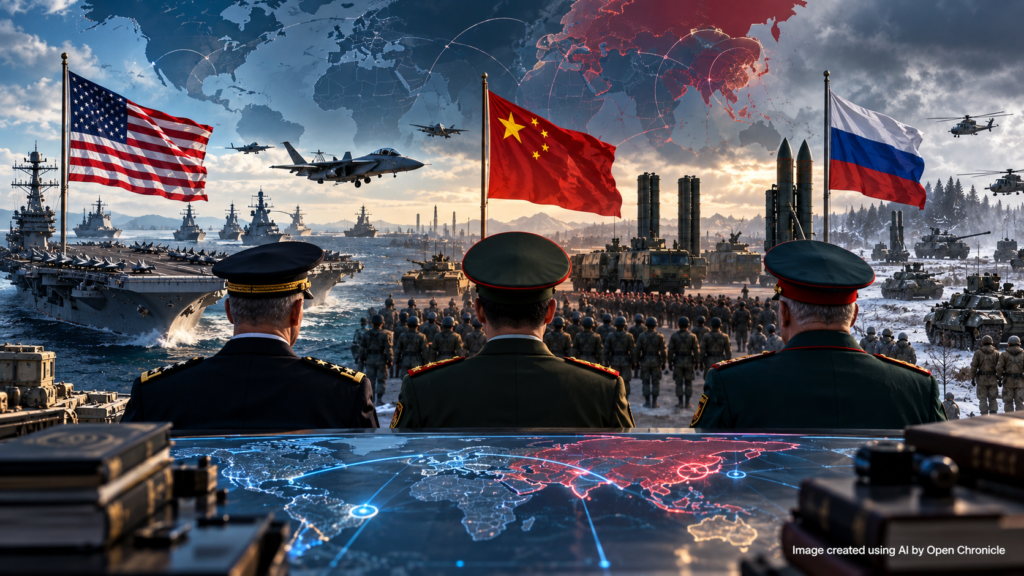
Pete Hegseth wants to cut roughly one fifth of America’s general and flag officer positions. The number sounds enormous. But comparing the Pentagon with the Chinese and Russian militaries reveals a more complicated question: how many senior commanders does a global military actually need?
By The Grand Strategy Institute Research Division
Grand Strategy Analysis | 30 September 2026
Approximately eight hundred generals and admirals.
For an institution built around the idea that commanders should command and soldiers should fight, the number immediately sounds enormous.
It has now become a target.
US Defense Secretary Pete Hegseth is preparing a major reduction in the number of senior military leadership positions, expanding an earlier reform effort into a plan aimed at cutting approximately 20 percent of general and flag officer billets by the beginning of 2027. The Pentagon presents the initiative as an effort to eliminate unnecessary bureaucracy, flatten command structures and return resources and authority toward operational formations. Critics have raised questions about whether the reductions could remove experience and institutional capacity during a period of unusually intense global military commitments.
But the argument raises a larger strategic question.
Does the United States actually have too many generals?
The obvious way to answer would appear to be comparison.
Count America’s generals.
Count China’s.
Count Russia’s.
Compare the numbers.
The problem is that such a calculation would produce a misleading result.
The three countries organise military authority differently. They publish radically different amounts of information. Their senior command systems perform different functions. Their armed forces operate across different geographical scales.
And in China’s case, even the relationship between military rank and institutional authority works differently from the American model.
The question is therefore not simply how many generals each country has.
The more important question is:
How much senior command structure does each military maintain, and what is that structure designed to do?
The American Number Is Large
The United States begins with an advantage for researchers: transparency.
American law explicitly limits the number of active duty general and flag officers assigned against service specific ceilings.
Under the current provisions of Title 10, the limits are:
US Army: 219
US Navy: 150
US Air Force: 168
US Marine Corps: 64
US Space Force: 24
Together, those service ceilings total 625 positions.
But that is not the entire structure.
The Secretary of Defense may designate up to 232 additional general and flag officer positions associated with joint duty requirements for exclusion from those service specific limits. There are also particular statutory exclusions and personnel circumstances that complicate any attempt to convert the legal ceilings into a simple headcount. Código dos Estados Unidos
This explains why contemporary descriptions of the American senior officer corps commonly produce a total around the eight hundred mark rather than simply adding the five service ceilings.
Hegseth’s proposed reduction is therefore substantial.
It is also part of a longer American debate.
America Has Been Cutting Generals Before
The current controversy can create the impression that America’s senior officer structure has only recently become unusually large.
The historical picture is more complicated.
In 2008, statutory service specific ceilings permitted 302 Army generals, 216 Navy admirals, 279 Air Force generals and 80 Marine Corps generals.
Those ceilings were considerably higher than today’s limits.
The structure has subsequently changed repeatedly as Congress and the Pentagon adjusted senior leadership authorisations and expanded the joint command system.
That matters because the present reform is not occurring against an institution that has never previously reduced its senior hierarchy.
The Pentagon has been wrestling with the problem for decades.
Why?
Because modern joint warfare creates an organisational paradox.
Military reformers want fewer layers of command.
Modern warfare keeps creating new things that require commanders.
Why Does America Need So Many Generals?
The United States does not maintain a military designed solely to defend the continental United States.
It maintains a military designed to operate globally.
That distinction changes everything.
American senior officers command the Army, Navy, Air Force, Marine Corps and Space Force.
Others serve on the Joint Staff.
Others lead geographic combatant commands.
Others lead functional commands.
There are commanders responsible for Europe.
The Indo-Pacific.
The Middle East.
Africa.
Latin America.
North America.
Special operations.
Cyber operations.
Strategic nuclear forces.
Space operations.
Transportation.
Global logistics.
Then come component commands beneath them.
Army components.
Naval components.
Air components.
Special operations components.
Major formations.
Training commands.
Acquisition organisations.
Military education.
Alliance positions.
NATO creates additional multinational command requirements.
So do American forces permanently or rotationally deployed overseas.
The senior structure is therefore partly a consequence of the architecture of American military power itself.
A globally distributed military creates a globally distributed command system.
That does not prove every position is necessary.
But it makes the raw number considerably less informative.
One General for Roughly 1,600 Personnel
The Pentagon’s FY2026 budget request provides an active component end strength of approximately 1.303 million personnel across the five military services.
If the universe of general and flag officers is approximated at around 800, that produces roughly one senior officer for every 1,600 active personnel.
At first sight, that ratio appears top heavy.
But even this calculation has limitations.
Generals do not exist simply to supervise groups of individual soldiers.
They command organisations.
A four star combatant commander may oversee operations involving personnel from every military service, reserve forces, civilians, contractors, intelligence agencies, foreign partners and allied militaries.
A senior officer assigned to NATO may exercise authority within a multinational structure that cannot be measured using American troop numbers alone.
A general overseeing acquisition may influence programmes worth tens of billions of dollars without commanding a large formation.
A Space Force general may supervise strategically critical capabilities with relatively few personnel.
Therefore:
personnel per general is an interesting indicator, but not a measure of command efficiency.
Then Comes China
China makes the comparison much more difficult.
The People’s Liberation Army has roughly two million active personnel, giving Beijing a substantially larger active force than Washington.
A superficial comparison might therefore assume that China should have proportionally more generals.
But the PLA does not organise senior authority in the same way.
One of the most important differences concerns the relationship between rank and grade.
In the Chinese system, institutional grade can be more important for understanding authority than military rank alone.
The grade corresponds closely to the organisational level at which an officer serves.
That means counting officers wearing a particular number of stars does not necessarily reveal the actual shape of the leadership hierarchy.
Researchers examining the PLA therefore often analyse positions rather than simply ranks.
And this produces a fascinating result.
The 176 Positions
Research published in 2026 by M. Taylor Fravel and the CSIS China Power team identified approximately 176 billets in the senior PLA leadership architecture.
These consisted of:
6 Central Military Commission positions
25 theater command leader positions
145 theater command deputy leader positions
But this number requires a major warning.
China does not have only 176 generals.
The figure represents a defined group of senior leadership positions at particular institutional grades. It is not a comprehensive count of every Chinese general officer.
Comparing:
United States: approximately 800 generals and admirals
with
China: 176
would therefore be methodologically wrong.
They measure different things.
Yet the 176 positions tell us something extremely useful.
They reveal the architecture of China’s highest military command.
Five Theater Commands
China reorganised the PLA around five geographic Theater Commands:
Eastern Theater Command
Southern Theater Command
Western Theater Command
Northern Theater Command
Central Theater Command
Their purpose is to strengthen joint operations and organise forces around major strategic directions.
The Eastern Theater Command is particularly important for contingencies involving Taiwan and the East China Sea.
The Western Theater Command covers an enormous area facing India and Central Asia.
The Southern Theater Command focuses partly on the South China Sea and Southeast Asian approaches.
This resembles the American combatant command concept in one important respect: both systems recognise that modern military operations require joint command above the individual services.
But the institutional structures are not identical.
And China introduces something largely absent from the American system.
Two Leaders Where America Often Has One
The PLA is the armed wing of the Chinese Communist Party.
Political control is therefore embedded directly into its command architecture.
Major PLA organisations generally contain both a military commander and a political commissar.
The commissar is not merely a communications adviser or political liaison.
Political commissars occupy positions of substantial institutional authority and are central to ensuring Party control, political discipline and ideological reliability.
This means a command architecture that looks redundant through an American organisational lens may perform a fundamentally different function in China.
One hierarchy is responsible for military command.
Another dimension ensures political control.
The two overlap.
This is one reason a simple comparison of generals produces poor analysis.
China is not merely organising forces.
It is institutionalising Party control throughout the military hierarchy.
Xi Jinping Has Created Another Complication
China’s current senior leadership is not operating under normal conditions.
Xi Jinping has overseen an extraordinary series of investigations, removals and disappearances involving senior PLA officers.
The scale accelerated dramatically in 2025 and 2026.
In January 2026, China’s Ministry of National Defense announced investigations into Zhang Youxia, one of China’s most powerful generals, and Liu Zhenli, chief of the Joint Staff Department.
Their removal followed earlier upheaval involving senior military leaders.
By February, the consequences at the very top were extraordinary.
Of the six generals appointed to the Central Military Commission in 2022, only one remained.
The PLA’s highest military decision making body had effectively lost most of the senior uniformed leadership appointed only several years earlier. CSIS
But the disruption extends much deeper.
Half of the Senior Architecture Has Been Touched
The CSIS dataset examined the effect across those approximately 176 senior PLA leadership positions.
Researchers identified more than one hundred senior officers who had been purged or potentially purged since 2022.
After adjusting for positions affected more than once, approximately 52 percent of the senior leadership billets had been touched by the upheaval.
Among 47 PLA leaders who were generals in 2022 or subsequently promoted to three star positions, 41 had been purged or potentially purged by the time of the analysis.
CSIS also found that only 11 of 52 particularly important leadership positions it examined were filled as of 20 February 2026.
These numbers require careful interpretation.
They do not demonstrate that the PLA has ceased functioning.
Nor do they establish precisely how the upheaval would affect Chinese performance in a future war.
They do demonstrate an extraordinary level of turnover at the top of the institution.
Hegseth and Xi Are Doing Very Different Things
This creates an interesting comparison with Washington.
Both American and Chinese senior military structures are undergoing significant change.
But the similarity largely ends there.
Hegseth’s initiative is presented as an organisational reform.
Its stated purpose is to reduce billets, remove bureaucratic layers and flatten the hierarchy.
China’s transformation involves disciplinary investigations, political control, corruption allegations, institutional reorganisation and Xi Jinping’s relationship with the military leadership.
The processes should not be treated as equivalents.
One concerns how many senior positions the Pentagon believes it needs.
The other concerns who Xi Jinping trusts to occupy China’s most important military positions, as well as broader questions of corruption, loyalty and organisational performance.
Yet both produce a common strategic question.
How much disruption can a military impose on its own senior leadership before reform begins to affect command effectiveness?
That question cannot yet be answered confidently for either system.
Russia Is the Hardest Comparison
Russia creates an entirely different methodological problem.
The country maintains a large military establishment, substantially expanded during the war against Ukraine.
President Vladimir Putin has authorised a force structure including approximately 1.51 million active service personnel within an overall establishment exceeding 2.39 million people.
That gives Russia an authorised active military larger than America’s active component, though authorised strength should not automatically be treated as identical to actual filled strength.
But a reliable, current, comprehensive public count of Russian generals and admirals is much harder to establish.
The war has made the problem worse.
Senior Russian officers have been:
Promoted.
Reassigned.
Removed.
Retired.
Killed.
Replaced.
Placed under investigation.
Transferred between commands.
At the same time, the Russian military itself has undergone substantial command reorganisation.
Any confident statement that Russia currently has precisely a particular number of generals would therefore require evidence stronger than the available consolidated open source record provides.
For this analysis, the appropriate entry is:
Current Russian general and flag officer total: no sufficiently reliable consolidated public figure identified.
That is not a weakness in the analysis.
It is an important finding about transparency.
Russia Has Changed the Structure Beneath the Generals
What can be analysed more confidently is the command architecture.
Russia currently operates five military districts:
Leningrad
Moscow
Southern
Central
Eastern
But even this apparently straightforward structure has changed because of the Ukraine war.
Research on the Russian military indicates that reforms formalised in 2025 moved the military districts toward a more administrative and force generation role while operational headquarters based around groups of forces assumed greater responsibility for wartime operations.
The arrangement reflects lessons from the Ukraine campaign and, in some respects, a return toward older Soviet concepts separating territorial force generation from operational wartime command.
This is strategically significant.
Russia is not simply expanding its army.
It is adapting the machinery through which a very large continental war is commanded.
Three Militaries, Three Different Problems
The comparison therefore begins to look very different from a league table.
The United States has a span problem
Its military responsibilities extend across the globe.
The Pentagon must command forces operating simultaneously across multiple continents and domains while integrating allies, nuclear forces, cyber operations, space capabilities and global logistics.
Its large senior officer corps partly reflects that extraordinary span.
China has a control problem
The PLA is simultaneously becoming more technologically sophisticated and more joint while remaining firmly subordinate to the Chinese Communist Party.
Its command architecture must therefore deliver both military effectiveness and political reliability.
The current purges expose the tension between those objectives.
Russia has a wartime adaptation problem
Moscow is restructuring a military fighting Europe’s largest interstate war in generations while simultaneously expanding personnel and rebuilding formations.
Its senior command structure is consequently being shaped by actual wartime requirements rather than peacetime organisational theory.
These are not equivalent military systems.
They should not be measured as though they were.
The Comparison That Can Be Made
A responsible comparison in September 2026 therefore looks like this:
| United States | China | Russia | |
|---|---|---|---|
| Active force reference | ~1.30 million FY2026 requested end strength | ~2 million | 1.51 million authorised |
| Senior system | General and flag officer ranks plus joint billets | Rank plus institutional grade | General and admiral ranks |
| Reliable total general officer count | Relatively transparent | No directly equivalent public total used here | No sufficiently reliable consolidated current figure identified |
| Useful senior leadership metric | Statutory service ceilings plus joint positions | ~176 top leadership billets | Command architecture rather than headcount |
| Highest structure | President / Secretary of Defense / Joint Chiefs and Combatant Commands | Central Military Commission | Ministry of Defence / General Staff |
| Geographic operational model | Geographic Combatant Commands | 5 Theater Commands | 5 Military Districts plus wartime operational groupings |
| Political commissars | No equivalent system | Yes | Different political control structure |
| Public transparency | High | Limited | Limited |
| Current transformation | Planned reduction in senior billets | Leadership upheaval, purges and reorganisation | Wartime expansion and command restructuring |
The important feature of this table is what it does not contain.
There is no fabricated China general total.
There is no speculative Russia general total.
There is no artificial ratio pretending that fundamentally different systems are identical.
Is America Top Heavy?
We can now return to the original question.
The answer depends on what exactly is being measured.
The United States unquestionably maintains a very large senior military hierarchy.
There are legitimate organisational questions about whether decades of joint command requirements, headquarters expansion and institutional layering have created unnecessary senior billets.
The Hegseth reform is therefore addressing a real question of organisational design.
But the raw number of generals cannot by itself establish that the Pentagon is excessively top heavy.
A military responsible for global operations will naturally require a different command architecture from a military primarily organised around regional contingencies.
The United States maintains treaty alliances across Europe and Asia.
It operates a global nuclear deterrent.
It possesses an independent Space Force.
It maintains worldwide logistics networks.
It commands naval forces across every major ocean.
It operates permanent combatant commands responsible for enormous geographical regions.
It integrates reserve components.
It staffs multinational commands.
It maintains strategic cyber and special operations organisations.
Every one of these missions generates command requirements.
The correct question is therefore not:
Why does America have 800 generals?
It is:
Which of those positions require general or flag officer authority, and which exist because bureaucracy has accumulated faster than missions have disappeared?
That is a much harder question.
It is also the question the reform will ultimately have to answer.
Cutting Stars Does Not Necessarily Cut Headquarters
There is another danger.
An organisation can eliminate a general’s billet without eliminating the bureaucracy beneath it.
A three star position can become a two star position.
A two star position can become a one star position.
A general officer billet can become a colonel billet.
The organisational box remains.
The staff remains.
The reporting requirements remain.
The meetings remain.
The paperwork remains.
Only the rank at the top changes.
If the objective is genuine institutional reform, reducing the number of stars is therefore insufficient.
The Pentagon must determine whether entire headquarters, functions or reporting layers are unnecessary.
Otherwise, the result may be a flatter looking organisational chart without a substantially flatter organisation.
The Real Measure Is Decision Speed
This leads to the more important strategic metric.
The purpose of military hierarchy is not administrative elegance.
It is command effectiveness.
How quickly can information move upward?
How quickly can decisions move downward?
How many headquarters must approve an action?
How clearly is responsibility assigned?
Can commanders adapt without waiting for multiple layers of authorisation?
Can joint forces coordinate without creating excessive bureaucracy?
Can political leaders identify who is responsible when operations fail?
A military with fewer generals can still be bureaucratic.
A military with more generals can still be operationally agile.
The number matters.
But decision speed, clarity of authority and quality of command matter more.
China Demonstrates the Opposite Risk
China illustrates what happens when the problem is not the quantity of senior leadership but its stability.
The PLA has spent years attempting to improve joint command.
Its Theater Commands were designed partly to overcome weaknesses created by service fragmentation.
Xi Jinping has demanded greater readiness and political obedience.
Yet the extraordinary disruption among senior commanders creates its own risks.
Institutional knowledge disappears when experienced leaders are removed.
Vacancies require replacements.
New commanders require time to understand organisations.
Subordinates may become cautious when senior officers are repeatedly investigated.
Political loyalty can become more important in career calculations.
At the same time, anti-corruption measures may remove genuinely problematic officials and expose institutional weaknesses.
The ultimate operational effect cannot simply be assumed.
But the comparison demonstrates something important.
A command system can suffer from too many senior leaders. It can also suffer from too few stable ones.
Russia Demonstrates a Third Risk
Russia illustrates another problem entirely.
War creates headquarters.
New formations require commanders.
New operational directions require command structures.
New military districts require staffs.
Expanded armed forces require additional officers.
At the same time, wartime losses and dismissals create vacancies.
The military bureaucracy can therefore expand precisely when combat experience demonstrates that command structures need simplification.
Russia’s experience in Ukraine shows why organisational reform during war is exceptionally difficult.
A military must learn while fighting.
It must replace leaders while maintaining operations.
It must create new formations while rebuilding damaged ones.
It must adapt doctrine while applying it.
This produces a command system shaped as much by battlefield necessity as by organisational theory.
The Global Command Premium
The American comparison ultimately reveals something that deserves a name.
The Global Command Premium.
A military operating worldwide pays an organisational cost for global reach.
Every alliance requires coordination.
Every overseas theatre requires command.
Every domain requires expertise.
Every joint operation requires integration.
Every major logistics network requires management.
Every nuclear command requires extraordinary oversight.
Every multinational headquarters requires senior representation.
The United States pays this premium because it has chosen to maintain a military architecture capable of operating globally.
China is increasingly beginning to encounter parts of the same problem as its military responsibilities expand.
If Beijing develops more overseas bases, permanent naval deployments, multinational security arrangements and global military commitments, its command requirements will probably grow more complicated.
Global military power creates global military bureaucracy.
The Question Behind Hegseth’s Reform
This makes the Pentagon reform more strategically significant than a debate about stars on uniforms.
Hegseth is effectively testing whether the United States can preserve global military reach while reducing the hierarchy required to manage it.
If the Pentagon can eliminate redundant headquarters, accelerate decision making and preserve operational expertise, the reform could demonstrate that the American command system had accumulated unnecessary organisational weight.
If reductions merely transfer responsibilities downward without eliminating missions or staffs, the bureaucracy may survive with fewer generals supervising it.
If experienced senior leaders disappear faster than institutions can absorb the change, the reforms could create disruption without producing efficiency.
Those are empirical questions.
The number of positions eliminated will not answer them.
The performance of the organisation will.
Strategic Assessment
The Grand Strategy Institute assesses that the available evidence does not support a simple conclusion that the United States has an unusually oversized senior officer corps when compared directly with China and Russia, because no methodologically equivalent public dataset exists across all three militaries.
The American system is substantially more transparent.
China’s system requires analysis of institutional grades as well as ranks.
Russia’s current general officer population cannot be established with sufficient confidence from a consolidated public source to justify a direct numerical comparison.
But several broader conclusions can be drawn.
The United States carries a global command burden
Its senior hierarchy reflects not only force size but worldwide missions, alliances, joint organisations, nuclear forces, cyber, space, special operations and logistics.
China combines command with political control
The PLA’s dual military and political leadership architecture means that senior organisational structure performs functions that have no direct American equivalent.
China’s leadership upheaval is strategically significant
The removal or disappearance of a large proportion of senior PLA leaders creates a command stability problem fundamentally different from the Pentagon’s effort to reduce billets.
Russia is reorganising under wartime pressure
Its military hierarchy is expanding and adapting around the requirements of a prolonged continental war, making peacetime comparisons particularly difficult.
Hegseth’s 20 percent target should therefore be judged by organisational consequences
The relevant measure is not simply whether the Pentagon has fewer generals in 2027.
It is whether it has fewer unnecessary command layers.
The Bigger Question
Militaries have always struggled with hierarchy.
Too little command produces chaos.
Too much command produces paralysis.
Modern warfare makes the balance increasingly difficult.
A general today may be responsible not only for soldiers and weapons but for satellites, cyber networks, artificial intelligence, nuclear systems, multinational forces, global logistics and operations occurring simultaneously across several domains.
That complexity naturally creates specialists and headquarters.
But every headquarters creates another layer through which information and authority may have to travel.
This is why the debate over America’s generals should not become a populist argument about whether eight hundred senior officers simply sounds excessive.
Nor should it become an institutional argument that every existing position must be necessary because the military created it.
Both approaches avoid the real issue.
The United States, China and Russia are conducting three different experiments in military command.
Washington is asking whether hierarchy can be reduced without weakening global reach.
Beijing is attempting to restore and reshape a senior leadership system after extraordinary political and disciplinary upheaval.
Moscow is adapting command structures while fighting a major war and expanding its armed forces.
The results may tell us considerably more than which country employs the fewest generals.
They may reveal something more fundamental:
which military can build a command system capable of making better decisions faster than its adversaries.
In the next major war, that may matter far more than the number of stars around the table.
Key Findings
Fifteen strategic findings on the senior command structures of the United States, China and Russia, and what their differences reveal about military organisation, political control and command effectiveness.
The Grand Strategy Institute
Continue Exploring Strategic Analysis
Return to The Grand Strategy Institute for strategic assessments, long-form analysis and research examining geopolitics, military affairs, international security, emerging technologies and the changing international order.
← Back to The Grand Strategy Institute