
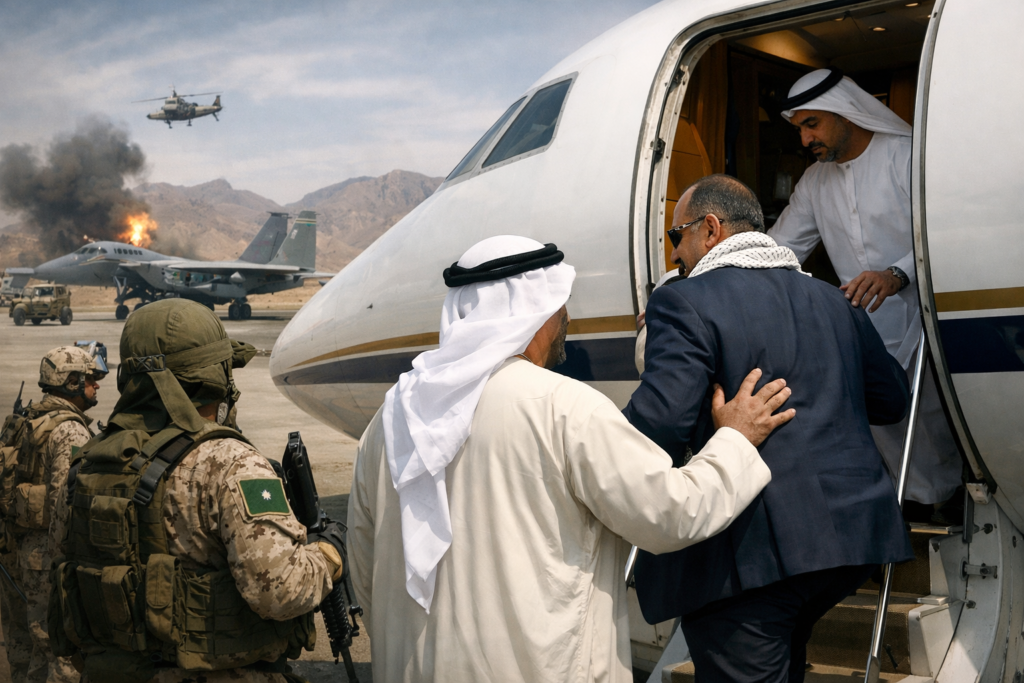
Image Credentials: Image Title: Tracing the Artist Through Biology, Scientists Explore Possible DNA Links to Leonardo da Vinci’s Art Source: (sora.openai) Date: January 2026. Attribution: This image was created using AI-generated imagery (sora.openai) and does not depict a real-world scene.
By Open Chronicle News Desk with Agencies | January 8, 2026
The Saudi-led coalition fighting in Yemen has accused the United Arab Emirates of secretly helping a prominent separatist leader flee the country after he was expelled from Yemen’s presidential council and accused of treason, deepening an already serious rift between the two Gulf allies.
Coalition officials said Aidarous al-Zubaidi, head of the UAE-backed Southern Transitional Council, left the port city of Aden late Tuesday night by sea before being flown to Abu Dhabi under Emirati supervision. The allegations mark one of the most direct public confrontations between Saudi Arabia and the UAE since their alliance intervened militarily in Yemen nearly a decade ago.
According to coalition spokesman Major General Turki al-Malki, Zubaidi boarded a passenger vessel flying the flag of St Kitts and Nevis in the early hours of Wednesday. The ship crossed the Gulf of Aden to Berbera in Somaliland, a self-declared breakaway region of Somalia, where a military cargo aircraft was allegedly waiting.
Malki said Zubaidi and several associates boarded an Ilyushin Il-76 aircraft under the supervision of UAE officers. The plane reportedly flew first to Mogadishu before heading over the Arabian Sea. He claimed the aircraft disabled its identification systems while over the Gulf of Oman, reactivating them shortly before landing at Al Reef Military Air Base in Abu Dhabi.
Neither the UAE nor the Southern Transitional Council immediately commented on the allegations. The STC denied that Zubaidi had fled the country, insisting he remained in Aden and continued to direct political and military activities from there. The group said coalition claims were fabricated and politically motivated.
The dispute escalated after the coalition said Zubaidi failed to travel to Riyadh for scheduled talks and accused STC forces of redeploying from bases in Aden to his home province of al Dhale. Coalition aircraft carried out air strikes on those forces, strikes that reportedly killed four people. The STC condemned the attacks as unjustified and inconsistent with calls for dialogue with Yemen’s internationally recognised government.
Saudi Arabia and the UAE have fought on the same side against Yemen’s Iran-backed Houthis movement since 2015. However, both countries support rival factions on the ground. Saudi Arabia backs the presidential council and the central government, while the UAE has long supported the STC, which seeks to re-establish an independent state in southern Yemen.
The infighting has increasingly undermined the coalition’s unity and raised fears of a new internal conflict in southern Yemen. Saudi officials warned last week that STC advances near the kingdom’s borders posed a direct threat to Saudi national security and to Yemen’s stability. Riyadh also accused Abu Dhabi of pressuring separatist forces to push into eastern Yemen.
Tensions intensified further after the coalition said it had struck a shipment of weapons and military vehicles allegedly delivered to the STC from the UAE. Abu Dhabi denied the claim, expressed deep regret over the accusations, and later agreed to withdraw its remaining forces from Yemen.
Since then, Saudi-backed government forces, supported by coalition air power, have retaken control of Hadramawt and al Mahra provinces. Witnesses and Yemeni officials told Reuters that Saudi-backed units were also consolidating control in Aden, long considered the STC’s stronghold.
The unfolding confrontation highlights the fragile nature of alliances within the Yemen war and underscores how competing regional agendas are reshaping the conflict, even as the country remains locked in one of the world’s worst humanitarian crises.