
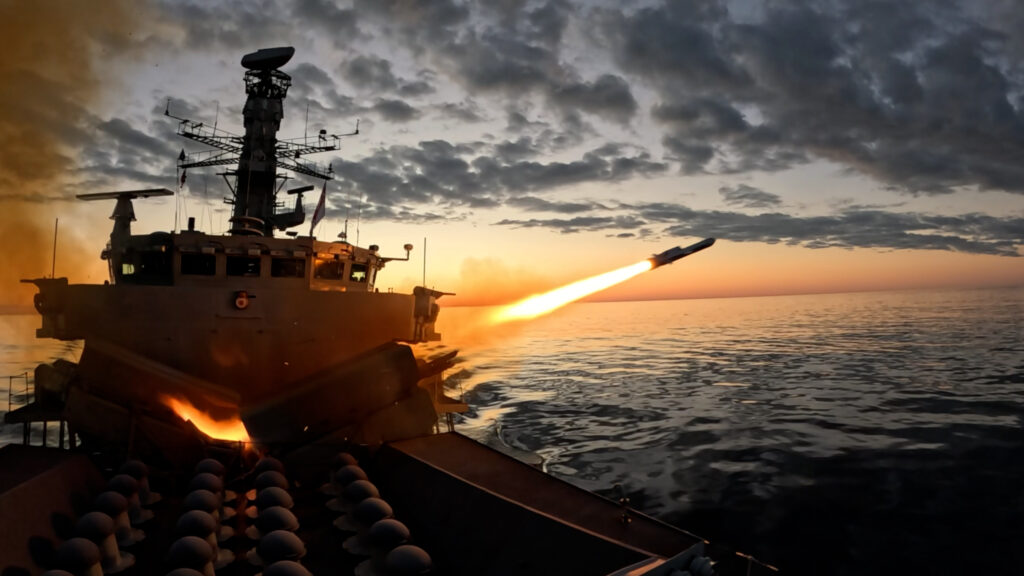
Image: from Royal Navy X@RoyalNavy
By Open Chronicle News Desk | January 9, 2026
The Royal Navy is set to bring a major new weapon into operational service later this year with the introduction of the Norwegian-designed Naval Strike Missile, marking a decisive step in rebuilding Britain’s surface warfare strike capability after the retirement of the Harpoon system.
According to the Ministry of Defence, the missile has been acquired under the Lunna House Agreement and will equip the Royal Navy’s escort fleet, replacing Harpoon, which went out of service in December 2023. Defence minister Luke Pollard described the new weapon as a generational upgrade, noting that it is roughly twenty years newer than Harpoon, offers significantly greater range, and provides a far more capable strike option against both naval and land-based targets.
The Royal Navy reached a key milestone in September 2025 when Type 23 frigate HMS Somerset successfully launched a Naval Strike Missile during Exercise Aegir off the coast of northern Norway. The live firing was conducted at the Andøya test range alongside Norwegian and Polish forces, marking the first time a British warship had employed the Kongsberg Defence and Aerospace-designed missile. British officials said the trial demonstrated growing interoperability with NATO partners in high-intensity maritime strike operations in the High North.
‼️🇬🇧🇺🇲🇳🇴 The Royal Navy has successfully conducted its first live firing of the Naval Strike Missile (NSM) during Exercise Aegir 25 in northern Norway. HMS Somerset launched the advanced missile alongside NATO allies Norway and Poland, marking a major step in replacing the UK’s… pic.twitter.com/7vZqVq2eRg
— Visioner (@visionergeo) September 28, 2025
With test firings now complete, the Ministry of Defence expects the missile to enter front-line service later this year. Once operational, the Naval Strike Missile will be carried by a total of eleven British surface combatants drawn from the Type 23 frigate and Type 45 destroyer fleets, restoring a long-range anti-ship capability that Britain has lacked since Harpoon was withdrawn.
The Naval Strike Missile is a stealthy, sea-skimming cruise missile designed to penetrate modern air defenses and strike with high precision. It has an operational range of more than 200 kilometres, with newer variants exceeding 300 kilometres. Its guidance system combines inertial navigation, GPS, terrain contour matching, and an imaging infrared seeker, allowing the missile to autonomously identify and home in on targets during the final phase of flight. The weapon carries a 120-kilogram blast and fragmentation warhead and flies at speeds approaching Mach 0.9, giving it the ability to inflict crippling damage on major surface vessels or hardened coastal targets.
British defence officials see the missile as central to a broader push to make the fleet more lethal and survivable in contested environments. In a separate parliamentary statement, Pollard said the Royal Navy is undertaking a significant modernization effort to increase fleet lethality, with the Naval Strike Missile and the helicopter-launched Sea Venom missile forming the backbone of that upgrade.
The arrival of the Naval Strike Missile comes as NATO navies face a more dangerous and complex maritime environment, with growing threats from advanced anti-ship missiles, submarines, and long-range strike systems fielded by peer competitors. By equipping its escorts with a modern, long-range precision weapon, the Royal Navy is seeking to ensure it can operate credibly alongside allies and hold adversary naval forces at risk well beyond the horizon.