
Image: Global Report X@Globalrepport
By José Carlos Palma | Open Chronicle Editor-in-Chief
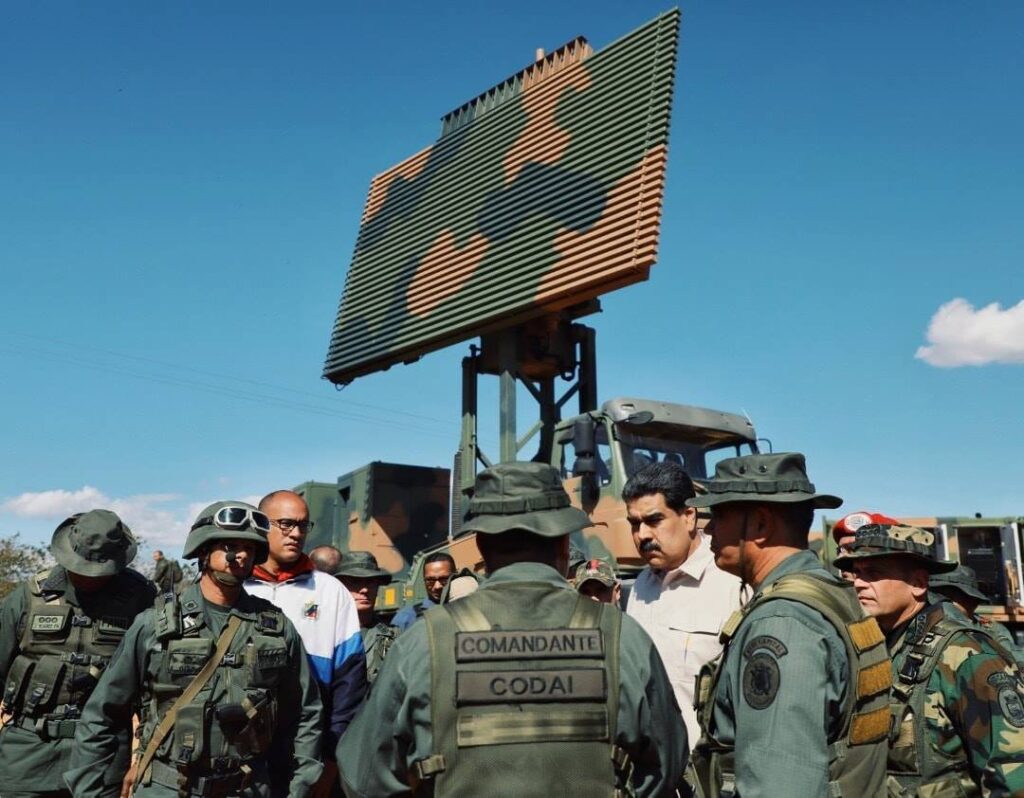
When Venezuela deployed China’s JY-27 long-range radar and Russia’s Nebo-M radar, both systems were expected to provide a powerful air-defense and early-warning umbrella. On paper, these radars are advertised as capable of detecting stealth aircraft at extreme ranges and resisting electronic attack. Yet in operational use, both systems performed far below expectations. Two overlapping explanations best account for what happened.
The first explanation is technical reality versus laboratory marketing. Modern strategic radars are often demonstrated and evaluated under idealized conditions. Clean electromagnetic environments, stable weather, controlled clutter, and cooperative targets allow manufacturers to generate impressive performance figures. Under those conditions, even low-observable aircraft may appear detectable at long range.
Venezuela does not offer those conditions. Real-world radar environments are saturated with interference. Solar radiation, atmospheric moisture, cloud formations, ionospheric effects, civilian transmissions, cosmic noise, and terrain reflections all degrade radar performance. In tropical regions such as northern South America, heavy humidity, rainstorms, and thermal turbulence create especially hostile propagation conditions. These effects are devastating for long-wavelength radars that rely on stable signal return.
Detecting a target in clutter is difficult. Tracking it continuously is far harder. This is where stealth aircraft gain their real advantage. Low-observable shaping does not simply reduce radar reflection. It produces unstable and inconsistent returns that make target tracking unreliable. A radar might register a brief contact at long range but fail to generate a stable track suitable for weapons guidance. That failure makes the detection tactically useless.
Stealth aircraft also do not operate alone. Aircraft such as the F-35 carry powerful onboard electronic warfare systems that actively distort radar signals, inject false data, and manipulate tracking algorithms. They are often supported by dedicated electronic attack aircraft that blanket radar networks with jamming, deception, and signal flooding. Even radars that can technically “see” a stealth aircraft under ideal conditions struggle to function when subjected to coordinated electronic warfare.
This is why modern Western air doctrine combines stealth with electronic warfare. Either capability is powerful alone. Together, they are overwhelmingly effective. The second explanation is operational vulnerability rather than pure technical failure.
Advanced radar systems are only as effective as their integration, crew training, maintenance, and command structure. Venezuelan air defense units rely on a mix of Chinese, Russian, and legacy Western equipment that was never designed to operate as a unified network. This creates delays in data fusion, degraded tracking continuity, and exploitable gaps in coverage.
In addition, foreign-supplied radar systems require constant software updates, calibration, and specialized technical support. Sanctions, political instability, and limited access to manufacturer support reduce performance over time. Without sustained integration and tuning, even advanced radars slowly lose reliability.
There is also the intelligence dimension. Modern air campaigns begin long before the first aircraft crosses a border. Signals intelligence, cyber reconnaissance, human sources, and commercial satellite imagery allow adversaries to map radar coverage, frequency use, maintenance cycles, and crew behavior. Once those vulnerabilities are known, electronic attack systems can be tailored to exploit them with precision.
That means a radar does not have to be destroyed to be neutralized. It only has to be blinded at the moment it matters. Taken together, these two explanations align. The Chinese JY-27 and Russian Nebo-M are not useless systems. But their advertised capability assumes controlled conditions, well-trained crews, fully integrated networks, and limited electronic attack. Venezuela offered none of those advantages. When exposed to environmental noise, fragmented command structures, and modern electronic warfare, their real-world performance dropped sharply.
The lesson is broader than Venezuela. Paper performance does not equal combat performance. In modern warfare, radar effectiveness is determined not by maximum detection range in a brochure but by how well a system survives in a hostile electromagnetic environment dominated by stealth aircraft, jamming, deception, and cyber-enabled targeting. That gap between theory and reality is where even the most sophisticated air defense systems often fail.
Bibliography
- Adam, John A., and James L. Smith. EW 101: A First Course in Electronic Warfare. Boston: Artech House, 2004.
- Barton, David K. Radar System Analysis and Modeling. Norwood, MA: Artech House, 2005.
- Center for Strategic and International Studies (CSIS). Countering A2/AD Systems. Washington, DC: CSIS, 2017.
- Center for Strategic and International Studies (CSIS). Venezuela’s Air Defense and Aerospace Sector. Washington, DC: CSIS, 2019.
- International Institute for Strategic Studies (IISS). The Military Balance. London: Routledge, annual editions.
- International Telecommunication Union Radiocommunication Sector (ITU R). Propagation Effects and Atmospheric Absorption Models for Radar and Radiocommunication Systems. Geneva: ITU, multiple editions.
- Jane’s Defence. JY 27 VHF Radar. London: Janes Information Group.
- Knott, Eugene F., John F. Shaeffer, and Michael T. Tuley. Radar Cross Section. 2nd ed. Raleigh, NC: SciTech Publishing, 2004.
- Mahafza, Bassem R. Radar Systems Analysis and Design Using MATLAB. Boca Raton, FL: Chapman and Hall CRC, 2013.
- NATO Joint Air Power Competence Centre. Electromagnetic Maneuver Warfare. Kalkar, Germany: JAPCC, 2020.
- RAND Corporation. The Russian Way of Warfare. Santa Monica, CA: RAND, 2017.
- Richards, Mark A., James A. Scheer, and William A. Holm. Principles of Modern Radar. Raleigh, NC: SciTech Publishing, 2010.
- Rosoboronexport. Nebo M Radar System. Moscow: Rosoboronexport, product literature.
- Schleher, Daniel C. Electronic Warfare in the Information Age. Boston: Artech House, 1999.
- Skolnik, Merrill I. Radar Handbook. 3rd ed. New York: McGraw-Hill, 2008.
- Stockholm International Peace Research Institute (SIPRI). Arms Transfers Database. Stockholm: SIPRI.
- Sweetman, Bill. Stealth Aircraft: Secrets of Future Airpower. St. Paul, MN: Motorbooks, 2001.
- United States Department of Defense. Electronic Warfare Strategy 2020. Washington, DC: U.S. Department of Defense, 2020.
- United States Joint Chiefs of Staff. JP 3 13 Information Operations. Washington, DC: Joint Chiefs of Staff, 2014.
- United States Air Force Research Laboratory. Integrated Air and Missile Defense Systems. Wright Patterson Air Force Base, OH: AFRL.
The Grand Strategy Institute
Continue Exploring Strategic Analysis
Return to The Grand Strategy Institute for strategic assessments, long-form analysis and research examining geopolitics, military affairs, international security, emerging technologies and the changing international order.
← Back to The Grand Strategy Institute