
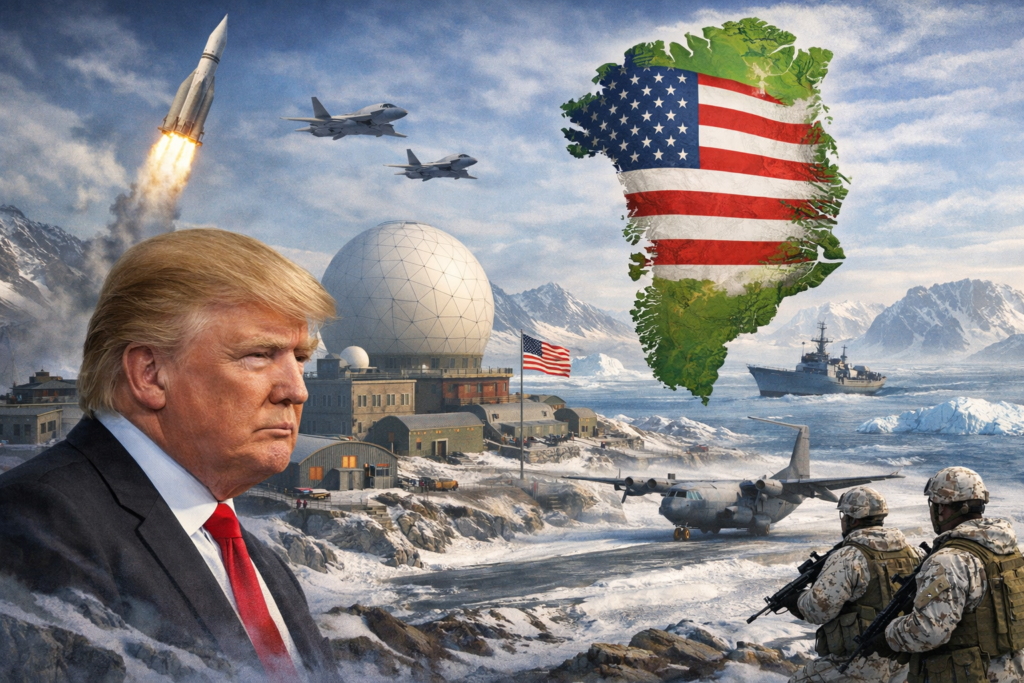
Image Credentials: Image Title: Greenland at the Center of Trump’s New Arctic Strategy Source: (sora.openai) Date: January 2026. Attribution: This image was created using AI-generated imagery (sora.openai) and does not depict a real-world scene.
By Elliot Hayes | Open Chronicle Senior Editor
President Donald Trump’s renewed push to assert U.S. control over Greenland has startled European allies, but the real surprise is not how aggressive his rhetoric has become. It is how unnecessary it is.
For more than seventy years, the United States has possessed extraordinary legal authority to operate militarily in Greenland. A little-known 1951 defense agreement between Washington and Copenhagen gives the U.S. sweeping rights to build, operate, and expand military facilities across the island, as long as Denmark remains part of NATO. The agreement allows American forces to improve terrain, construct bases, deploy equipment, and operate freely for defense purposes.
Danish officials and Greenlandic leaders see this as the core contradiction behind Trump’s threats. The United States does not need to seize Greenland to achieve its security goals. It already has an open door.
That is why Trump’s recent statements about using military force or purchasing the island have been met with confusion and alarm across Europe.
Greenland’s strategic value has exploded in the twenty-first century. Sitting above the Arctic Circle, it anchors the northern approaches to North America. It lies astride emerging shipping lanes opened by melting ice, and it sits directly between Russia, Europe, and the United States.
The U.S. military has used Greenland since World War II, when it served as a vital link in the Atlantic air and naval war. During the Cold War, the island hosted dozens of bases, radar stations, and early warning systems aimed at detecting Soviet bombers and missiles.
Today, only one major base remains, Pituffik Space Base, but its role is more important than ever. It supports missile warning systems, space surveillance, and Arctic domain awareness.
As Russia militarizes its Arctic coastline and China pushes into polar shipping and mining, Washington sees Greenland as a strategic keystone.
Trump has framed this in stark geopolitical terms. He has repeatedly warned that Chinese and Russian ships are anchoring themselves in Arctic waters, and he argues that the United States must lock down Greenland to prevent rivals from gaining influence there.
What makes this confrontation so strange is that the United States already has legal access to everything it says it needs.
Under the 1951 U.S.-Denmark defense agreement, Washington can establish defense areas anywhere in Greenland. It can build bases, deploy troops, install radar, and operate equipment. Any expansion requires consultation with Denmark and Greenland, but historically, those talks have been cooperative and flexible.
Danish officials point out that whenever the United States has asked to increase its military footprint, Copenhagen and Nuuk have almost always said yes.
From their perspective, there is no security problem that requires sovereignty change. If the Pentagon wants more bases, more radar, more patrol aircraft, or more missile defenses, the treaty already provides a pathway.
This is why Denmark’s prime minister has urged Trump to stop threatening Greenland. From Europe’s view, Washington is attacking an ally while already holding the legal tools it wants.
Foreign policy experts increasingly believe Trump’s Greenland campaign is less about logistics and more about leverage.
Trump operates through what scholars call gunboat diplomacy. He prefers to use power, threats, and spectacle to force other governments to concede rather than negotiate quietly through treaties. By talking about buying or taking Greenland, Trump may be trying to intimidate Denmark into giving the United States even more control, fewer restrictions, and faster approvals.
There is also the issue of rare earth minerals. Greenland holds large deposits of the materials used in electronics, missiles, and renewable energy. China currently controls most of the world’s supply. Trump sees Greenland as a way to break that dependency.
Yet mining experts say the economics are brutal. Greenland’s weather limits operations to half the year, costs are astronomical, and infrastructure barely exists. Any serious mining would take decades and massive investment.
That suggests Trump’s push is not really about digging up rocks. It is about geopolitical signaling.
Greenland has become a stage for a much larger contest over American power.
Trump’s administration has embraced what it calls the Donroe Doctrine, a modernized version of the Monroe Doctrine that asserts U.S. dominance across the Western Hemisphere and adjacent regions. After the capture of Venezuela’s leader, Trump appears eager to show that American military reach is not just rhetorical.
Greenland offers a powerful symbol. It is vast, remote, rich in resources, and tied to Europe through NATO. Pushing hard there sends a message to Russia, China, and even U.S. allies that Washington is willing to use pressure rather than patience.
For Denmark and Greenland, this is deeply unsettling. They do not reject American security cooperation. They reject the idea that partnership must come with threats.
The greatest danger in this standoff is not military. It is political.
As long as Trump’s goals are concrete, such as more radar, more bases, and more surveillance, Denmark and Greenland can negotiate. Those things fit inside the 1951 framework.
But if Trump’s real objective is symbolic dominance, something closer to territorial expansion or prestige, there is no easy compromise. You cannot split sovereignty or bargain over national identity.
Greenland’s leaders have already said they are not for sale. Denmark has made the same clear.
The irony is that the United States does not need to own Greenland to dominate it militarily. It already has the legal foundation to do nearly everything it wants.
The conflict, then, is not about security.
It is about power, perception, and how far Trump is willing to push America’s allies to prove it.
The Grand Strategy Institute
Continue Exploring Strategic Analysis
Return to The Grand Strategy Institute for strategic assessments, long-form analysis and research examining geopolitics, military affairs, international security, emerging technologies and the changing international order.
← Back to The Grand Strategy Institute