
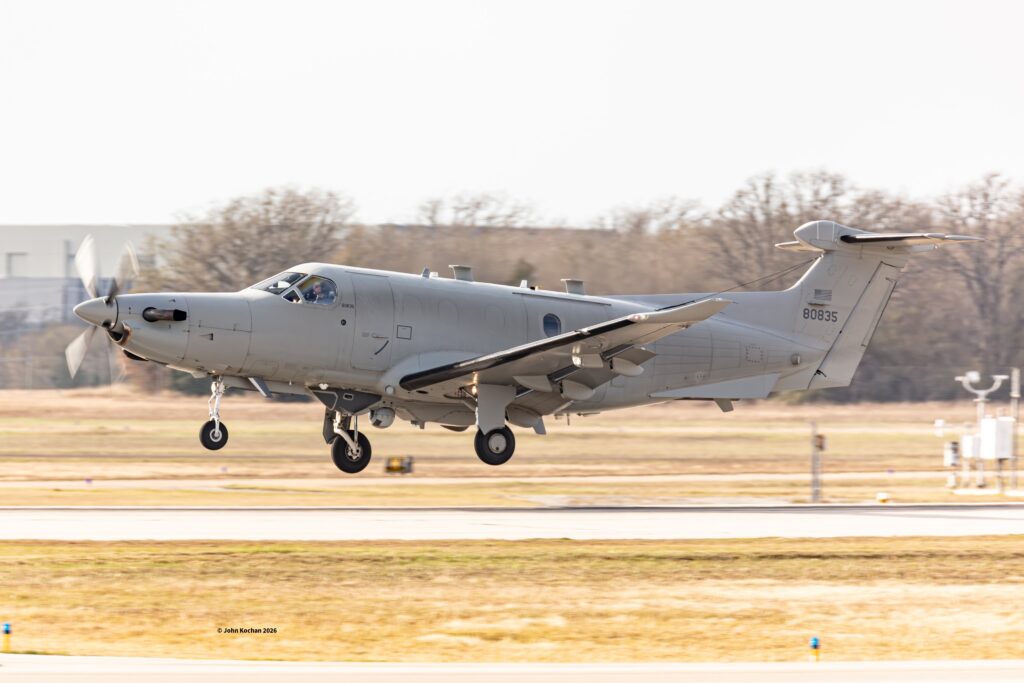
Image: from John Kochan X@WindTunnelGuy
The United States Air Force has surged special operations intelligence aircraft toward the North Sea, signaling a potential escalation in the standoff surrounding a Russian-flagged, sanctioned crude oil tanker believed to be operating under U.S. seizure risk.
On January 7, three U-28A Draco aircraft were tracked flying north over the United Kingdom before converging on the same operating area in the North Sea. The aircraft, using the callsigns AGREE32, AGREE34, and AGREE36, departed from RAF Mildenhall and RAF Coningsby before turning north off the Scottish coast and climbing to operational altitude. Flight tracking data indicated that all three aircraft were assigned to the same mission area, a pattern consistent with coordinated special operations tasking.
The U-28A Draco is a highly modified Pilatus PC 12 operated by the U.S. Air Force Special Operations Command. It provides real-time intelligence, surveillance, and reconnaissance support to special operations forces, including maritime interdiction, counterproliferation, and hostage recovery missions. The aircraft is capable of relaying live imagery, signals intelligence, and targeting data directly to special operations teams and command elements.
GM My X-Frens!!
We had not 1 but 2 U-28A DRACOs stop in here at CLL. I barely managed to catch them as they snuck out. Once they got airborne, one of them showed the generic icon and a basic hex code with no other information for about 2 minutes then disappeared off ADS-B… pic.twitter.com/OB74n6G92Y— John Kochan 🚁🚀🛩️ (@WindTunnelGuy) January 7, 2026
The movement of the U-28A aircraft follows a series of preparatory activities by U.S. special operations units in the United Kingdom. Earlier this week, CV-22 B Osprey tiltrotor aircraft from the 7th Special Operations Squadron were observed conducting fast rope insertion and recovery drills at RAF Fairford. Such training is closely associated with boarding operations, including the seizure of vessels at sea.
US AGREE32, AGREE34 and AGREE36 on route to Reykjavik out of Wick. All a Pilatus U-28A Draco, an American special operations, tactical ISR, forward air control, and counter insurgency aircraft operated by Air Force Special Operations Command (AFSOC). pic.twitter.com/Ilhvr7iQTq
— Johan Louwers (@johanlouwers) January 7, 2026
These deployments coincide with the continued movement of the tanker Marinera, formerly known as Bella 1, which departed Venezuelan waters in December carrying crude oil linked to sanctioned Iranian and Venezuelan entities. The vessel, now sailing under a Russian flag, has been tracked moving through the Caribbean and into the North Atlantic, where it was last reported northwest of Ireland.
According to reporting by The Wall Street Journal, Russia has dispatched a submarine and additional naval units into the North Atlantic in an effort to deter any U.S. attempt to seize the tanker. That development has raised the risk of a confrontation between American and Russian forces in international waters.
The U-28A aircraft are well-suited to this type of maritime standoff. From high altitude, they can monitor ship movements, coordinate special operations teams, provide navigation and timing cues for boarding helicopters, and feed targeting data to naval or air assets. When deployed in multiples, they also provide redundancy and the ability to maintain continuous coverage over a contested area.
The aircraft movements also come amid a broader increase in U.S. intelligence flights in the region. RC 135 Rivet Joint signals intelligence aircraft operating from RAF Mildenhall have flown repeated sorties over the North Atlantic and western approaches to Europe, focusing on maritime and naval activity tied to the tanker’s transit.
While the Pentagon has not publicly acknowledged any planned operation, the deployment of three special operations intelligence aircraft to the same maritime sector strongly suggests that U.S. forces are preparing for possible direct action. With Russian naval units reportedly moving to shield the Marinera, the North Sea and surrounding waters have become the latest flashpoint in the expanding global confrontation over sanctions enforcement and maritime control.