
Image: from 2 Foreigners In Bollywood X@2_F_I_B
By Open Chronicle News Desk with Agencies | January 9, 2026
Russia’s own defense analysts are now publicly admitting what Western navies have long assessed, the Russian Navy no longer has the strength, reach, or endurance to protect the country’s oil tankers from foreign interception. In a rare moment of candor, pro-Kremlin military commentators writing for the channel Voyennyy Osvedomitel acknowledged that Moscow lacks the ships and logistical depth required to escort or defend Russian-linked commercial vessels operating far from home waters.
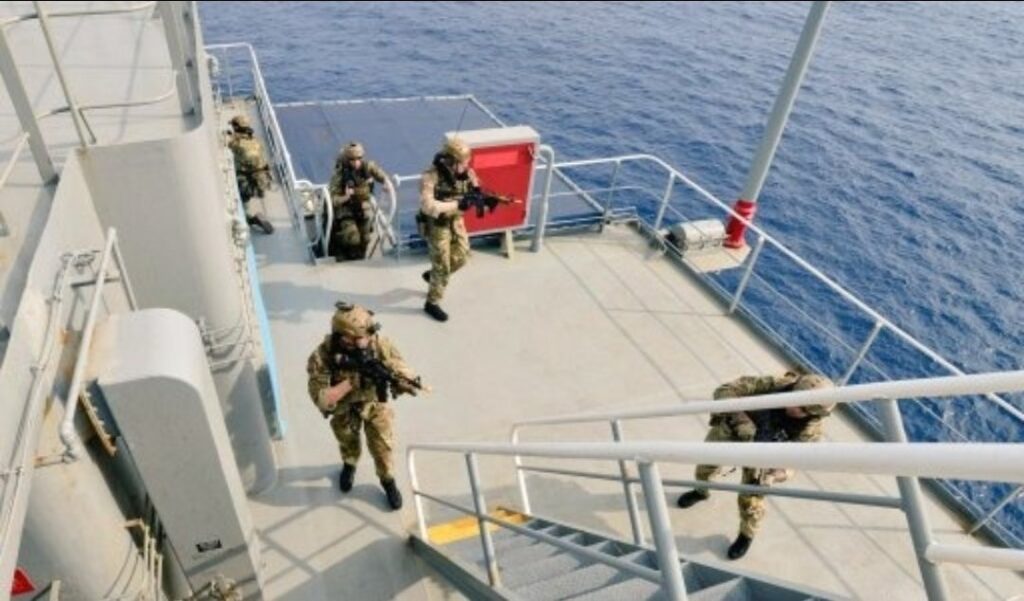
The assessment comes after a string of U.S. and allied seizures of tankers carrying sanctioned Russian crude, most recently the Russia-flagged Marinera in the North Atlantic. Despite the presence of Russian naval units and even a submarine somewhere in the wider region, analysts conceded that there was no realistic way to challenge or deter the operation. As Voyennyy Osvedomitel bluntly put it, the idea that Russian warships could confront American vessels to prevent seizures is a fantasy rather than a strategy.
At the heart of the problem lies the collapse of Russia’s ocean-going fleet. In the early 2000s, Moscow planned to build between 44 and 50 modern corvettes and frigates by 2020, forming the backbone of a renewed blue water navy. Instead, only 16 were delivered. Of those, ten are small corvettes whose ability to survive and operate in harsh North Atlantic winter conditions is highly questionable. The remaining six include two that are effectively trapped in the Black Sea, hemmed in by the war in Ukraine and Türkiye’s enforcement of the Montreux Convention.
The failure extends beyond new construction. Russia also intended to modernize roughly twenty large Soviet era surface combatants, including destroyers, cruisers, and anti-submarine ships. In practice, only two have received serious upgrades, the cruiser Marshal Ustinov and the frigate Marshal Shaposhnikov. Most of the rest remain afloat but not truly operational, unable to sustain long deployments, conduct modern air defense, or support convoy operations thousands of kilometers from Russian ports.
These weaknesses mean that Russia can still show the flag in nearby waters such as the Baltic or the Barents Sea, but it cannot provide continuous protection to merchant ships crossing the Atlantic, the Indian Ocean, or key chokepoints where U.S. and allied forces operate. This gap between ambition and reality has become especially dangerous as sanctions enforcement moves from financial measures to physical interdiction of shipping.
Even if Russia could place warships alongside tankers, analysts say another barrier looms, the legal domain. The United States has issued arrest warrants for crews of sanctioned vessels, turning civilian seafarers into legal targets. Moscow has no reliable way to protect or recover foreign nationals employed on these ships if they are detained. As a result, the very crews needed to move Russian oil may refuse to sail into contested waters, regardless of what the Navy does.
This vulnerability was indirectly acknowledged in December 2025 by Admiral Aleksandr Moiseev, Russia’s Navy commander in chief, in an article for the military journal Voennaya Mysl. Moiseev outlined theoretical measures to protect commercial shipping, including improved counter-drone defenses. Yet he also conceded that outside Russia’s exclusive economic zone, the main options are to withdraw early from danger, react after detentions occur, or seek shelter in friendly or neutral ports. Notably absent was any credible doctrine for escorting convoys or breaking a blockade in distant seas.
The broader context makes the picture even bleaker. Russia has already lost much of its Black Sea Fleet’s combat power to Ukrainian missile and drone strikes. The Caspian Flotilla has been repeatedly targeted by long-range drones. In the Mediterranean, Russia’s naval presence has withered as friendly regimes weakened and Türkiye tightened control over access to the Black Sea. What remains is a fleet designed for regional defense, not global power projection.
As Voyennyy Osvedomitel summarized, Russia now has “only paper capability” when it comes to protecting its maritime lifelines. Years of stalled shipbuilding, corruption, sanctions, and wartime losses have hollowed out the navy. In a world where oil tankers can be seized thousands of miles from Russian shores, this weakness is no longer theoretical. It is now a strategic crisis that strikes at the core of Russia’s ability to fund its war and sustain its economy.