
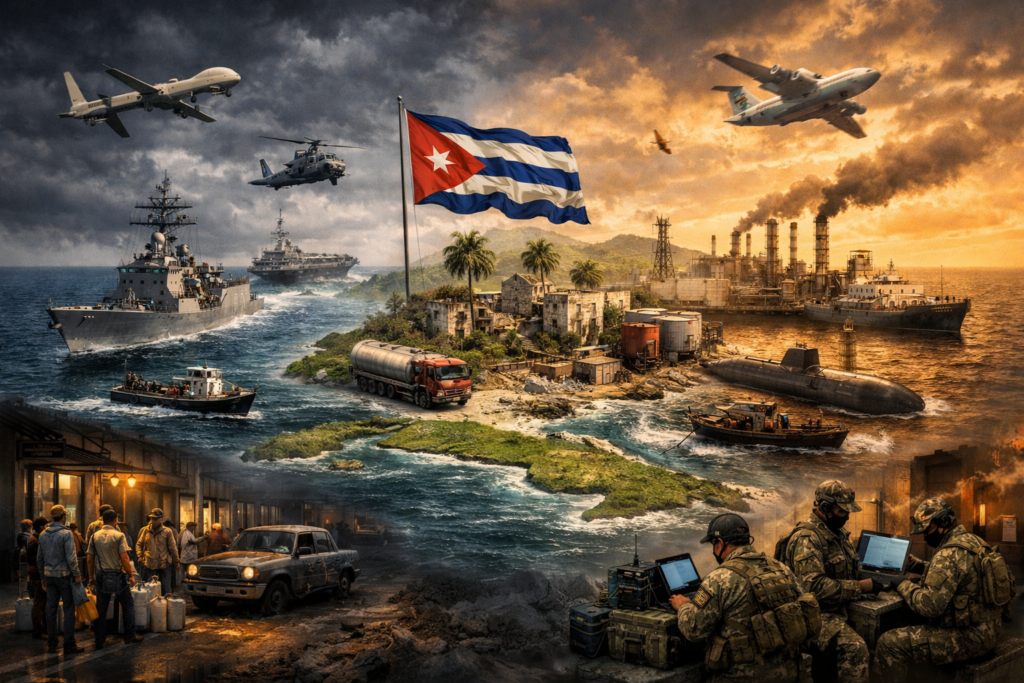
Image Credentials: Image Title: Intelligence Assessment: Grey Zone Contestation in the Caribbean Source: (sora.openai) Date: January 2026. Attribution: This image was created using AI-generated imagery (sora.openai) and does not depict a real-world scene.
By José Carlos Palma | Open Chronicle Editor-in-Chief
The current tension in the Caribbean is best understood as a calibrated contest of endurance between Moscow and Washington, played below the threshold of open confrontation. While the United States relies on overt naval pressure and maritime interdiction, Russia has activated a mature Grey Zone playbook designed to prevent the total economic and energy isolation of its Caribbean partner. The result is a controlled stalemate in which fuel scarcity weakens Cuban society without collapsing the state, while each external actor tests the legal, operational, and political limits of the other.
Since early 2026, Russian activity in the Caribbean has reflected a deliberate shift away from overt state logistics toward deniable and legally ambiguous methods. The objective is not to defeat the blockade outright, but to keep it porous enough to preserve Havana’s core governing functions.
Central to this effort is the expanded use of so-called Dark Fleet operations. Aging tankers operating outside mainstream insurance and shipping markets are sailing with disabled AIS transponders, effectively erasing their digital footprint. These vessels routinely conduct ship-to-ship transfers in international waters, blending Russian crude with other grades to obscure its origin and frustrate attribution. The tactic increases uncertainty for interdiction forces, which must weigh the legal risk of boarding a vessel whose cargo cannot be conclusively identified.
Complementing this approach is aggressive flag hopping. Tankers have been observed changing registration multiple times during a single voyage, often shifting between permissive registries such as Panama, Liberia, or Gabon. Each change complicates jurisdictional authority and delays decision-making, reducing the feasibility of rapid interdiction under international law.
More strategically ambitious is what intelligence analysts have labeled the Arctic Bridge. Russia is experimenting with routing fuel from its northern ports directly to the Caribbean using ice-class tankers. While economically inefficient, the route exploits harsh weather, sparse monitoring, and unconventional traffic patterns to strain United States surveillance assets. The intent is less about volume and more about forcing Washington to disperse attention across multiple theaters.
The United States views the blockade as a necessary security measure aimed at reshaping regional influence, particularly Cuban support networks linked to Venezuela. The European Union, however, has adopted a sharply different posture that blends legal resistance with strategic self-interest.
Led by Spain and France, Brussels has formally challenged the legality of maritime interdictions conducted in international waters without a United Nations Security Council mandate. EU legal briefs cite violations of the 1982 UN Convention on the Law of the Sea, arguing that freedom of navigation is being selectively reinterpreted for political ends.
Equally contentious is the question of extraterritoriality. The EU remains fundamentally opposed to the United States’ secondary sanctions that penalize European companies for commercial activity involving Cuba. In response, the EU has reactivated its Blocking Statute, offering legal protection to firms that refuse to comply with United States sanctions enforcement.
Beyond legal doctrine, European diplomats have raised acute humanitarian and security concerns. A complete energy collapse in Cuba, they warn, would likely trigger large-scale migration flows toward Europe, particularly Spain. Such a scenario could destabilize Mediterranean border management and generate political pressures inside the EU that Washington does not directly bear.
Russia’s primary action remains Grey Zone energy shipments, with the stated objective of maintaining a strategic foothold in what Moscow views as the United States’ near abroad. The European Union has positioned itself as a diplomatic and legal counterweight, seeking to protect commercial interests while preventing a migration shock. China has adopted a quieter but persistent role, extending financial credits and technical support to secure long-term access to Cuban infrastructure and port facilities. The United States continues to rely on naval interdiction as leverage, aiming to force a broader political deal that would curtail Cuban influence in Venezuela.
As of mid-January 2026, the blockade has reduced oil flows to Cuba by approximately sixty-five percent. This represents a significant operational success for Washington, yet it falls short of strategic resolution. Russian Grey Zone tactics have ensured a minimal but steady trickle of fuel, sufficient to power critical state functions, security services, and regime survival mechanisms.
The civilian population, by contrast, bears the brunt of the pressure. Prolonged blackouts, transport disruptions, and economic paralysis have become normalized conditions. From an intelligence perspective, this outcome reflects a deliberate equilibrium. The Cuban state is weakened but intact, Russia preserves influence at relatively low cost, the European Union contains secondary fallout, and the United States avoids escalation while maintaining pressure.
In essence, the Caribbean has become a laboratory for twenty-first-century coercion, where legality, deniability, and humanitarian risk are wielded as strategic tools. The contest is no longer about control of sea lanes alone, but about who can best endure ambiguity without triggering collapse or war.
The Grand Strategy Institute
Continue Exploring Strategic Analysis
Return to The Grand Strategy Institute for strategic assessments, long-form analysis and research examining geopolitics, military affairs, international security, emerging technologies and the changing international order.
← Back to The Grand Strategy Institute