
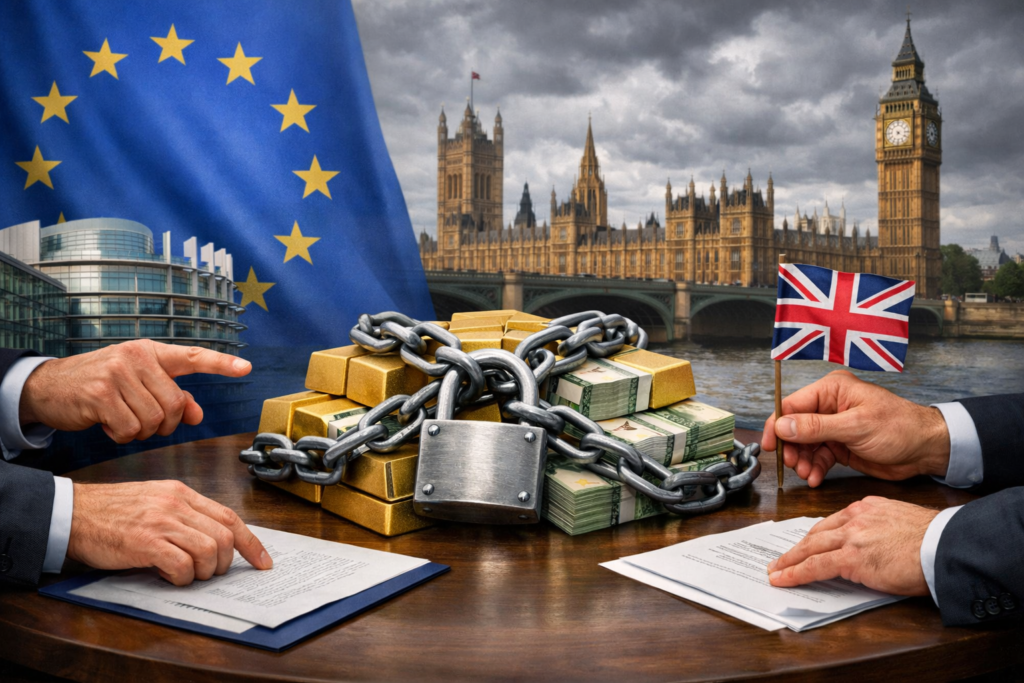
Image Credentials: Image Title: EU Seeks ‘Farage Clause’ in Brexit Reset Talks to Guard Against Future U Turns Source: (sora.openai) Date: January 2026. Attribution: This image was created using AI-generated imagery (sora.openai) and does not depict a real-world scene.
By Open Chronicle News Desk Staff with Agencies
LONDON and BRUSSELS — The European Union is pushing for a powerful financial safeguard in its negotiations with Britain over a post-Brexit reset of relations, seeking to protect itself against the risk that a future UK government could once again tear up hard-won agreements.
At the center of the dispute is what EU diplomats have informally dubbed the Farage clause, a termination and compensation provision that would require whichever side withdraws from a new UK-EU deal to pay the costs of rebuilding border and regulatory infrastructure. The demand comes as Prime Minister Keir Starmer’s Labour government works to ease trade frictions left behind by Brexit, particularly in agriculture and food exports.
According to reporting by the Financial Times, a draft agreement on sanitary and phytosanitary standards, designed to remove post-Brexit checks on farm goods, includes language obliging any party that quits the deal to cover the expense of restoring border controls, inspection facilities, and staffing. Those costs could run into the billions.
EU officials see the clause as insurance against political volatility in Britain. Reform UK leader Nigel Farage has vowed to rip up any new alignment with Brussels should he come to power, raising fears in European capitals that the bloc could again be left footing the bill for a British policy reversal.
UK government sources, however, have pushed back strongly against the characterization of the provision as politically targeted. They say such exit clauses are standard in international agreements and would apply equally to the EU, meaning Brussels would also have to compensate London if it walked away.
A Labour Party source dismissed criticism of the clause as overblown, saying exit provisions are a routine feature of trade deals and not a threat to democracy.
The dispute underlines how raw the financial scars of Brexit remain. When Britain left the EU in 2020, Brussels created a €5.4 billion adjustment reserve to help member states cope with the disruption of new borders. Ireland received €920 million, the Netherlands more than €800 million, and France €672 million to hire customs officers, veterinary inspectors, and border police, and to build new inspection posts at ports and terminals.
France alone spent at least €200 million establishing new controls at Calais, Dunkirk, Le Havre, and the Channel Tunnel, including specialist facilities for transporting racehorses. The Netherlands hired more than 900 customs officers and 145 additional veterinarians for Rotterdam, while Spain recruited 860 extra border staff.
Those outlays are now at the heart of Brussels’s thinking. Under the draft Farage clause, if either side were to quit a new SPS agreement, compensation would include the cost of infrastructure, equipment, recruitment, and training needed to reinstate border checks.
Anand Menon, director of the think tank UK in a Changing Europe, said the EU’s tough stance should come as no surprise.
“They have decided that we need these agreements more than they do,” he said. “As such, they will extract every last concession.”
Negotiations on the agriculture and food safety deal are due to begin this month, though officials on both sides acknowledge they could take many months. The SPS agreement is one of the most complex elements of Labour’s broader reset package, which also includes Britain’s planned return to the Erasmus student exchange program.
Progress has also stalled on another sensitive area, the EU’s carbon border adjustment mechanism, which would impose levies on high-emission goods exported to the bloc. Hopes of a breakthrough before Christmas have faded.
As talks resume, the Farage clause is emerging as a potent symbol of how deeply the EU wants to guard against a repeat of Brexit’s economic shock. For Brussels, the message is clear, any future divorce from new agreements will come with a very large bill attached.