
By Open Chronicle Science Desk
October 1, 2026
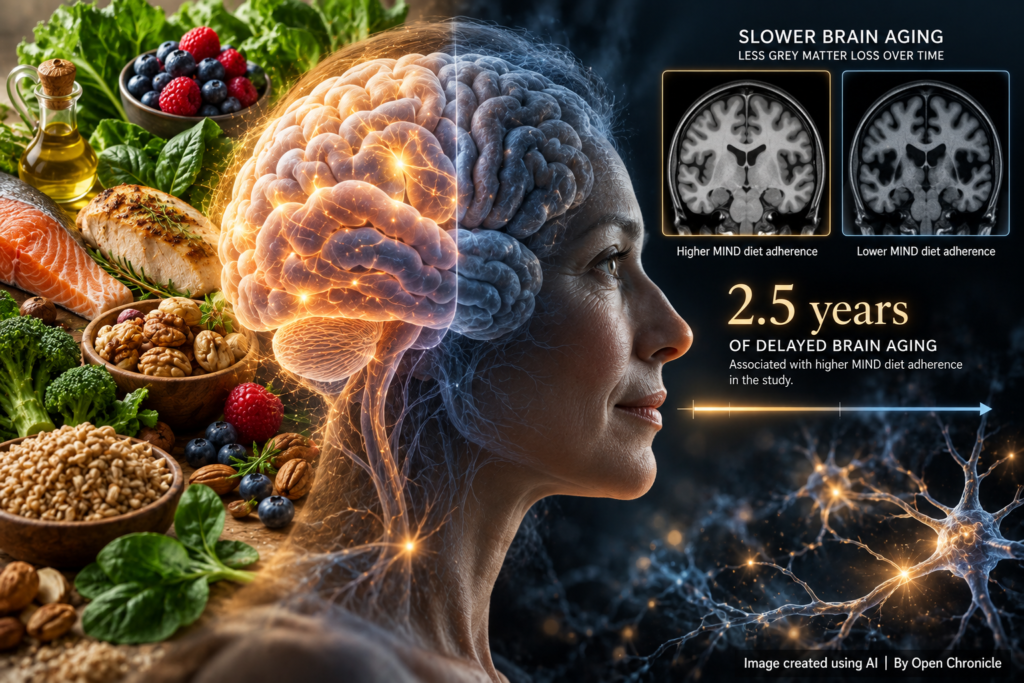
People who followed the MIND diet more closely experienced slower loss of grey matter and less enlargement of the brain’s ventricles over more than a decade, with the strongest difference corresponding to approximately 2.5 years of delayed structural brain aging.
Could what we eat influence how quickly the physical structure of our brain ages?
A long term study following more than 1,600 middle aged and older adults suggests that greater adherence to the MIND diet, an eating pattern specifically developed with brain health in mind, is associated with slower structural changes in the aging brain.
Researchers found that people who followed the diet more closely experienced a slower decline in grey matter, the brain tissue involved in functions including memory, learning, decision making and information processing.
They also experienced slower enlargement of the brain’s ventricles, fluid filled spaces that typically become larger as surrounding brain tissue is lost with age.
For grey matter, the difference associated with stronger MIND diet adherence corresponded to approximately 2.5 years of delayed brain aging.
The findings, based on participants from the long running Framingham Heart Study Offspring cohort, are published in the Journal of Neurology, Neurosurgery & Psychiatry.
Importantly, the research does not prove that following the MIND diet directly prevents brain aging.
But it provides new evidence that dietary patterns may be associated not only with cognitive performance but with measurable differences in how the physical structure of the brain changes over time.
What Is the MIND Diet?
MIND stands for Mediterranean Dietary Approaches to Stop Hypertension Diet Intervention for Neurodegenerative Delay.
As its name suggests, the diet combines principles from two established dietary patterns.
One is the Mediterranean diet.
The other is DASH, Dietary Approaches to Stop Hypertension, an eating plan originally developed to help prevent and control high blood pressure.
The MIND diet modifies elements of both with a particular focus on foods thought to support neurological health.
It emphasises green leafy vegetables, other vegetables, berries, nuts, whole grains, fish, beans, olive oil and poultry.
The original MIND scoring system also includes moderate wine consumption, although contemporary health guidance increasingly treats alcohol separately because even moderate consumption carries health risks and is not necessary to follow the broader dietary pattern.
Foods the MIND diet recommends limiting include butter and margarine, cheese, red meat, pastries, sweets and fried or fast foods.
Previous studies have associated greater adherence to the diet with better cognitive outcomes.
What has remained less certain is whether those associations correspond to measurable differences in the physical aging of the brain.
Looking Inside the Aging Brain
To investigate that question, researchers studied 1,647 adults participating in the Framingham Heart Study Offspring cohort.
Their average age at the beginning of the investigation was approximately 60.
The Framingham Heart Study is particularly valuable for research of this kind because participants have undergone health evaluations repeatedly over many years.
For this analysis, dietary information came from food frequency questionnaires completed during examinations conducted between 1991 and 2001.
Participants reported how frequently they consumed different foods, allowing researchers to calculate their adherence to the MIND dietary pattern.
Scores could range up to 15, with higher scores representing closer adherence.
The average score among participants was just under 7 out of 15.
Researchers then combined this dietary information with repeated magnetic resonance imaging of participants’ brains.
Two Decades of MRI Data
Beginning in 1999, participants underwent brain MRI examinations approximately every two to six years.
To be included in the analysis, each person needed at least two MRI assessments between 1999 and 2019.
Participants also showed no evidence of stroke or dementia at their first MRI examination.
This repeated imaging allowed researchers to do something that a single brain scan cannot.
Instead of simply comparing the brains of people eating different diets at one moment in time, scientists could measure how each person’s brain structure changed over the years.
The average follow up period was approximately 12 years.
That provided a window into the gradual anatomical changes associated with aging.
What Happens to the Brain as We Age?
The MRI scans showed the expected effects of aging across the study population.
Total brain volume decreased.
Grey matter declined.
White matter volume declined.
The hippocampus, a structure essential to learning and memory and particularly relevant to Alzheimer’s disease research, also became smaller.
At the same time, volumes of cerebrospinal fluid and the brain’s ventricles increased.
Researchers also observed increases in white matter hyperintensities.
These appear as bright areas on certain MRI scans and are often associated with small vessel disease and damage within the brain’s white matter.
These structural changes are common features of aging.
But they did not occur at exactly the same rate in everyone.
Dietary patterns were associated with some of those differences.
2.5 Years of Difference in Brain Aging
The clearest association involved grey matter.
Every three point increase in MIND diet score was associated with approximately 0.279 cubic centimetres per year less grey matter loss.
Researchers estimated that this represented around 20 percent less age related decline.
Expressed another way, the difference corresponded to approximately 2.5 years of delayed structural brain aging.
That does not mean the diet literally makes someone’s entire brain 2.5 years younger.
The figure represents an equivalence derived from the observed rate of grey matter change.
Nevertheless, it provides a useful indication of the magnitude of the association.
A similar pattern appeared in the brain’s ventricles.
The Brain’s Expanding Spaces
Ventricles are interconnected spaces inside the brain filled with cerebrospinal fluid.
As brain tissue shrinks with aging, these spaces generally become larger.
Their expansion can therefore provide another indirect measure of brain tissue loss.
Every three point increase in MIND diet adherence was associated with approximately 0.071 cubic centimetres per year less ventricular expansion.
Researchers estimated that this represented around 8 percent less tissue loss and corresponded to approximately one year of delayed brain aging according to this measure.
Taken together, the grey matter and ventricular findings suggest that closer adherence to the MIND diet is associated with slower progression of some structural features of brain aging.
Berries Stand Out
When researchers examined individual components of the diet, some foods produced particularly interesting associations.
Berries were among them.
Greater berry consumption was associated with slower increases in ventricular volume.
Berries contain numerous biologically active compounds, including polyphenols and anthocyanins, that have been investigated for antioxidant and anti inflammatory effects.
Oxidative stress can damage cells when reactive molecules overwhelm biological defence mechanisms.
Because neurons are metabolically active and can be vulnerable to oxidative damage, dietary compounds capable of influencing these pathways have attracted considerable interest in neuroscience.
But the observational study cannot establish that compounds within berries directly produced the differences seen in the MRI scans.
The association nevertheless aligns with the MIND diet’s particular emphasis on berries rather than fruit in general.
Poultry Was Also Associated With Healthier Changes
Poultry produced another favourable association.
Higher poultry consumption was linked with slower ventricular enlargement.
It was also associated with a slower decline in grey matter.
The researchers suggest that high quality protein sources could potentially contribute to neurological health alongside foods rich in antioxidants.
But individual foods should be interpreted cautiously.
People do not consume nutrients in isolation, and dietary behaviours frequently cluster together.
Someone who regularly eats vegetables, berries and whole foods may differ in many other respects from someone whose diet contains large quantities of highly processed food.
This is one reason researchers study entire dietary patterns such as MIND rather than focusing exclusively on individual ingredients.
Sweets Showed the Opposite Pattern
Some foods were associated with less favourable brain changes.
Higher consumption of sweets was linked with faster enlargement of the ventricles.
It was also associated with greater atrophy of the hippocampus.
The hippocampus is one of the brain regions of greatest interest in research on aging and dementia because of its fundamental role in memory.
Loss of hippocampal volume occurs with normal aging but can become particularly pronounced in neurodegenerative diseases including Alzheimer’s disease.
The association does not establish that eating sweets directly caused hippocampal shrinkage.
But it adds to the broader pattern connecting dietary quality, metabolic health and brain aging.
Fried Fast Foods and the Hippocampus
Higher consumption of fried fast foods was also associated with greater hippocampal volume loss.
Researchers proposed several possible biological explanations.
Fried fast foods can contain large amounts of unhealthy fats and, depending on preparation, trans fats and advanced glycation end products.
Dietary patterns rich in these foods may contribute to inflammatory processes and vascular damage.
Blood vessel health is intimately connected with brain health.
The brain consumes a substantial proportion of the body’s oxygen and energy despite accounting for only a small fraction of total body mass.
Its neurons therefore depend on an extensive vascular network to continuously supply oxygen and nutrients.
Damage to that system can influence neurological aging.
Two Unexpected Results
Not all the findings followed the pattern researchers might have predicted.
Whole grains, normally considered an important component of healthy dietary patterns, were associated in this study with several less favourable structural changes.
Higher intake correlated with faster losses of grey matter and hippocampal volume and faster ventricular enlargement.
The finding does not demonstrate that whole grains damage the brain.
Unexpected associations can arise from characteristics of the population, dietary measurement, residual confounding, statistical variation or differences between the foods grouped together within a dietary category.
It is therefore a result requiring further investigation rather than a reason to abandon established nutritional guidance.
Cheese produced an equally surprising result in the opposite direction.
The Cheese Paradox
The MIND diet traditionally recommends limiting cheese.
Yet participants reporting greater cheese consumption showed slower declines in grey matter and hippocampal volume, less ventricular enlargement and fewer white matter hyperintensities.
Again, the researchers cannot establish that cheese was responsible for these differences.
The finding illustrates an important limitation of reducing complex dietary patterns to simple lists of foods that are supposedly “good” or “bad” for the brain.
Nutrition interacts with genetics, metabolism, physical activity, cardiovascular health, total energy intake, socioeconomic factors and numerous other variables.
Individual components of a dietary score may therefore behave differently from the overall pattern.
The Association Was Stronger With Age
The relationship between MIND diet adherence and brain structure appeared particularly pronounced among older participants.
Researchers suggest this could indicate that dietary differences become more visible as people enter periods when brain atrophy accelerates.
Older individuals also display greater variation in rates of brain aging, potentially making associations easier to detect.
If confirmed, the finding could mean that dietary patterns remain relevant even later in life.
But the study does not establish the age at which adopting the MIND diet would provide the greatest potential benefit.
Long term intervention studies would be needed to answer that question.
Diet May Be Only Part of the Picture
Researchers also observed stronger associations among participants who were more physically active.
The relationship was similarly stronger among people who were not overweight or obese.
These findings raise an important possibility.
Brain aging may be influenced by combinations of lifestyle behaviours rather than one intervention acting independently.
Diet, exercise, cardiovascular fitness, sleep, blood pressure, metabolic health, smoking and social activity can all interact.
A nutritious diet combined with regular physical activity and effective cardiovascular risk management may therefore have different consequences from dietary change alone.
This broader perspective increasingly characterises research into healthy aging.
Why Grey Matter Matters
Grey matter contains large concentrations of neuronal cell bodies, dendrites and synapses.
It is distributed throughout areas involved in movement, sensory processing, language, memory, emotion and complex thought.
Loss of grey matter occurs naturally as humans age.
But accelerated loss can accompany neurological disease.
Preserving grey matter volume does not automatically guarantee preservation of cognition, because brain function depends on complex networks and not simply tissue volume.
Nevertheless, longitudinal measurements of grey matter provide scientists with an important biological marker for investigating neurological aging.
The finding that MIND diet adherence was associated with a slower decline over more than a decade therefore provides a structural counterpart to earlier research linking the dietary pattern with cognitive health.
What the Study Cannot Tell Us
Despite its long follow up period and repeated MRI measurements, this was an observational study.
That distinction is essential.
Researchers observed what people ate and how their brains changed.
They did not randomly assign 1,647 participants to follow different diets for 12 years.
The results can therefore identify associations but cannot prove that the MIND diet caused slower brain aging.
Another limitation comes from the food frequency questionnaires.
Participants had to remember and report what they had eaten.
Human memory is imperfect, and dietary questionnaires inevitably introduce measurement error.
Diet may also have changed during the long follow up period.
The researchers could not fully account for every such change.
Other Important Limitations
Scientists were also unable to completely rule out mild cognitive impairment at the time participants received their first MRI scan.
Genetic factors associated with neurodegenerative disease could have influenced the results.
Another issue concerns the study population.
Participants were predominantly White.
The results therefore cannot automatically be assumed to apply to populations with different ethnic, genetic, cultural or dietary backgrounds.
Future research involving more diverse populations will be important for determining how broadly the findings can be generalised.
Association Is Not a Prescription
The study also demonstrates why nutritional research requires careful interpretation.
Its headline finding is compelling.
Greater MIND diet adherence was associated with a rate of grey matter decline equivalent to approximately 2.5 fewer years of structural brain aging.
But that does not mean scientists have discovered a diet capable of turning a 70 year old brain into a 67.5 year old brain.
Nor does it prove that adopting the diet today will prevent dementia.
Instead, researchers identified a measurable difference in the trajectories of particular MRI markers among people with different levels of adherence to the dietary pattern.
That is scientifically significant without requiring stronger claims.
Can Diet Help Protect the Aging Brain?
The results add to a growing body of evidence suggesting that brain health cannot be completely separated from the health of the rest of the body.
The brain depends on blood vessels.
It depends on metabolic regulation.
It requires a continuous supply of nutrients and energy.
It is exposed to inflammatory and oxidative processes occurring throughout the body.
Diet can influence many of these systems.
That provides several biologically plausible pathways through which long term eating patterns might influence neurological aging.
But proving those relationships requires multiple types of research, including observational studies, controlled interventions, biological experiments and long term cognitive follow up.
The new findings provide another piece of that larger scientific puzzle.
A Brain Healthy Pattern Rather Than a Miracle Diet
Perhaps the most useful interpretation of the research is not that one particular food protects the brain.
The strongest message concerns an overall pattern.
The MIND diet emphasises vegetables, berries, nuts, legumes, fish, poultry, whole grains and olive oil while limiting several categories of foods high in saturated fat, added sugar or heavy processing.
Participants who adhered more closely to that overall pattern showed slower changes in important measures of brain structure.
Some individual foods produced unexpected associations.
Some expected relationships did not appear.
That complexity is precisely why the researchers caution against drawing conclusions from isolated components.
The brain ages over decades.
If diet influences that process, its effects are also likely to accumulate over long periods rather than emerge from any single meal or ingredient.
Twelve Years Inside the Aging Brain
The unusual strength of this research lies in its ability to look across time.
A single MRI provides a snapshot.
Repeated MRI examinations create something closer to a film.
Across an average of 12 years, researchers could watch brain tissue gradually change and compare those trajectories with dietary patterns recorded earlier in adulthood.
People whose diets more closely resembled the MIND pattern lost grey matter more slowly.
Their ventricles expanded more slowly.
And several individual dietary components were associated with differences in hippocampal and other structural measures.
None of those findings proves that food alone controls the pace of neurological aging.
But together they strengthen the case for considering diet as one component of long term brain health.
The researchers conclude that the findings reinforce the potential of the MIND diet as a brain healthy dietary pattern and support further investigation of its possible role in strategies designed to slow neurodegeneration in aging populations.
The prospect is compelling.
The human brain inevitably changes with age.
But how quickly some of those changes occur may not be entirely beyond our influence.
Story Source
Materials provided by BMJ Group.
Note: Content may be edited for style and length.
Journal Reference
Hui Chen, Gulisiya Hailili, Lu sha Tong, Leqi Fei, Yaying Cao, Xin Xu, Xue Li, Debora Melo van Lent, Changzheng Yuan.
Adherence to the MIND diet and longitudinal brain structural changes over a decade: evidence from the Framingham Heart Study Offspring cohort.
Journal of Neurology, Neurosurgery & Psychiatry, 2026; 97 (6): 505.
DOI: 10.1136/jnnp-2025-336957