
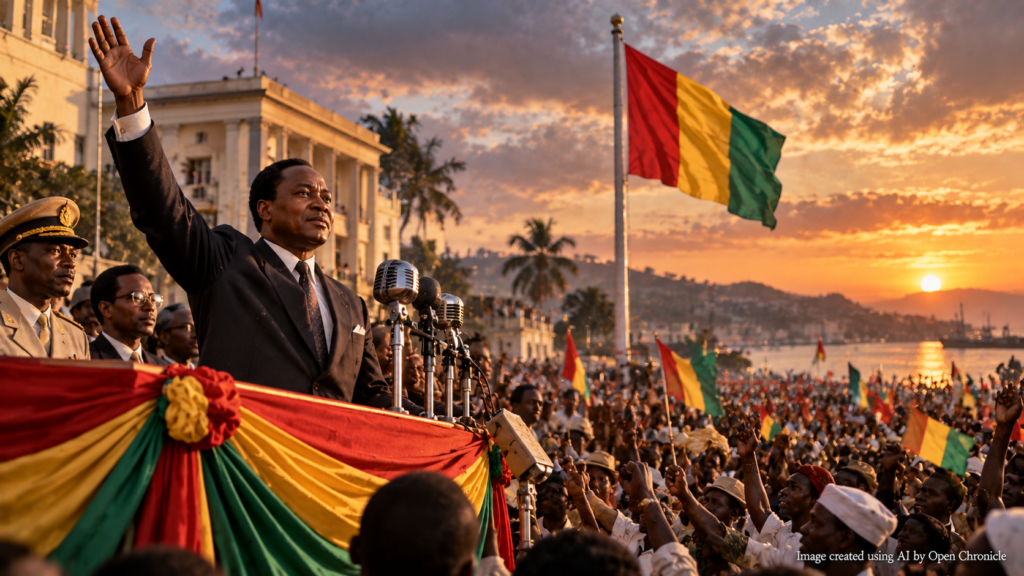
How one territory’s rejection of Charles de Gaulle’s proposed French Community created an independent African republic and became a powerful symbol of the accelerating collapse of European colonial rule
By Open Chronicle History Desk
On October 2, 1958, a new country appeared on the political map of Africa.
Its name was the Republic of Guinea.
Only days earlier, voters in the French West African territory had been asked to make an extraordinary choice.
France was creating a new constitutional system under Charles de Gaulle. Its African territories could approve the proposed constitution and enter a new French Community, or reject it and take the path toward immediate independence.
Across France’s African territories, the answer was overwhelmingly yes.
Guinea chose differently.
It voted no.
Four days after the referendum, Guinea’s National Assembly proclaimed the country independent on October 2, 1958. U.S. diplomatic records confirm that the Republic of Guinea was established by proclamation of its National Assembly on that date.
At the center of the confrontation stood a charismatic trade-unionist and political leader:
Ahmed Sékou Touré.
Guinea’s decision would resonate far beyond its borders.
It challenged France’s attempt to reorganize its African empire.
It encouraged anti-colonial movements elsewhere.
It thrust a small West African country directly into the politics of the Cold War.
And it helped signal that the era of European colonial rule in Africa was approaching a decisive turning point.
1. Africa Under Colonial Rule
At the beginning of the twentieth century, almost the entire African continent was controlled by European colonial powers.
Britain possessed enormous territories.
France governed a vast empire stretching across North, West and Central Africa.
Belgium controlled the Congo.
Portugal maintained colonies including Angola, Mozambique and Guinea-Bissau.
Spain retained African possessions.
Only a handful of African states remained formally independent.
The political map created during the nineteenth-century Scramble for Africa appeared remarkably durable.
But beneath it, African societies were changing.
Urbanization was expanding.
Trade unions were growing.
Educated political elites were emerging.
African soldiers had fought in two world wars.
Ideas of nationalism and self-determination were spreading.
The colonial order was beginning to fracture.
2. French West Africa
Guinea formed part of French West Africa, a federation that included territories corresponding to several modern West African states.
France governed these territories through a colonial administrative system centered in Dakar.
Guinea possessed considerable natural resources.
Its mineral wealth would later become especially important, particularly its enormous reserves of bauxite, the principal ore used to produce aluminium.
But colonial Guinea remained economically underdeveloped.
Infrastructure largely served colonial administrative and commercial priorities.
Political authority remained ultimately in French hands.
By the middle of the twentieth century, however, a new generation of African political leaders was demanding change.
3. The Second World War Changes Africa
The Second World War profoundly weakened Europe’s colonial empires.
France itself had been defeated and occupied by Nazi Germany in 1940.
African soldiers fought for France and other Allied powers.
The rhetoric of freedom and liberation used during the war inevitably raised questions.
If Europeans were fighting for national freedom, why should colonial peoples remain subjects?
After 1945, nationalist movements expanded across Africa and Asia.
India became independent in 1947.
Indonesia secured recognition of its independence in 1949.
Across Africa, demands for political representation and self-government intensified.
The colonial powers faced a transformed world.
4. Ghana Leads the Way
One development was particularly important for West Africa.
On March 6, 1957, the British colony of the Gold Coast became independent as Ghana.
Under Kwame Nkrumah, Ghana became the first sub-Saharan African colony to achieve independence in the postwar wave of decolonization.
Its political significance extended far beyond its borders.
Nkrumah argued that Ghana’s independence would be incomplete unless it contributed to the liberation of the rest of Africa.
For African nationalists elsewhere, Ghana provided proof that independence was not a distant aspiration.
It was happening.
And Guinea was watching.
5. Sékou Touré
The central figure in Guinea’s independence movement was Ahmed Sékou Touré.
Born in 1922, Touré became active in trade-union politics.
His political influence grew through the labor movement and through the Democratic Party of Guinea, associated with the broader African Democratic Rally.
He developed a reputation as a forceful advocate of African political autonomy.
Touré understood that organized labor could become a powerful political instrument.
Strikes and mass political mobilization increased pressure upon the colonial administration.
By the late 1950s, he had become the dominant political figure in Guinea.
Soon he would face the most consequential decision of his career.
6. France Faces an Imperial Crisis
Meanwhile, France itself was undergoing a political crisis.
The Fourth Republic had struggled with governmental instability.
France was also fighting a brutal colonial war in Algeria.
In May 1958, political turmoil surrounding the Algerian conflict helped bring Charles de Gaulle back to power.
De Gaulle sought to reconstruct the French political system.
A new constitution would establish the Fifth Republic.
But the future of France’s overseas territories also had to be addressed.
The solution was the proposed French Community.
7. The French Community
The proposed system attempted to replace older colonial relationships with a new political association.
African territories accepting the constitution would join the French Community.
They would receive greater autonomy while maintaining significant institutional links with France.
But de Gaulle also made another possibility explicit.
A territory could reject the constitution.
And rejection would mean independence.
During an August 24, 1958 speech at Brazzaville, de Gaulle stated clearly that any territory voting “no” in the September referendum could take independence immediately and that metropolitan France would not oppose it. elysee.fr
The choice was therefore real.
But it carried enormous risks.
8. De Gaulle Travels Through Africa
During the summer of 1958, de Gaulle toured French Africa promoting the new constitutional arrangement.
The journey was intended to demonstrate the possibilities of a reformed relationship between France and its African territories.
In most places, political leaders were prepared to accept the proposal.
Some viewed membership in the French Community as a transitional stage toward eventual independence.
Others feared the economic consequences of an immediate rupture with France.
Then de Gaulle arrived in Guinea.
The atmosphere was different.
9. Conakry
In Conakry, Sékou Touré confronted the French leader with a much stronger demand for sovereignty.
The encounter later became one of the most famous episodes in the history of Francophone African decolonization.
Touré’s political message was unmistakable.
Guinea was prepared to accept the risks of independence rather than preserve a relationship it considered incompatible with full sovereignty.
The disagreement was not merely personal.
It represented two competing visions of decolonization.
France sought an organized transition through continued institutional association.
Touré wanted Guinea to control its own political future.
The referendum would decide.
10. September 28, 1958: The Referendum
On September 28, 1958, voters across France and its overseas territories considered the proposed constitution.
In France itself, the constitution was overwhelmingly approved.
Most African territories also voted yes.
Guinea did not.
The Élysée’s historical account of de Gaulle’s presidency records that the overseas territories approved the constitution except Guinea, which consequently became the first of the relevant French African territories to choose immediate independence under this referendum mechanism.
The political consequences were immediate.
Guinea had chosen to leave the French constitutional framework.
Now independence had to become reality.
11. The Only “No”
Guinea’s rejection was remarkable because it stood virtually alone among the French African territories participating in the referendum.
Political leaders elsewhere had reasons to proceed more cautiously.
Their economies were deeply connected to France.
French administrators possessed technical expertise.
Public services depended upon established institutional networks.
Financial support came from metropolitan France.
Military relationships also mattered.
Breaking those connections overnight carried enormous uncertainty.
Guinea accepted that uncertainty.
That decision gave the referendum significance far beyond its borders.
12. Four Days
There was almost no long transitional period.
The referendum occurred on September 28.
Four days later came independence.
On October 2, 1958, Guinea’s National Assembly proclaimed the sovereign Republic of Guinea.
The colonial relationship with France had ended.
Sékou Touré became the new republic’s first president.
A territory that had been part of French West Africa was now an independent state.
The speed was extraordinary.
Decades of colonial rule had ended in days.
13. France Withdraws
The rupture between France and Guinea was severe.
French officials departed rapidly.
Technical personnel left.
Administrative relationships were dismantled.
French assistance was withdrawn.
The departure created major practical difficulties for the new state.
Guinea urgently needed administrators, teachers, technicians, financial resources and international partners.
Independence had been achieved.
Now came the much harder task:
making independence function.
14. What Does Independence Actually Mean?
This was one of the central questions facing every newly independent African state.
A flag could be raised in a day.
A constitution could be adopted.
A colonial governor could leave.
But statehood required much more.
Schools.
Hospitals.
Courts.
Civil servants.
Roads.
Electricity.
Currency arrangements.
Foreign trade.
Security forces.
Diplomatic representation.
Development policy.
Guinea inherited borders and institutions created under colonial rule.
The new government now had to transform those structures into the institutions of a sovereign African state.
15. The Economic Challenge
Guinea possessed enormous natural wealth.
The country would become especially important because of its bauxite deposits.
It also possessed agricultural resources and hydroelectric potential.
Yet natural resources did not automatically produce prosperity.
Infrastructure remained limited.
The economy had been structured within a French imperial network.
Independence therefore required Guinea to build new commercial and financial relationships rapidly.
The break with France intensified that challenge.
This economic vulnerability would strongly influence Guinea’s foreign policy.
16. Ghana and Guinea
One of Guinea’s strongest early supporters was Ghana.
Kwame Nkrumah viewed Guinea’s independence as another major advance for African liberation.
The relationship between Nkrumah and Touré became politically significant.
Both leaders promoted versions of Pan-Africanism, the idea that African states should cooperate closely and that the continent’s political liberation should eventually produce deeper forms of unity.
For Guinea, Ghana offered more than symbolism.
It demonstrated that an independent African state could assist another newly independent country attempting to escape colonial economic dependence.
17. Pan-Africanism
The late 1950s were an extraordinary moment for Pan-African politics.
Leaders including Nkrumah and Touré believed colonial borders and political fragmentation could leave African countries weak.
They imagined greater continental cooperation.
Economic coordination.
Diplomatic solidarity.
Support for liberation movements.
Perhaps even political federation.
Those ambitions would prove difficult to realize.
African governments had different political systems, strategic interests and economic priorities.
But the ideal helped shape the politics of decolonization.
Guinea became one of its important early centers.
18. Guinea Enters the Cold War
Independence came during another global transformation.
The Cold War was dividing international politics.
The United States and its allies competed with the Soviet Union and its partners for influence.
Newly independent states were becoming increasingly important.
Washington wanted to prevent Soviet expansion.
Moscow presented itself as an opponent of European colonialism.
New African governments sought development assistance while attempting to preserve their own political autonomy.
Guinea suddenly became part of this global competition.
19. Recognition
International recognition did not arrive everywhere simultaneously.
The United States initially considered how quickly it should formally recognize the new country.
A State Department telegram of October 17, 1958 acknowledged Sékou Touré’s request to establish diplomatic relations and stated that Washington was considering recognition of Guinea as an independent state.
President Dwight D. Eisenhower formally extended U.S. recognition in November.
The young republic was entering international diplomacy.
20. Guinea Joins the United Nations
Guinea soon sought membership in the United Nations.
On December 3, 1958, its representative submitted a formal declaration accepting the obligations of the UN Charter.
The Security Council recommended Guinea’s admission on December 9.
Three days later, on December 12, 1958, the General Assembly admitted the Republic of Guinea to the United Nations without a vote.
Only seventy-one days had passed since independence.
Guinea was now fully represented in the principal global organization of sovereign states.
21. A Precedent for French Africa
Guinea’s path initially appeared exceptional.
It did not remain so for long.
Within two years, much of French Africa would become independent.
1960 became known as the Year of Africa.
Seventeen African countries achieved independence that year.
Among them were numerous former French territories.
Senegal.
Mali.
Côte d’Ivoire.
Niger.
Upper Volta, now Burkina Faso.
Dahomey, now Benin.
Chad.
Central African Republic.
Congo-Brazzaville.
Gabon.
Mauritania.
The colonial map was being dismantled at extraordinary speed.
Guinea’s decision in 1958 had anticipated the transformation.
22. Independence Did Not Mean Democracy
The end of colonial rule did not guarantee democratic government.
This distinction is essential to Guinea’s history.
Sékou Touré gradually consolidated political power.
Guinea developed into a highly centralized one-party state.
Political opposition was suppressed.
Critics were imprisoned.
Many Guineans went into exile.
The notorious Camp Boiro became associated with political detention, torture and death.
The leader who had become internationally celebrated for rejecting colonial rule also presided over an authoritarian political system.
Both realities belong to the historical record.
23. Revolutionary State-Building
Touré’s government attempted to restructure Guinean society.
The state expanded its role in the economy.
Political institutions became closely connected to the ruling party.
The government promoted national identity and sought to weaken structures associated with colonial rule.
Guinea cultivated relationships with socialist countries while also maintaining contacts with other states.
The objective was political and economic independence.
The results were mixed.
Some policies expanded state institutions and reinforced sovereignty.
Others contributed to economic difficulties and political repression.
24. Guinea and France
Relations with France remained deeply strained after independence.
The abrupt break of 1958 created bitterness on both sides.
Diplomatic relations fluctuated.
Yet geography, language, economics and history made permanent separation impossible.
Two decades later, French President Valéry Giscard d’Estaing visited Guinea.
Speaking in Conakry in December 1978, he explicitly recalled that Guinea had attained independence on October 2, 1958 and described France and Guinea as countries that had become separated twenty years earlier and were now meeting again.
The colonial relationship was gone.
A new interstate relationship had slowly emerged.
25. The Wider Decolonization of Africa
Guinea’s independence belongs within one of the greatest geopolitical transformations of the twentieth century.
In 1945, European colonial empires still controlled much of Africa.
Within two decades, most of the continent consisted of independent states.
The transition occurred through many different paths.
Negotiation.
Referendums.
Political mobilization.
Strikes.
International pressure.
Insurgency.
War.
Guinea’s path was distinctive.
Its decisive break came through a referendum and an immediate declaration of sovereignty.
26. The Meaning of the “No”
The September vote became politically symbolic because it transformed a constitutional referendum into a question about sovereignty.
For Touré and his supporters, rejecting the proposed French Community represented the assertion that political independence should not be postponed because of economic fear.
For French officials and African leaders who favored the Community, gradual transition offered the possibility of maintaining economic stability and institutional cooperation.
Those competing calculations illustrate an important point.
Decolonization was not a single political programme.
African leaders disagreed profoundly about its pace, institutions and economic consequences.
Guinea chose one of the most immediate paths available.
27. A Small Country With an Enormous Symbolic Role
Guinea was not Africa’s largest country.
It was not the continent’s richest.
It did not possess the largest population.
Yet in 1958 its political significance became disproportionately large.
The reason was simple.
When presented with a choice between continued institutional association and immediate sovereignty, Guinea chose sovereignty.
That decision reverberated across French-speaking Africa.
It demonstrated that the French imperial structure was no longer permanent.
Once one territory had left, others could imagine doing the same.
28. The Paradox of Independence
Guinea’s history after 1958 also illustrates one of the central paradoxes of twentieth-century decolonization.
Political sovereignty could be achieved rapidly.
Economic independence was much harder.
Colonial economies had been integrated into global commercial networks controlled largely from abroad.
New governments inherited limited industrial bases.
Technical expertise was scarce.
Capital was scarce.
Infrastructure was uneven.
International commodity prices could determine national fortunes.
The flag changed immediately.
The economic structures underneath it often changed much more slowly.
29. The Legacy of Sékou Touré
Sékou Touré remains a complex historical figure.
To supporters of African liberation, he became the leader who refused to compromise Guinea’s sovereignty.
His role in the 1958 referendum secured his place in the history of African decolonization.
But his long presidency also became associated with authoritarian rule, political persecution and exile.
Touré remained in power until his death in 1984.
Understanding his legacy therefore requires holding two histories together.
The anti-colonial leader.
And the authoritarian ruler.
Neither can erase the other.
30. Why October 2 Matters
October 2, 1958 mattered because Guinea demonstrated that the political architecture of European colonialism could change with extraordinary speed.
Four days earlier, it had been a French colonial territory.
Now it was a sovereign republic.
Within two years, independence would sweep across much of Africa.
The map that Europeans had constructed during the age of empire was disappearing.
But the story also carries a warning against treating independence as the end of history.
Sovereignty created possibilities.
It also created immense responsibilities.
New states had to build institutions, economies and national identities while navigating Cold War rivalries and the enduring structural legacies of colonialism.
Guinea would experience all of those challenges.
October 2, 1958: The Day Guinea Chose Its Own Road
Imagine Conakry in the first days of October 1958.
Only days earlier, voters had entered polling stations to answer a constitutional question.
Their answer transformed the country.
French colonial authority was ending.
A new flag would represent a sovereign state.
Government offices that had belonged to an empire now belonged to a republic.
Diplomats would have to be appointed.
International recognition would have to be secured.
Schools and hospitals would have to continue functioning.
An economy would have to survive a sudden institutional rupture.
Nothing about independence guaranteed success.
But the fundamental decision had been made.
Guinea would govern itself.
Its choice did not destroy French colonial rule across Africa overnight.
Yet it demonstrated that the imperial system could be rejected.
Less than two years later, the African political map would be transformed by an extraordinary wave of independence.
In that larger history, October 2, 1958 stands as one of the moments when decolonization stopped looking like a distant possibility and began to look increasingly irreversible.
Guinea had said no to the old relationship.
And in doing so, it had said yes to the uncertain, difficult and historic experiment of sovereignty.
Historical Sources and Further Reading
Guinea’s independence in October 1958 formed part of the wider
transformation of France’s relationship with its African territories.
The following institutional and diplomatic records document Charles
de Gaulle’s position before the September referendum, the proclamation
of the Republic of Guinea, and the country’s subsequent entry into the
international community.
Charles de Gaulle’s Brazzaville Speech · August 24, 1958
The official text of Charles de Gaulle’s address in Brazzaville,
delivered during his tour of French Africa before the constitutional
referendum. The speech provides important primary evidence for the
political choice presented to France’s African territories, including
the possibility of independence following rejection of the proposed
constitutional framework.
Establishment of the Republic of Guinea · 1958
A document from the Foreign Relations of the United States collection
recording Guinea’s emergence as an independent republic and the
diplomatic questions that followed its separation from France.
It provides contemporary evidence of how Guinea’s independence was
understood within international diplomatic circles.
Admission of Guinea to Membership in the United Nations
United Nations documentation relating to Guinea’s admission as a member
state in December 1958, only weeks after the declaration of independence.
The record illustrates the rapid transition from colonial territory to
internationally recognized sovereign state.
Guinea’s Acceptance of the Obligations of the UN Charter
The formal declaration submitted by the Republic of Guinea accepting
the obligations contained in the Charter of the United Nations.
The document forms part of the institutional record of Guinea’s
emergence as a sovereign participant in the international system.
Open Chronicle History examines Guinea’s independence within the broader
history of African decolonization and the transformation of France’s
postwar empire. The referendum of September 1958 and the proclamation
of independence on October 2 established Guinea as a sovereign state,
but independence was followed by difficult questions of economic
development, international alignment and political authority. Sékou
Touré’s historical legacy therefore encompasses both his prominent role
in anti-colonial politics and the authoritarian system that developed
during his long presidency.