
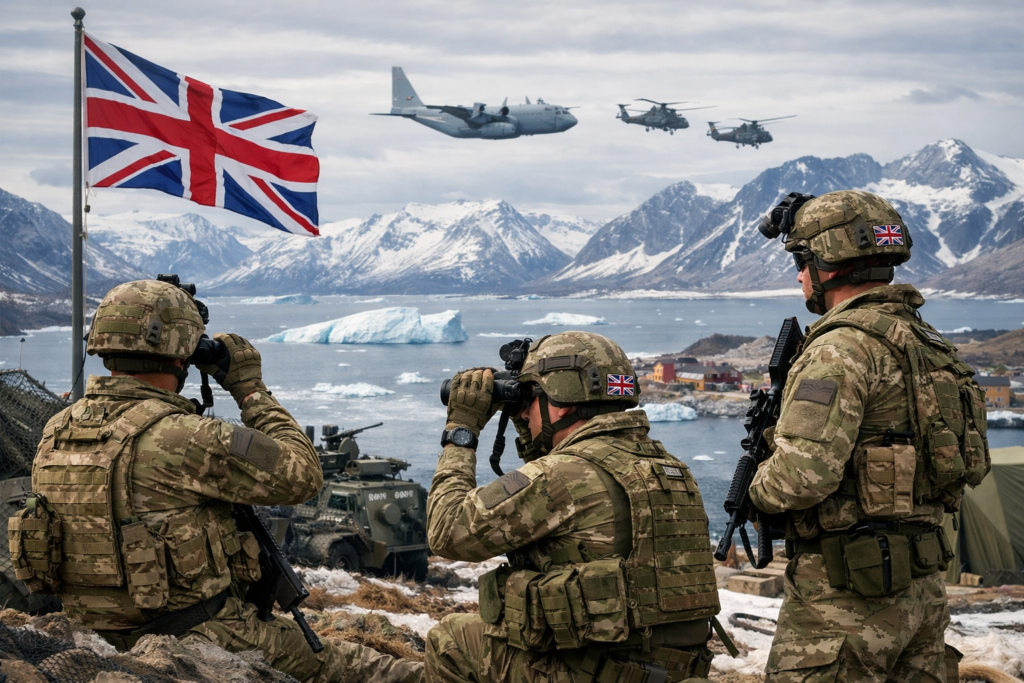
Image Credentials: Image Title: UK Weighs Greenland Troop Deployment as Tensions Rise Over Arctic Security Source: (sora.openai) Date: January 2026. Attribution: This image was created using AI-generated imagery (sora.openai) and does not depict a real-world scene.
By Open Chronicle News Desk Staff with Agencies
London is weighing the possibility of sending British troops to Greenland as part of a broader NATO effort to ease security tensions sparked by President Donald Trump’s renewed push to assert American control over the Arctic territory.
According to reports in The Independent and The Telegraph, Prime Minister Keir Starmer is considering a potential deployment to the autonomous Danish territory, which has become a flashpoint in the growing strategic rivalry between Western allies on one side and Russia and China on the other. Government sources said Starmer shares Trump’s assessment that Moscow’s expanding military footprint in the High North represents a serious and growing threat to Euro-Atlantic security.
Downing Street officials have confirmed that talks are underway with European allies, including Germany and France, to explore options for a NATO mission on the island. Military planners are said to be drafting early-stage proposals that could include British soldiers, naval vessels, and aircraft. These plans range from a permanent troop presence to time-limited exercises, intelligence cooperation, and new defense investments designed to strengthen deterrence in the Arctic.
The initiative reflects mounting concern in European capitals that Greenland’s strategic location, sitting astride vital Arctic air and sea routes and close to North America, makes it a critical piece of NATO’s northern defense architecture. Russia has steadily increased its military activity in the Arctic, while China has sought to expand its influence through scientific, commercial, and infrastructure projects across the region.
Trump has made Greenland a central focus of his foreign policy rhetoric, arguing that the island is essential to US security and warning that without American control, it could fall under Russian or Chinese influence. Speaking on Friday, he said the United States would “do something on Greenland, whether they like it or not,” a statement that sent shockwaves through allied governments.
Leaders of Greenland’s political parties responded by firmly rejecting any suggestion of becoming part of the United States. “We do not want to be Americans, we do not want to be Danes, we want to be Greenlanders,” they said in a joint statement, underlining the island’s desire for greater self-determination while remaining within the Kingdom of Denmark.
Denmark has also dismissed any notion of selling or transferring Greenland, reiterating its sovereignty over the territory. However, Copenhagen has indicated it is open to deeper cooperation with NATO partners to bolster Arctic security, a stance that aligns with the emerging European plan to strengthen the alliance’s presence without altering Greenland’s political status.
For Britain, a deployment would mark a significant step in its post-Brexit security posture, reinforcing its role as a leading military power within NATO. It would also serve as a diplomatic signal to Washington that allied governments are prepared to address legitimate security concerns in the Arctic, even as they resist any move to redraw borders or undermine the sovereignty of Greenland and Denmark.
As discussions continue, the Arctic is fast becoming one of the most sensitive theaters in global geopolitics, where climate change, natural resources, and great power competition are converging. Whether through joint exercises or a standing NATO force, Greenland is now at the center of a struggle to define how the West defends the top of the world without fracturing the alliance itself.