
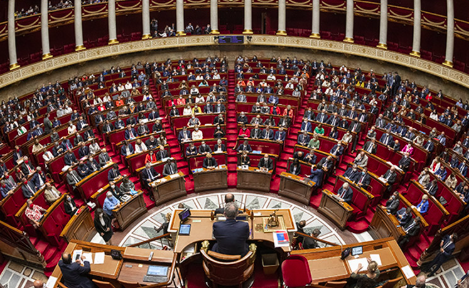
Image: from MinuteActu X@Minute_actuu
By Open Chronicle News Desk Staff with Agencies
January 14, 2026
PARIS — Thursday, January 15, 2026 — The French government, led by Prime Minister Sébastien Lecornu, successfully defeated two motions of no confidence in the National Assembly on Wednesday. The votes, triggered by the controversial EU-Mercosur trade agreement, failed to garner the necessary support, leaving the administration intact despite mounting pressure from the agricultural sector and opposition parties.
The Numbers: A Symbolic Defeat for the Opposition
The motions, tabled separately by the left-wing France Unbowed (LFI) and the far-right National Rally (RN), were intended to condemn the government’s handling of the trade deal with the South American bloc. However, the results fell significantly short of the 288 votes required to topple the cabinet:
-
LFI Motion: 256 votes in favor.
-
RN Motion: 142 votes in favor.
The outcome was largely expected after Socialist Party leader Olivier Faure questioned the utility of bringing down the government over an issue where President Emmanuel Macron has consistently voiced opposition to the current terms of the deal.
L'Assemblée rejette notre motion de censure sur le Mercosur.
Notre motion a obtenu 256 voix sur les 289 qui auraient été nécessaires pour faire tomber le gouvernement.
Les socialistes ne l’ont pas votée et sauvent Sébastien Lecornu. pic.twitter.com/gkSNtxQ2NH
— Gabrielle Cathala (@GabrielleCthl) January 14, 2026
Farmers’ Fury Moves to the Motorways
While the government survived the parliamentary challenge, the streets told a different story. Though the 350 tractors that occupied the space outside the National Assembly departed at dawn, the protest transitioned into a nationwide blockade.
On Wednesday, farmers targeted critical infrastructure, blocking motorways and several fuel depots across the country. The anger stems from fears that the Mercosur deal will flood the French market with agricultural products that do not meet the strict environmental and sanitary standards imposed on local producers.
Legislative Olive Branch: The “Emergency Bill”
In a bid to de-escalate the crisis, Prime Minister Lecornu announced a draft “emergency bill” focused on simplifying agricultural regulations. The legislation, set for review before the summer, aims to address:
-
Water Policy: Streamlining access for irrigation.
-
Wolf “Predation”: Providing more flexibility for farmers to protect livestock.
-
Means of Production: Reducing bureaucracy surrounding farming inputs.
Government spokesperson Maud Bregeon criticized the opposition for blocking the state budget while claiming to support farmers, noting that the budget contains essential financial aid for the sector.
The Battle Shifts to Strasbourg
Foreign Minister Jean-Noël Barrot maintained that France has “not lost the war,” pointing out that the agreement still requires ratification by the European Parliament and individual member states.
The next major flashpoint is scheduled for January 20, when French farmers will hold a demonstration outside the European Parliament in Strasbourg. The following day, MEPs will vote on whether to refer the Mercosur agreement to the Court of Justice of the European Union—a legal move that could stall the deal’s implementation for months.
Mercosur Crisis: Key Dates and Figures
| Event | Date | Impact / Result |
| No-Confidence Votes | Jan 14, 2026 | Failed. Government remains in power. |
| National Blockades | Jan 14-15, 2026 | Motorways and fuel depots were obstructed. |
| Strasbourg Protest | Jan 20, 2026 | Massive farmer demonstration planned. |
| EU Parliament Vote | Jan 21, 2026 | Potential referral to the Court of Justice. |
The Lecornu government has secured a reprieve in the National Assembly, but the political victory remains overshadowed by the physical blockades across France. With the fight moving to the European level next week, the survival of the government in Paris may depend on its ability to convince Brussels to halt or drastically alter the Mercosur deal.