
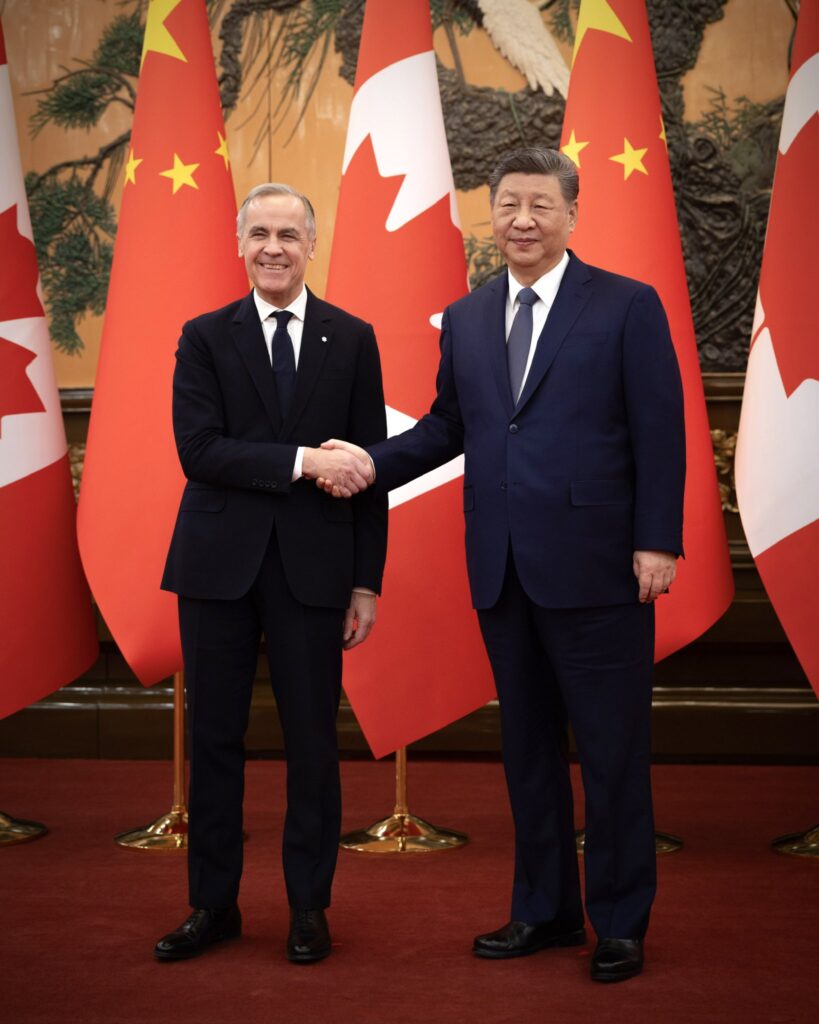
Image: from Mark Carney X@MarkJCarney
By Open Chronicle News Desk Staff with Agencies
January 16, 2026The United States has issued a sharp warning to Canada following Ottawa’s decision to ease restrictions on Chinese electric vehicles, arguing that the move could have long-term economic and security consequences.
Senior officials in President Donald Trump’s administration said Canada would “surely regret” its agreement to allow up to 49,000 Chinese-made electric vehicles into its market at a reduced tariff rate of 15 percent, down from the previous 100 percent. The comments underline growing tensions in North America over trade policy, industrial strategy, and China’s expanding role in the global automotive sector.
Speaking at a Ford factory in Ohio, US Transportation Secretary Sean Duffy criticized the Canadian decision, saying it would undermine domestic manufacturing and expose Canada to strategic risks. He stressed that vehicles imported under the new Canadian framework would not be permitted to enter the United States.
“I think they will look back at this decision and regret bringing Chinese cars into their market,” Duffy said, as the administration highlighted its efforts to support US-based auto production and lower costs for American consumers.
BREAKING 🚨
The U.S. just publicly WARNED Canada over Chinese EVs.
Sean Duffy: “Canada will regret this decision.”
Jamieson Greer: “Those cars aren’t coming here.”Good Luck Crossing the Border with your Chinese EV pic.twitter.com/DxP2dYYC7c
— Marc Nixon (@MarcNixon24) January 16, 2026
The Canadian decision followed talks in Beijing, where Prime Minister Mark Carney announced expectations that China would significantly reduce tariffs on Canadian canola seed by early March, lowering the combined rate to around 15 percent from 85 percent. The agreement was framed by Ottawa as a pragmatic trade-off aimed at restoring access to the Chinese market for key Canadian exports.
JUST IN: 🇨🇳🇨🇦 China to allow visa-free entry for Canadian visitors. pic.twitter.com/eKLSRSGgum
— BRICS News (@BRICSinfo) January 16, 2026
US Trade Representative Jamieson Greer, however, questioned the wisdom of the deal, arguing that short-term trade concessions could lead to longer-term strategic dependence. “In the long run, they are not going to like having made that deal,” he said.
A central concern raised by US officials is vehicle cybersecurity. Greer pointed to regulations adopted in January 2025 governing internet-connected vehicles and navigation systems, which he described as a major barrier to Chinese automakers entering the US market. According to Greer, compliance with American cybersecurity standards would be difficult for Chinese manufacturers, effectively limiting their ability to operate in the United States.
Despite this hard line, President Trump has previously suggested he would welcome Chinese automakers building vehicles on US soil, a position that reflects his broader focus on domestic investment rather than imports. Still, opposition to Chinese vehicles remains strong across the US political spectrum.
Lawmakers from both major parties have echoed industry warnings that China poses a serious threat to the American auto sector. Ohio Senator Bernie Moreno, a Republican, drew loud applause at the Ohio event when he declared his firm opposition to Chinese cars entering the US market.
“As long as I have air in my body, there will not be Chinese vehicles sold in the United States of America,” Moreno said.
The dispute highlights widening differences between Washington and Ottawa on how to balance trade, industrial policy, and relations with China. While Canada seeks economic relief and market access, the United States is signaling that it will continue to treat Chinese electric vehicles as both an economic and a national security challenge.