
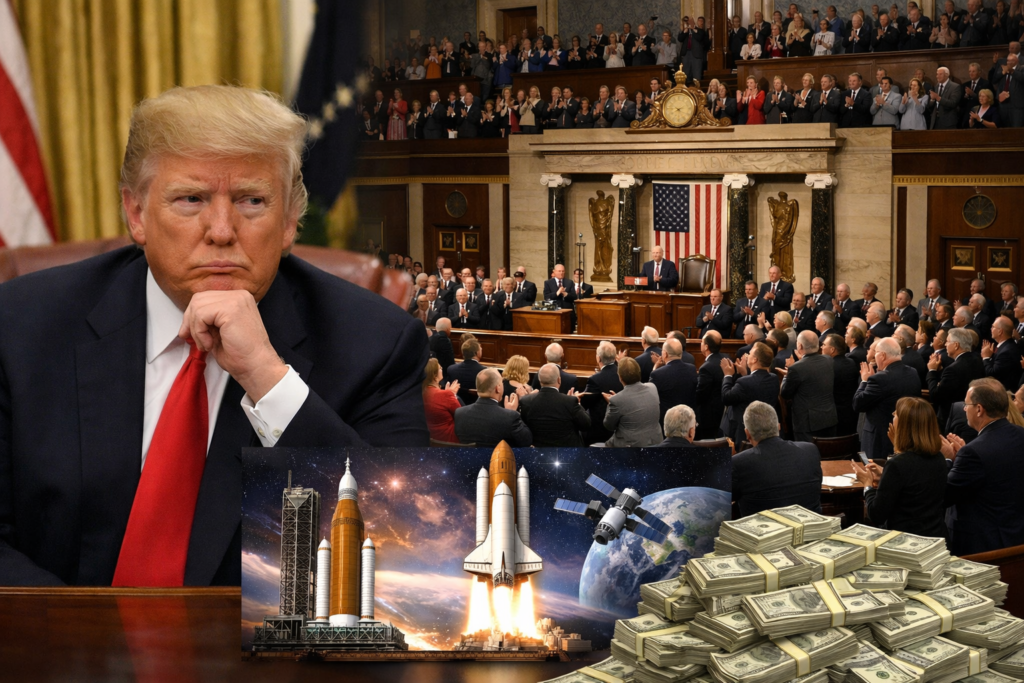
Image Credentials: Image Title: Congress Defies Trump, Secures Historic NASA Funding in Major Budget Showdown Source: (sora.openai) Date: January 2026. Attribution: This image was created using AI-generated imagery (sora.openai) and does not depict a real-world scene.
By Open Chronicle News Desk Staff with Agencies
Washington — In a rare display of bipartisan consensus, the United States Congress has passed a 24.4 billion dollar budget for NASA for fiscal year 2026, firmly rejecting President Donald Trump’s proposal for deep cuts to the space agency and underscoring the legislature’s authority over federal spending.
The so-called minibus spending package was approved by overwhelming margins, 397 to 28 in the House of Representatives and 82 to 15 in the Senate. The bill now heads to President Trump’s desk, where he is widely expected to sign it into law despite having proposed a far smaller budget earlier this year.
Trump’s original fiscal plan called for allocating just 18.8 billion dollars to NASA, a reduction of roughly 24 percent compared to 2025 levels. The most severe reductions targeted NASA’s science programs, with proposed cuts of nearly 47 percent, a move that would have led to the cancellation of more than 40 active or planned missions. Lawmakers from both parties signaled early on that such reductions were politically and strategically unacceptable.
“This package rejects the steep cuts the president wanted and protects investments that families across America depend on every day,” said Senator Patty Murray of Washington, vice chair of the Senate Appropriations Committee. She emphasized that the legislation preserves funding for scientific research, energy cost relief programs, and environmental protections alongside space exploration.
Under the final agreement, NASA’s Science Mission Directorate will receive 7.25 billion dollars, only a marginal decrease from 2025 and nearly double what the White House had requested. This decision effectively saves dozens of missions, including the Da Vinci and VERITAS probes to Venus, as well as ongoing deep space missions such as New Horizons at Pluto, Juno orbiting Jupiter, and the OSIRIS APEX asteroid project.
One major casualty remains the Mars Sample Return program, a long-delayed and increasingly expensive effort to bring Martian soil collected by the Perseverance rover back to Earth. Even so, NASA is continuing to explore alternative architectures for retrieving the samples at a lower cost.
Beyond the minibus bill, Congress had already approved additional long-term funding through the One Big Beautiful Bill Act, which allocates 10 billion dollars to NASA over six years, largely for human spaceflight initiatives. Combined, total NASA funding for fiscal year 2026 will exceed 27.5 billion dollars.
According to the Planetary Society, this represents NASA’s largest budget since 1998, when adjusted for inflation. For many lawmakers, the vote was not just about space exploration but about asserting congressional power and signaling that long-term scientific investment remains a national priority regardless of shifting presidential agendas.
The outcome highlights a broader political reality in Washington, even in an era of sharp partisan division, space policy continues to command strong cross-party support, and attempts to dramatically shrink NASA face stiff resistance on Capitol Hill.