
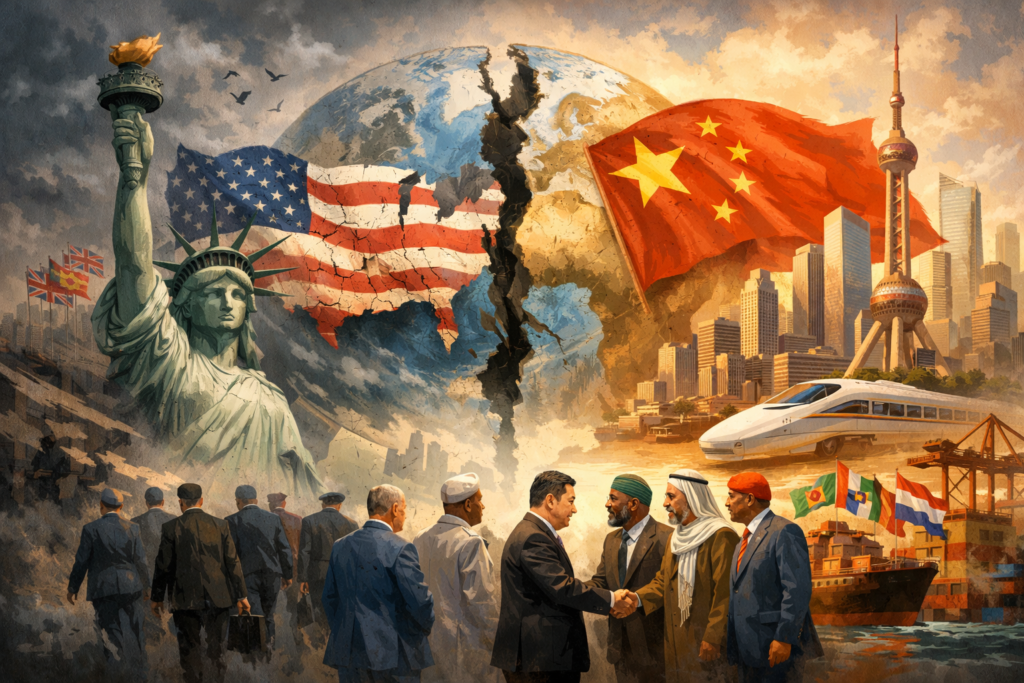
Image Credentials: Image Title: How Trump Is Making China Great Again: A Global Shift in Power Perceptions Source: (sora.openai) Date: January 2026. Attribution: This image was created using AI-generated imagery (sora.openai) and does not depict a real-world scene.
By Madison Walker | Open Chronicle Senior Editor
A growing number of countries no longer view the United States as a reliable ally, while expectations of China’s global rise are strengthening across much of the world. This is the central conclusion of a new international report titled How Trump Is Making China Great, published by the European Council on Foreign Relations in cooperation with the University of Oxford’s Europe in a Changing World project and the Calouste Gulbenkian Foundation.
Based on survey data collected in November 2025 from nearly 26,000 respondents across 21 countries, the report paints a picture of a rapidly shifting geopolitical landscape. It suggests that the “America First” policies of President Donald Trump are accelerating a decline in global confidence in US leadership, while indirectly reinforcing China’s position as a future global powerhouse.
Declining Trust in the United States
Across multiple regions, perceptions of the United States have deteriorated sharply. About one in four respondents in China, Russia, Ukraine, and even the United States itself expect American global influence to decline in the coming years.
The shift is most pronounced in Europe. Only 16 percent of EU citizens now consider the United States an ally, while 20 percent see it as a rival or outright enemy. This marks a dramatic change from previous years and reflects deep unease over Washington’s approach to European security, trade, and diplomacy under the Trump administration.
Despite Trump’s rhetoric, the report highlights a disconnect between US government policy and American public opinion. Around 40 percent of Americans still see the EU as an ally, and nearly half agree that European security is inseparable from US security. A majority of Americans also continue to view Russia’s war in Ukraine as a direct threat to US national security.
China’s Rising Appeal
While confidence in the US erodes, expectations of China’s future role are expanding. In major middle powers, belief in China’s growing influence over the next decade is strikingly high. This sentiment is strongest in South Africa, where 83 percent expect China’s influence to increase, followed by Brazil at 72 percent and Turkey at 63 percent.
Within the European Union, many citizens believe China will emerge as the world leader in electric vehicle manufacturing and renewable energy technologies within ten years. These expectations reflect both China’s industrial momentum and doubts about Western cohesion and long-term strategy.
Shifting Attitudes Toward Trump
The report also tracks declining optimism about Donald Trump globally. In India, for example, 84 percent of respondents viewed Trump’s election as positive for their country at the end of 2024. That figure has now dropped to 53 percent. Similar patterns appear elsewhere, suggesting that initial hopes for transactional benefits have given way to broader concerns about instability and unpredictability.
Europe’s Growing Pessimism and Rearmament Debate
Europeans emerge from the survey as among the most pessimistic populations surveyed. Nearly half doubt that the future will be better for their own countries, and a majority are pessimistic about the world as a whole.
This mood is accompanied by a growing acceptance of hard security measures. Across Europe, 52 percent support higher defense spending, 45 percent favor the reintroduction of compulsory military service, and 47 percent are open to the idea of a European nuclear deterrent. These figures reflect a profound reassessment of Europe’s security posture in an era of weakened transatlantic trust.
Russia, Ukraine, and the New Lines of Conflict
The data also show shifting perceptions in Russia. Europe is now seen as Moscow’s primary adversary by a majority of Russians, overtaking the United States. Fewer Russians today view the US as their main enemy compared to previous years, a change that underscores how the center of geopolitical confrontation is moving closer to Europe.
Ukrainians, according to the report’s authors, increasingly look to Brussels rather than Washington for long-term support, another sign of Europe’s growing strategic responsibility.
A World Reordered
Mark Leonard, cofounder and director of the ECFR, summarizes the findings bluntly. The world increasingly believes that Western dominance is fading. Europe no longer sees America as a dependable ally, Russia views Europe as its main enemy, and China is emerging as the primary beneficiary of this fragmentation.
The report concludes that Trump’s effort to put America first has, paradoxically, reduced US popularity among allies and helped propel China into a leading global position. In the eyes of much of the world, power is shifting, alliances are loosening, and the geopolitical center of gravity is moving eastward.
The Grand Strategy Institute
Continue Exploring Strategic Analysis
Return to The Grand Strategy Institute for strategic assessments, long-form analysis and research examining geopolitics, military affairs, international security, emerging technologies and the changing international order.
← Back to The Grand Strategy Institute