
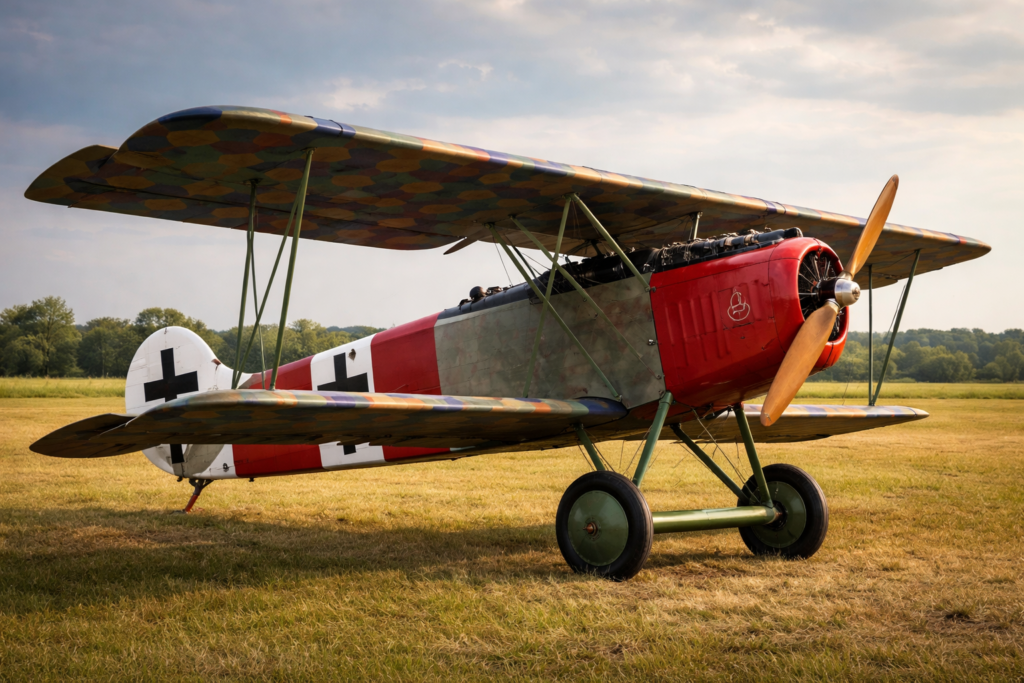
Image Credentials: Image Title: The Fokker D.VII: The Fighter That Shaped Aerial Warfare in World War I Source: (sora.openai) Date: January 2026. Attribution: This image was created using AI-generated imagery (sora.openai) and does not depict a real-world scene. Source: (sora.openai) Date: January 2026. Attribution: This image was created using AI-generated imagery (sora.openai) and does not depict a real-world scene.
By Open Chronicle History Desk | January 17, 2026
In the final year of World War I, the skies over Europe witnessed the rise of an aircraft that would redefine aerial combat: the Fokker D.VII. Developed by Dutch-born engineer Anthony Fokker for the German Luftstreitkräfte, the D.VII quickly earned a reputation as the most formidable fighter of the conflict. Its performance was so feared that the Armistice Treaty of November 1918 specifically demanded the surrender of all D.VII aircraft to Allied forces — a rare distinction that highlighted the aircraft’s battlefield dominance.
The Fokker D.VII was a testament to innovative aeronautical engineering. Its design utilized a metal frame covered in fabric, providing both lightness and durability. Powered by a high-performance inline engine, typically rated at 185 hp with some experimental models reaching 240 hp, the aircraft combined impressive climb rates with excellent maneuverability. This allowed German pilots to engage in vertical dogfights with a level of control unmatched by Allied fighters like the Sopwith Camel or SPAD XIII, which were prone to stalling or spinning under extreme aerial maneuvers.
Great! The Dutch Fokker D.VII of the Deutsches Museum in Munich will return to Holland. In 1945, American soldiers belonging to the Monuments Men, discovered the aircraft in a barn in Vilsbiburg during their search for stolen art treasures. It was transferred to museum in Munich. pic.twitter.com/lssi9mlsTK
— Klaas Meijer (@klaasm67) March 11, 2025
A Fokker test pilot famously remarked, “The plane with this engine is very good, has an excellent rate of climb, and the excess power allows for zooming at extremely high, almost vertical angles. Then, the plane just hangs on its propeller.” This capability made the D.VII lethal in combat, giving pilots a critical advantage in both offensive and defensive engagements.
Despite a relatively limited production run of 775 aircraft entering frontline Jagdstaffeln squadrons, the Fokker D.VII proved extraordinarily effective, racking up hundreds of confirmed kills. Its robust construction and reliable handling made it a preferred aircraft for Germany’s top aces. Early production challenges, such as phosphorus bullets igniting due to engine heat, were swiftly resolved, further solidifying the aircraft’s reputation on the battlefield.
Fokker D.VII replica C-GWWI of the Great War Flying Museum in the all-white markings of Hermann Goering. pic.twitter.com/mKej33J0hY
— Ron Eisele (@ron_eisele) April 14, 2023
The D.VII’s dive characteristics and rate of climb allowed pilots to execute aggressive tactics that Allied aircraft could not match. In dogfights, the D.VII could gain altitude rapidly, engage from above, and maintain stability in high-speed dives, giving German pilots a significant edge in both offensive sorties and defensive maneuvers over the Western Front.
The Fokker D.VII was more than just a technological marvel; it was a strategic concern for the Allies. The Armistice Treaty explicitly listed the D.VII among the materials to be surrendered:
“Surrender in good condition by the German armies of the following war material… all of the D 7’s…”
This rare mention reflected Allied recognition that, without neutralizing this fighter, Germany could have retained significant aerial strength even in defeat.
Staffel Leader Oberleutnant Karl Menckhoff’s Fokker D.VII of Jasta 82, Bergnecourt, France, July 1918. pic.twitter.com/PMADqr8mtL
— Ron Eisele (@ron_eisele) January 10, 2026
After the war, the Fokker D.VII continued to have a lasting influence on military aviation worldwide. Several countries acquired the aircraft through war reparations, and licensed production continued in nations such as the United States and Austria until 1929. Its design principles — structural integrity, climb performance, and maneuverability — informed the next generation of fighter aircraft and cemented the D.VII as a benchmark for aerial combat excellence.
The Fokker D.VII stands as a symbol of the transformative power of aviation in World War I. Combining superior engineering with combat versatility, it reshaped air warfare, providing German pilots with unprecedented advantages and compelling the Allies to acknowledge its threat in international treaties. Decades later, historians and aviation enthusiasts continue to regard the D.VII as the apex of WWI fighter design, a plane whose influence would resonate long after the guns of the Great War fell silent.
‘Low Level Strafe’- gouache on board by Michael Turner (b.1934). Work by the British aviation & automotive artist depicting the German Fokker D.VII fighter of the Great War. pic.twitter.com/lTPv5l4qqh
— Peter Hill (@petehill854) August 19, 2024
Fokker D.VII Technical Specifications and Combat Record
Role: Fighter aircraft
Manufacturer: Fokker Flugzeugwerke
First flight: January 1918
Introduced: Spring 1918
Number built: ~3,300 (775 frontline aircraft for German Jagdstaffeln)
Crew: 1 (pilot)
Dimensions:
-
Wingspan: 8.90 m (29 ft 2 in)
-
Length: 6.95 m (22 ft 10 in)
-
Height: 2.95 m (9 ft 8 in)
-
Wing area: 20 m² (215 sq ft)
Weight:
-
Empty: 687 kg (1,514 lb)
-
Maximum takeoff: 950–1,100 kg (2,094–2,425 lb)
Powerplant:
-
1 × Mercedes D.IIIa / BMW IIIa inline-six engine, 185–240 hp
Performance:
-
Maximum speed: 189–200 km/h (117–124 mph)
-
Service ceiling: 6,000–7,000 m (19,685–22,965 ft)
-
Climb rate: ~5.5 m/s (1,080 ft/min)
-
Endurance: ~90–120 minutes
Armament:
-
2 × 7.92 mm LMG 08/15 Spandau machine guns
-
Early experimental versions had incendiary/phosphorus bullets (later resolved)
Construction:
-
Metal tube fuselage frame with fabric covering
-
Plywood was used in later wartime models due to material shortages (reduced performance)
Notable Pilots and Combat Record
-
Rittmeister Hermann Göring – Future leader of the Luftwaffe, scored kills in D.VII
-
Oberleutnant Ernst Udet – Famous ace who praised the D.VII’s climb and handling
-
Leutnant Rudolf Berthold – German ace who flew the D.VII in the war’s final months
Combat Achievements:
-
Hundreds of confirmed kills during 1918
-
Exceptional performance in vertical dogfights, allowing pilots to engage and disengage at will
-
Robust construction enabled survival in combat that might have downed other fighters
Legacy:
-
Explicitly demanded in the Armistice Treaty
-
Licensed production continued until 1929 in several countries
-
Influenced fighter aircraft design in the 1920s and 1930s
References
-
van Wyngarden, G. (2006). Fokker D.VII Aces of World War 1. Osprey Publishing.
-
Franks, N., & Bailey, F. W. (1993). Over the Front: A Complete Record of the Fighter Aces and Units of the United States and French Air Services, 1914–1918. Grub Street.
-
Herris, J. (2010). Fokker Aircraft of WWI: Volume 1 – Fighters. Aeronaut Books.
-
Grosz, P. M., Haddow, G. W., & Schiemer, H. M. (1990). Fokker D.VII: The German Air Force’s Premier Fighter of World War I. Albatros Publications.
-
Vanwyngarden, G. (2011). Early German Aces of World War I. Osprey Publishing.
-
Gray, P., & Thetford, O. (1962). German Aircraft of the First World War. Putnam & Company.