
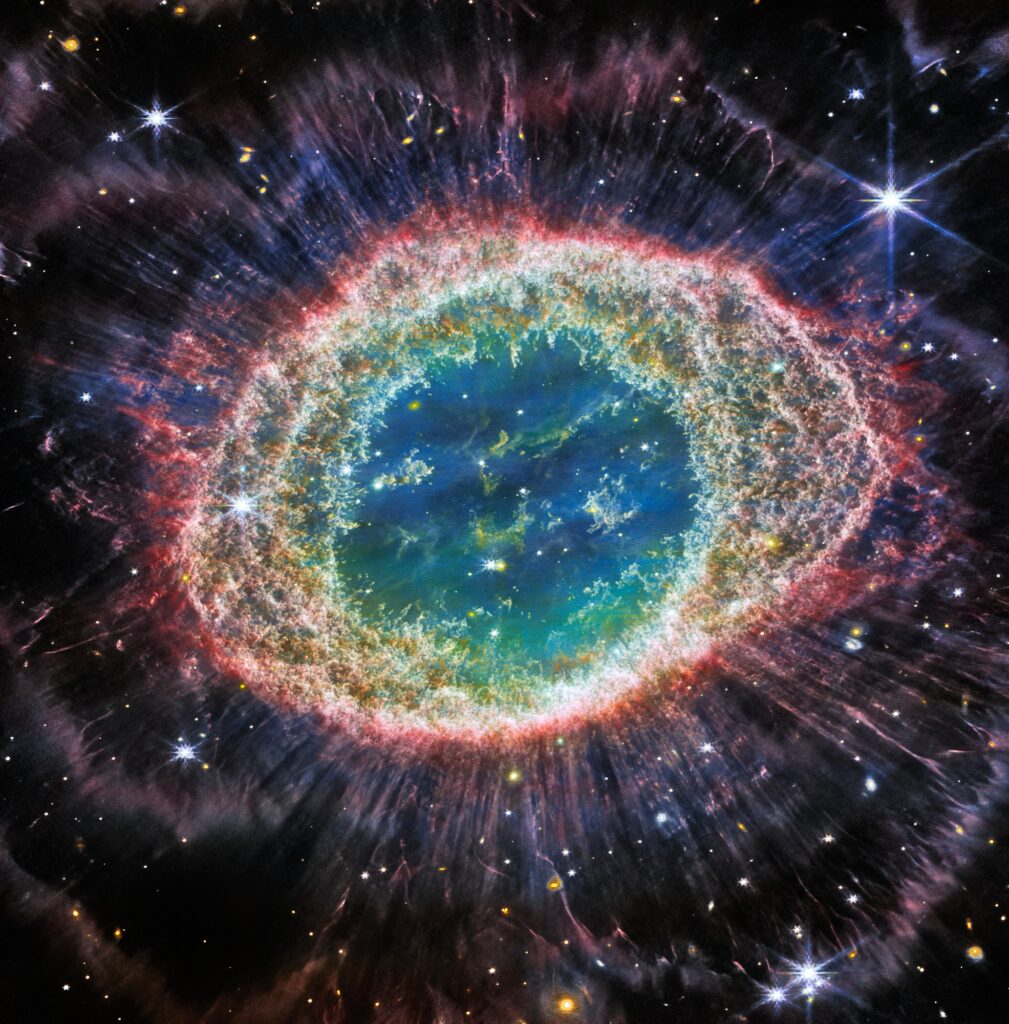
Image: from World and Science X@WorldAndScience
By Science & Technology Desk January 18, 2026
In a discovery that has surprised the astronomical community, a team of researchers has identified a gargantuan “bar” made of iron hidden within the famous Ring Nebula (Messier 57). The findings, published today in the Monthly Notices of the Royal Astronomical Society, reveal a structure of such immense proportions that it challenges our current understanding of how dying stars distribute their elemental remains.
Mysterious discovery: new instrument uncovers a huge bar-shaped iron feature in the Ring Nebula: https://t.co/sKoJn3SPGN pic.twitter.com/NDNe9Xb3Fr
— World and Science (@WorldAndScience) January 16, 2026
A Monumental Discovery
The Ring Nebula, located approximately 2,600 light-years away in the constellation Lyra, has been a favorite subject for telescopes for centuries. However, it took a cutting-edge new instrument to reveal its metallic secret. Using the WHT Enhanced Area Velocity Explorer (WEAVE) on the William Herschel Telescope in the Canary Islands, astronomers detected a narrow cloud of ionized iron atoms stretching across the center of the nebula.
The scale of this structure is difficult to comprehend. The iron bar spans a distance roughly 500 times greater than Pluto’s orbit around the Sun. Despite its diffuse nature, the total mass of iron contained within the bar is approximately equal to the mass of the planet Mars.
The Power of WEAVE
The discovery was made possible by WEAVE’s Large Integral Field Unit (LIFU), which uses hundreds of optical fibers to capture spectra from every point across the nebula simultaneously.
“Even though the Ring Nebula has been studied using many different telescopes, WEAVE allowed us to observe it in a way that provided far more detail than before,” said lead author Dr. Roger Wesson of University College London (UCL) and Cardiff University. “When we processed the data, this previously unknown ‘bar’ of iron atoms popped out as clear as anything in the middle of the familiar ring.”
The Mystery of Its Origin
The presence of such a concentrated structure of iron in a planetary nebula is unexpected. Planetary nebulae are formed when stars like our Sun reach the end of their lives and shed their outer layers, but the distribution of elements is usually more symmetrical.
Astronomers are currently debating two primary theories for the bar’s existence:
-
Stellar Ejection Dynamics: The bar may be a byproduct of complex, undiscovered processes in how the dying star expelled its material, potentially influenced by a binary companion star.
-
The “Vaporized Planet” Hypothesis: A more speculative but intriguing theory suggests the iron could be the remains of a rocky, Earth-like or Mars-like planet that was vaporized as the central star expanded into a red giant.
What This Means for Our Sun
The Ring Nebula is often cited as a preview of the future of our own solar system. In several billion years, the Sun is expected to eject its outer layers in a similar fashion. If the “vaporized planet” theory holds, this discovery could provide a grim look at the ultimate fate of the inner planets of our solar system, including Earth.
Next Steps
The research team is already planning follow-up observations at higher spectral resolutions to determine if other chemical elements are present within the iron bar. “We need to know whether any other elements co-exist with the iron,” explained co-author Professor Janet Drew of UCL. “That information would likely tell us which model of formation is correct.”
Story Source:
Materials provided by University College London. Note: Content may be edited for style and length.
Journal Reference:
- R Wesson, J E Drew, M J Barlow, J García-Rojas, R Greimel, D Jones, A Manchado, R A H Morris, A Zijlstra, P J Storey, J A L Aguerri, S R Berlanas, E Carrasco, G B Dalton, E Gafton, R García-Benito, A L González-Morán, B T Gänsicke, S Hughes, S Jin, R Raddi, R Sánchez-Janssen, E Schallig, D J B Smith, S C Trager, N A Walton. WEAVE imaging spectroscopy of NGC 6720: an iron bar in the Ring. Monthly Notices of the Royal Astronomical Society, 2026; 546 (1) DOI: 10.1093/mnras/staf2139