
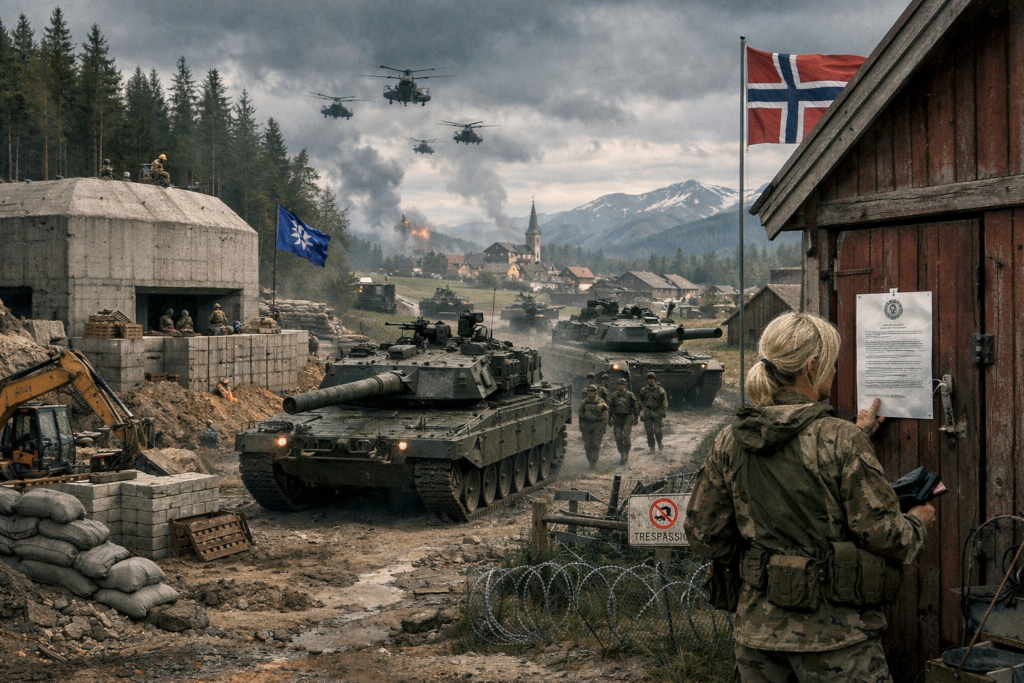
Image Credentials: Image Title: Fortifications, Confiscations, and Secret Plans: How Europe is Preparing for War with Russia Source: (sora.openai) Date: January 2026. Attribution: This image was created using AI-generated imagery (sora.openai) and does not depict a real-world scene.
By José Carlos Palma | January 20, 2026
As the geopolitical climate on the European continent shifts from “hypothetical threat” to “strategic reality,” nations across the EU and NATO have moved into an unprecedented state of military and civilian readiness. From the construction of concrete bunkers in the Baltics to the notification of property confiscation in Norway, 2026 has become the year Europe began seriously preparing for a confrontation with the Russian Federation.
The sense of urgency has been amplified by the deteriorating relationship between the European Union and the United States over the Greenland dispute, forcing European capitals to consider a security future that may not include a U.S. umbrella.
In one of the most stark examples of mobilization readiness, thousands of Norwegians received letters from the military this week informing them that their homes, cars, and even inflatable boats could be confiscated for defense needs in the event of war.
“Our society must be prepared for security crises and, in the worst case, for war,” said Anders Jernberg, head of the military logistics organization. The move is part of Norway’s largest buildup of civilian readiness since World War II.
Berlin has finalized a confidential 1,200-page document known as the “Operational Plan Germany.” The plan outlines how the country would transform into a massive military hub for NATO. Key elements include:
-
Troop Transit: Logistics for transferring 800,000 allied troops from North Sea ports to the eastern flank via German railways and autobahns.
-
Infrastructure: A €166 billion investment by 2029 to modernize dual-use bridges and transit routes.
-
Business Autonomy: Instructions for private companies on securing generators, water supplies, and protecting critical infrastructure from sabotage.
On the front lines of a potential conflict, Poland and the Baltic states are leading NATO in defensive spending and physical fortifications:
-
Poland: Currently the alliance leader in defense spending at 4.7% of GDP, Warsaw is constructing the “Eastern Shield”, a massive network of pillboxes, minefields, and anti-tank ditches along its borders with Russia and Belarus.
-
Baltics: Estonia has begun installing 600 concrete bunkers as part of the “Baltic Defense Line,” while Lithuania is creating multi-layered defenses 50 km from its border, including “dragon’s teeth” and bridges rigged for demolition.
Sweden and Finland have fully abandoned their historic neutrality. Sweden recently expanded its national civil service and called up 8,000 young people for compulsory military service. Finland, having completed a 200-kilometer fence on its eastern border equipped with intelligent surveillance, has seen a boom in civilian training, with months-long waiting lists for shooting and survival courses.
Despite these strategic moves, the perception of danger remains uneven across the continent. In Germany, thousands of students have taken to the streets to protest against “excessive militarization” and military service reform.
Analysts warn that for Europe’s defense reforms to be effective, governments must bridge the generational gap and ensure broad public support. Without social cohesion, the risk of internal disputes weakening the continent’s deterrence potential remains a significant vulnerability in the face of the challenges ahead.
The Grand Strategy Institute
Continue Exploring Strategic Analysis
Return to The Grand Strategy Institute for strategic assessments, long-form analysis and research examining geopolitics, military affairs, international security, emerging technologies and the changing international order.
← Back to The Grand Strategy Institute