
Image: Peter B X@realpeteyb123
By Open Chronicle News Desk January 20, 2026
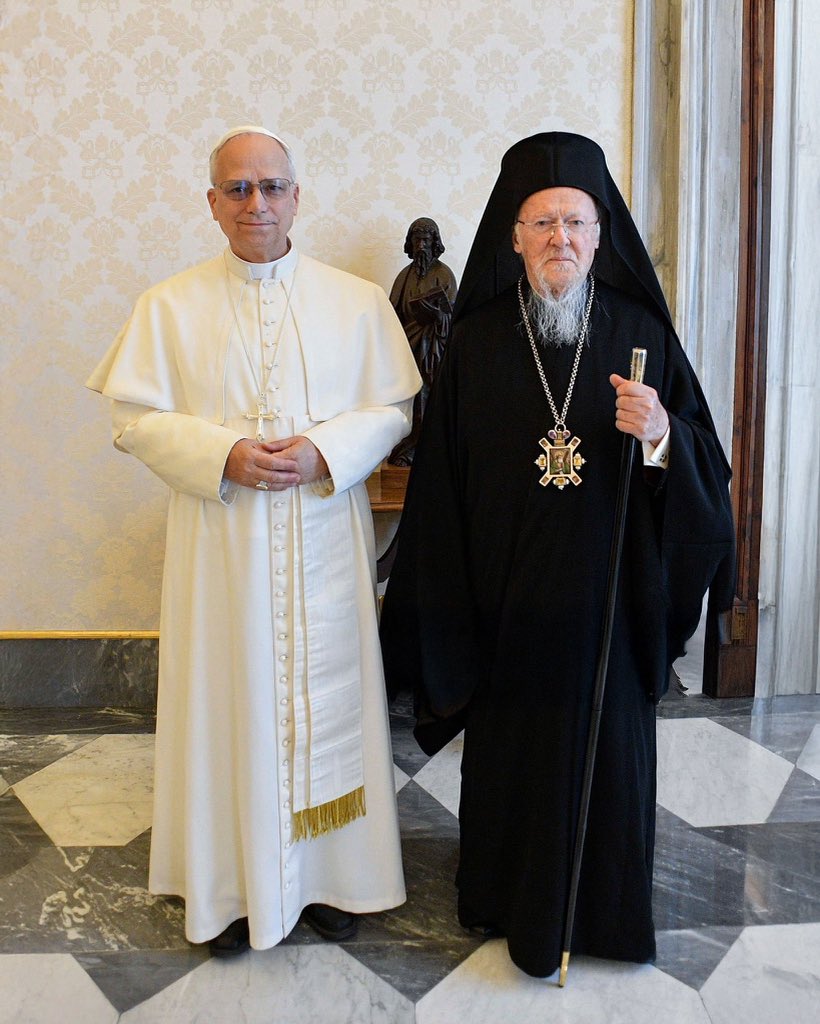
ISTANBUL / MOSCOW – In an unprecedented escalation of the conflict within Eastern Orthodox Christianity, Russia’s foreign intelligence service (SVR) has launched a vitriolic attack on Ecumenical Patriarch Bartholomew I, the spiritual leader of the world’s 300 million Orthodox Christians. In a formal statement released on January 12, the agency labeled the 85-year-old Patriarch as the “Antichrist in a Cassock” and the “Devil Incarnate,” accusing him of acting as a tool for Western intelligence.
The move marks a significant shift, as the Kremlin’s intelligence apparatus has now explicitly entered a theological and canonical dispute that has fractured the Orthodox world since 2018.
“Dark Eyes” on the Baltics
The SVR’s statement accuses Bartholomew of “schismatic activities” and claims he is attempting to dismantle the influence of the Russian Orthodox Church (ROC) in the Baltic states of Estonia, Latvia, and Lithuania.
“This ‘devil incarnate’ is obsessed with ousting Russian Orthodoxy from the Baltic states, establishing in its place church structures completely under the control of the Phanar,” the statement read, referring to the historic Greek neighborhood in Istanbul where the Patriarchate is headquartered. The agency further alleged that Bartholomew is acting under the direct influence of British intelligence to fuel “Russophobic sentiments” across Europe.
A Fragmented “Holy War”
The roots of the animosity date back to 2018, when Bartholomew recognized an independent Ukrainian Orthodox Church, effectively severing it from the Moscow Patriarchate. Since the 2022 invasion of Ukraine, Patriarch Kirill of Moscow—a close ally of Vladimir Putin—sought to frame the conflict as a “holy war,” further deepening the schism with Constantinople.
While the Russian Orthodox Church itself has remained silent on the SVR’s specific “Antichrist” branding, the Patriarchate in Istanbul has responded with “deepest sorrow.” In a communiqué, Bartholomew dismissed the attack as “fake news” and “fabricated information” from state propagandists.
Strategic Distraction and the “Montenegro Mystery”
Scholars of Orthodox Christianity noted that the SVR statement included a puzzling claim: that Bartholomew intends to grant independence to the unrecognized “Montenegrin Orthodox Church” to strike a blow against the Serbian Orthodox Church.
Metropolitan Emmanuel of Chalcedon, a senior deputy of the Patriarchate, dismissed the claim as “informational noise,” stating that Constantinople has had no contact with the group in Montenegro. Analysts suggest the inclusion of Montenegro may be an attempt by Moscow to incite anger among Serbs and broaden the coalition against Bartholomew.
Testing the “New Washington”
Church officials in Istanbul believe the timing of the intelligence report is also tied to the shifting political landscape in the United States. Metropolitan Emmanuel suggested that by suddenly blaming British intelligence instead of the Americans, the Russian leadership might be “testing its relations with the new administration in Washington” while searching for a new scapegoat for its regional setbacks.
As the “ecclesiastical façade” of the Moscow Patriarchate continues to collapse into the state’s security apparatus, the verbal assault on the “first among equals” signals that the battle for the soul of Orthodoxy is now firmly a matter of Russian national security policy.